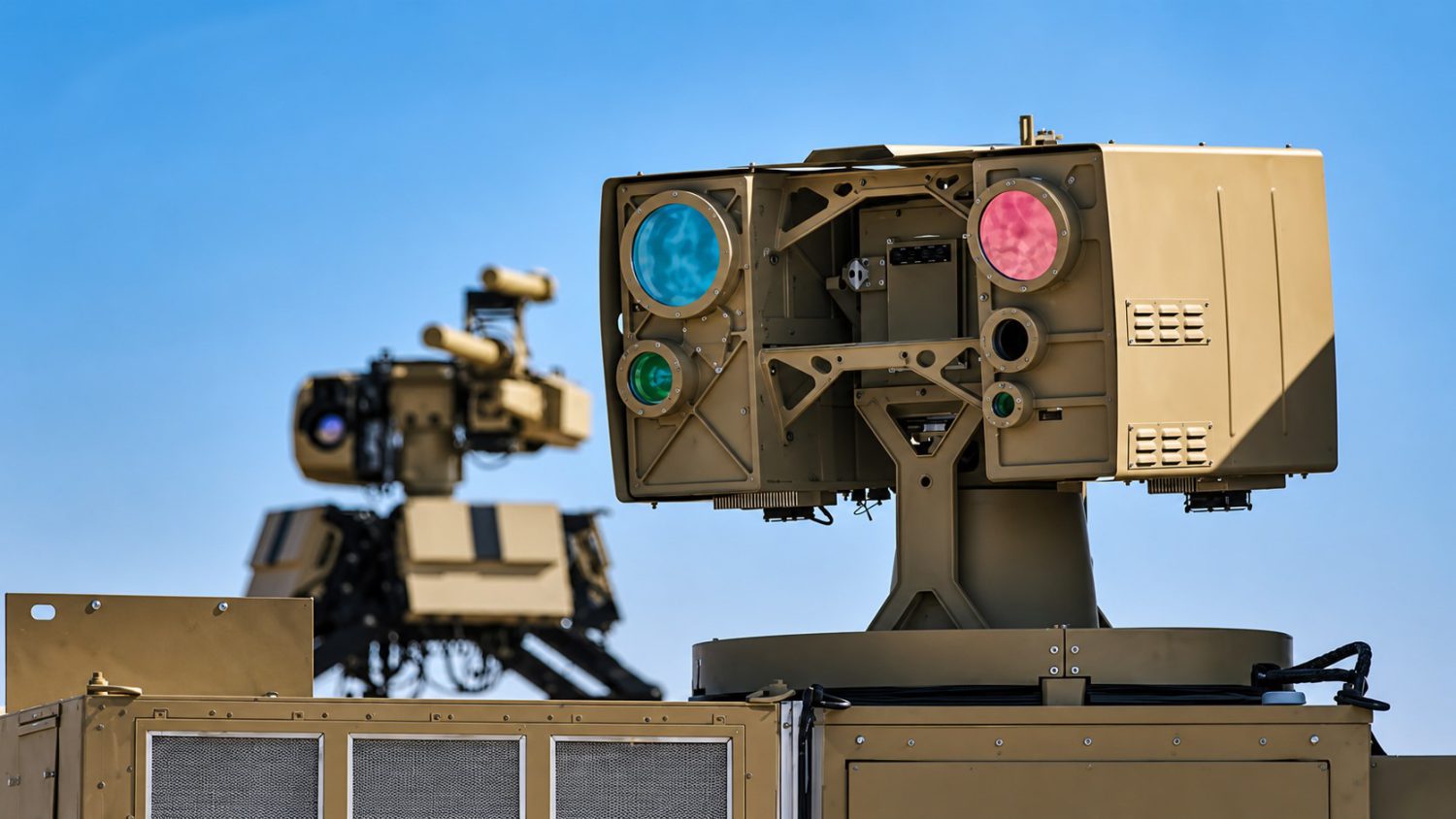
A cheap enemy drone buzzes over an infantry squad’s position. No fighter jets. No Patriot battery. Just a soldier in a tactical vehicle, thumbing a familiar-looking controller — and a silent beam of light that turns the drone into falling debris. No reload. No resupply run. No sound.
That’s not a concept video. It’s what the U.S. Army has been training soldiers to do since systems arrived at Fort Sill.
Speed of Light, Cost of Nothing: What LOCUST Actually Does
The LOCUST Laser Weapon System delivers a hard-kill counter-drone capability that fires repeatedly at near-zero cost per shot — no ammunition, no logistics tail.
AeroVironment’s LOCUST Laser Weapon System has been delivered to the U.S. Army Rapid Capabilities and Critical Technologies Office under the Army Multi-Purpose High Energy Laser program — two systems on General Motors Defense Infantry Squad Vehicles first, then two more on Oshkosh Defense Joint Light Tactical Vehicles in December 2025. Four mobile, field-ready, drone-killing lasers. Integrated at AeroVironment’s directed-energy facility in Albuquerque, New Mexico. Validated at Yuma Proving Ground. Now in soldiers’ hands at Fort Sill.
The system features:
- 20 kW-class laser power on a modular open architecture
- Powers up in roughly 15 minutes
- Targeting gimbal sweeps a full 360° at 100 degrees per second
- One operator, one Xbox-style controller
- Engagement range stays classified, though reporting puts effective reach at “at least several kilometers”
- Cost per shot: effectively negligible compared to any kinetic interceptor
The kill chain is blunt and efficient. AI-assisted tracking identifies the target. The system dwells on it. Critical components — sensors, flight controls, propulsion — stop working. The drone falls.
“A technically sophisticated solution that has demonstrated reliability and operational readiness for the C-UAS fight,” said Mary Clum, AeroVironment’s Senior VP for Space & Directed Energy, in the company’s August 2025 program announcement.
From Yuma to the Battlefield: What Comes Next
The AMP-HEL program is the product of years of field testing, iterative soldier feedback, and roughly $75 million in Army prototype funding.
This didn’t appear overnight. LOCUST traces back to the Palletized High Energy Laser program and earlier BlueHalo contracts — a base $45.7 million other transaction authority award with $30.2 million in options built the technical foundation. The ISV increment runs lighter and faster for frontline mobility; the JLTV version upgrades the beam director aperture for better focus at range, adding heavier protection and greater onboard power capacity. Soldier feedback from Fort Sill training has been actively reshaping ergonomics and software. This is a system that evolves.
Fair caveats exist:
- Weather and line-of-sight constraints are real limitations
- Exact performance specs remain classified, which limits independent scrutiny
- The gap between test-range results and contested battlefield conditions is worth watching
“The time is now for directed energy to get into the hands of warfighters everywhere,” said John Garrity, AeroVironment’s VP of Directed Energy Systems.
The generation that grew up on Call of Duty is now pointing real lasers at real drones with a game controller. If future battlefields flood with cheap drone swarms — the pattern in recent conflicts points that way — the Army’s answer is quieter, faster, and nearly free per shot.