Multiple sclerosis doesn’t just take mobility. It takes places. The trail you hiked as a family. The rocky beach. The friend’s house with three front steps. Over twenty-plus years, those places quietly disappear from your life — like tabs closing in a browser nobody reopened.
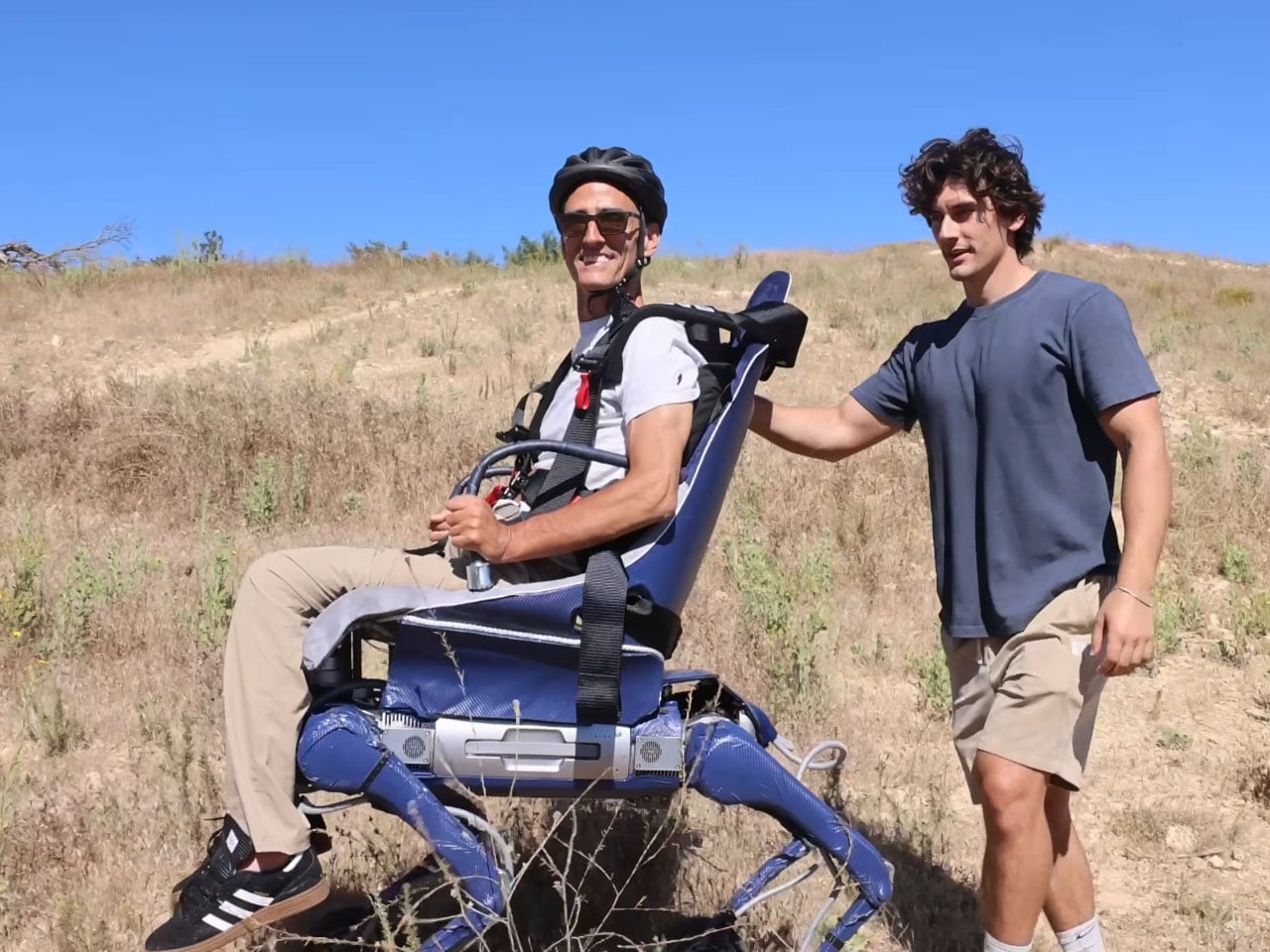
Jake Laser decided to reopen them. He took a Unitree Go2-W — a quadruped robot that rolls on wheels across flat ground and switches to articulated legs over rough terrain — and turned it into a rideable all-terrain mobility chair for his father. Not a concept render. Not a crowdfunding page. A functioning machine his dad actually rode.
How You Strap a Human to a Robot Dog
Racing seat, safety harness, and software recalibration solved the hardest problem — keeping a shifting human body stable on four mechanical legs.
The engineering required more than bolting a chair to a robot’s back. A laser mounted a racing bucket seat over the machine’s spine and positioned the rider’s legs forward, clearing space for the robot’s own limbs to articulate underneath. A heavy-duty safety harness locks the rider in place.
The critical work happened in software: recalibrating the robot’s balance system to compensate for a human’s shifting weight during dynamic movement over uneven ground.
Key build details:
- Platform: Unitree Go2-W quadruped with in-wheel motors and articulated legs
- Terrain tested before human use: tall ledges, ladders, stairs, rocky riverbeds
- Control: wireless dual-joystick controller handling drive, rotation, strafe, and ride-height adjustment
- Safety: heavy-duty harness; balance software recalibrated for human passenger weight
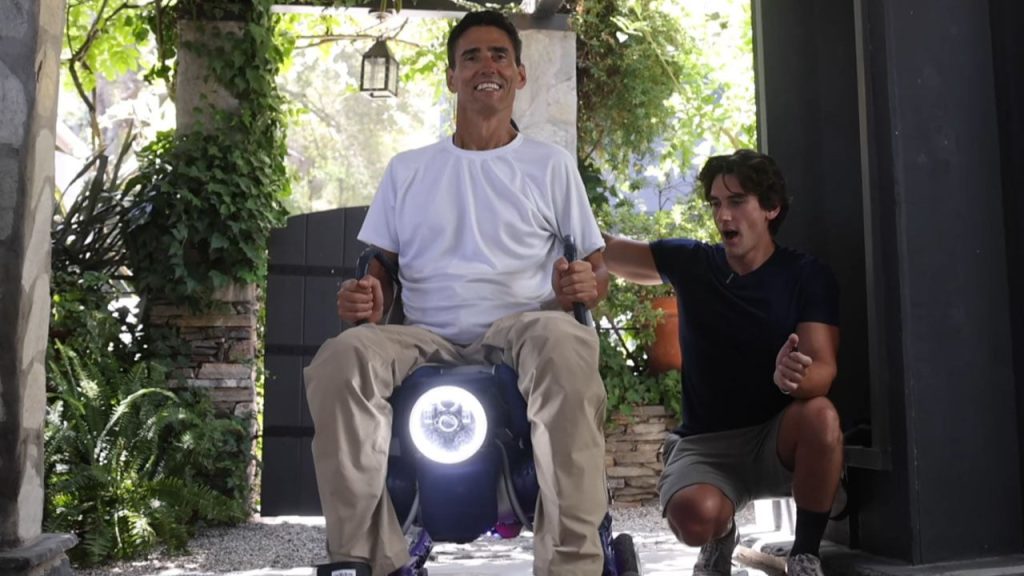
- Design: 1940s Bugatti-inspired bodywork with carbon-fiber accents, chrome headlights, LED underbody glow, and custom spinner wheel covers
After more than two decades, his father revisited places that MS had made unreachable.
What This Actually Means
What the Bugatti bodywork signals isn’t vanity — it’s a deliberate statement about dignity, care, and what consumer robotics can now accomplish in the right hands.
The styling is worth your attention. This isn’t a pity project cobbled together from spare parts. The curved panels, the chrome headlights, the LED underbody glow — those details tell you Laser wanted his father to feel pride, not just function. That reframes the whole build: less garage experiment, more deliberate act of love with an engineering degree behind it.
Verified specs like battery life, payload limits, and safety certification remain unclear, which matters for anyone hoping to replicate the build. Those gaps are real, and they deserve honest acknowledgment.
But the broader implication is hard to ignore. Conventional power wheelchairs — often priced well into five figures — still struggle with stairs, slopes, and uneven ground. Legged robots capable of handling that terrain were, until recently, confined to research labs. The Unitree Go2-W changed that calculus. One builder, working independently, closed a gap that dedicated assistive device engineering has left open for years.
That’s not a knock on the medical device industry — regulatory constraints and liability standards exist for good reason. It’s an observation about where consumer robotics has quietly arrived.
The question worth sitting with: if a maker can build this in a home workshop, what should the companies with full R&D budgets be building next?