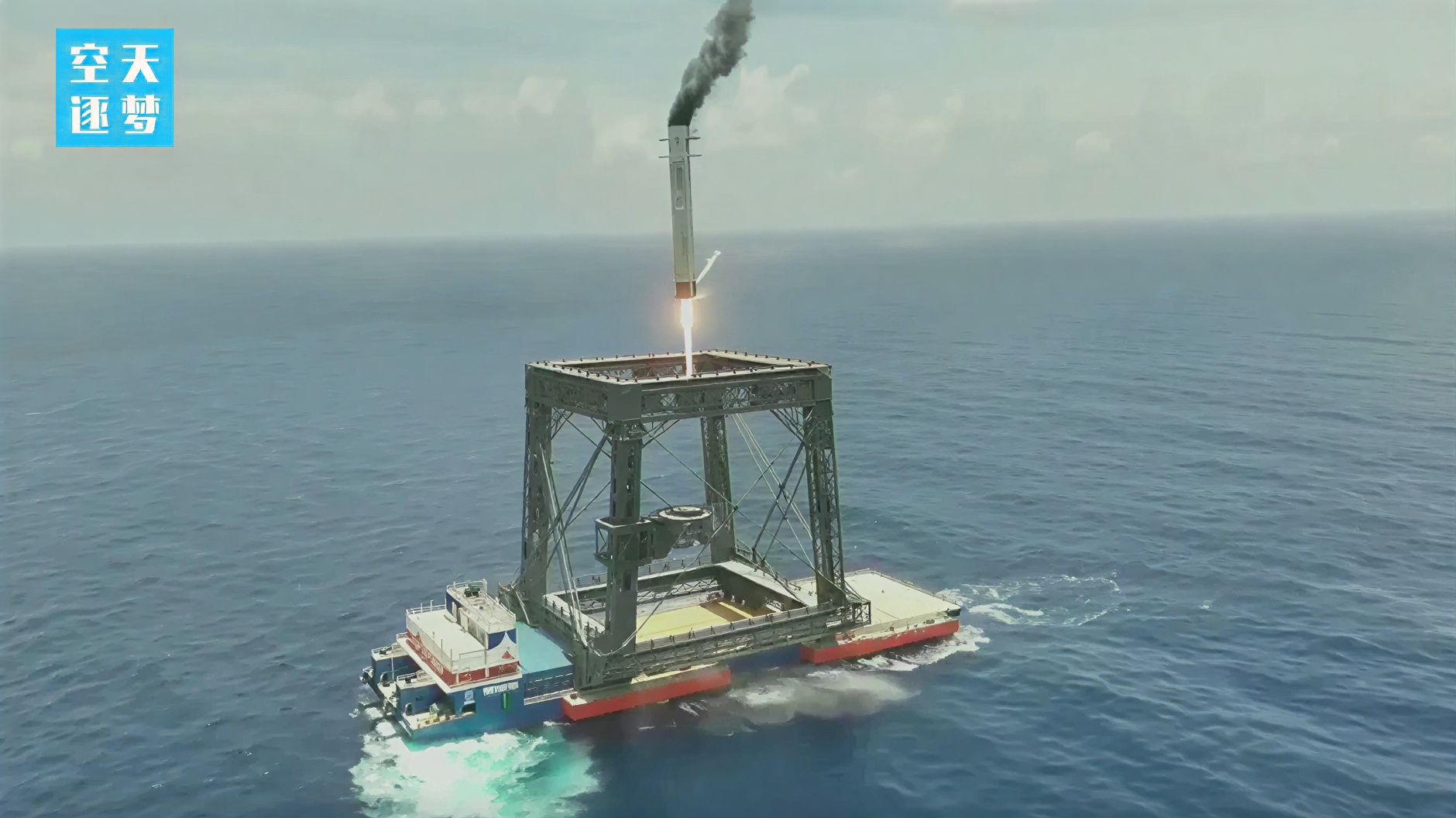
Landing legs are optional, it turns out. On July 10, 2026, the Long March 10B lifted off from Wenchang, Hainan, on its maiden flight — and its first-stage booster descended onto a maritime recovery vessel, where hooks near its base snagged a tensioned wire-net grid. China is now the second country, after the United States, to recover an orbital-class booster. That’s according to state media outlets including China Daily and CCTV, whose framing as a “historic breakthrough” should be read with that context in mind.
Not Your Typical Landing
Where SpaceX uses legs and tower arms, CALT built a system of hooks, wires, and rail-mounted dollies.
SpaceX’s Falcon 9 touches down on retractable landing legs. Starship gets grabbed mid-air by massive tower arms. China’s state-owned developer, the China Academy of Launch Vehicle Technology (CALT), went a different direction entirely. The booster flies itself down, cuts engines just above the capture frame, and hooks onto a tensioned wire-net mounted on rail-driven dollies that automatically reposition on the recovery ship. No landing pad. No tower. Essentially a precision maritime intercept with a very expensive payload on the line.
Three figures frame the scale of the challenge:
- The booster was reportedly captured intact, with CALT targeting a reflight before the end of 2026
- A previous maritime test missed the platform by roughly 200 meters — precision was far from guaranteed going in
- China logged 92 orbital launches last year versus approximately 193 for the US, 165 of those by SpaceX alone, per Engadget reporting
One Catch Doesn’t Close the Gap
The decade-long head start SpaceX holds isn’t measured in landings — it’s measured in turnaround speed.
Joining a club that’s been exclusive since SpaceX first landed a Falcon 9 booster in 2015 matters. But one recovery is a proof of concept, not a production line. South China Morning Post reporting frames the achievement as joining “the space race with an edge on SpaceX” — though catching a rocket once and catching one reliably every two weeks are fundamentally different problems. Refurbishment speed, booster lifetime, cost data — all remain unknown quantities. Scientists continue making their own surprising discoveries, like finding a Moon Goo layer beneath the lunar surface.
The Real Competition Is Logistics
China’s 2030 space-power ambitions hinge on making reusability routine, not just technically possible.
Reaching orbit cheaply and often is no longer flags-on-the-moon theater. It’s a supply chain competition — less Moon Mission control, more last-mile delivery infrastructure. China’s private sector is also pushing hard: LandSpace’s ZhuQue-3 uses a Falcon 9-style legged system, though a recent high-profile attempt ended in a booster loss the company chose not to publicly show, according to SpaceNews. The state and private sectors are effectively racing each other as much as they’re racing anyone else.
If CALT reflies this booster before December, that’s the headline worth watching. Recovery proved the engineering works. Reuse is where the economics either do or don’t follow.