Arrive at the Fangchenggang border terminal and you might get queue directions from a 5-foot-7 robot speaking your language. That’s not a trade show demo — it’s an active deployment. Under a 264-million-yuan contract (roughly $37–40 million), UBTech Robotics is placing its Walker S2 humanoid at the Dongxing crossing into Vietnam, with deliveries ramping from December 2025, according to the South China Morning Post.
The machines handle two distinct jobs:
- In passenger terminals, they detect crowd build-ups, guide travelers into queues, answer routine customs questions in multiple languages, and escalate congestion to human staff.
- In cargo lanes, separate units scan barcodes, read serial numbers, and cross-check shipping manifests against customs databases.
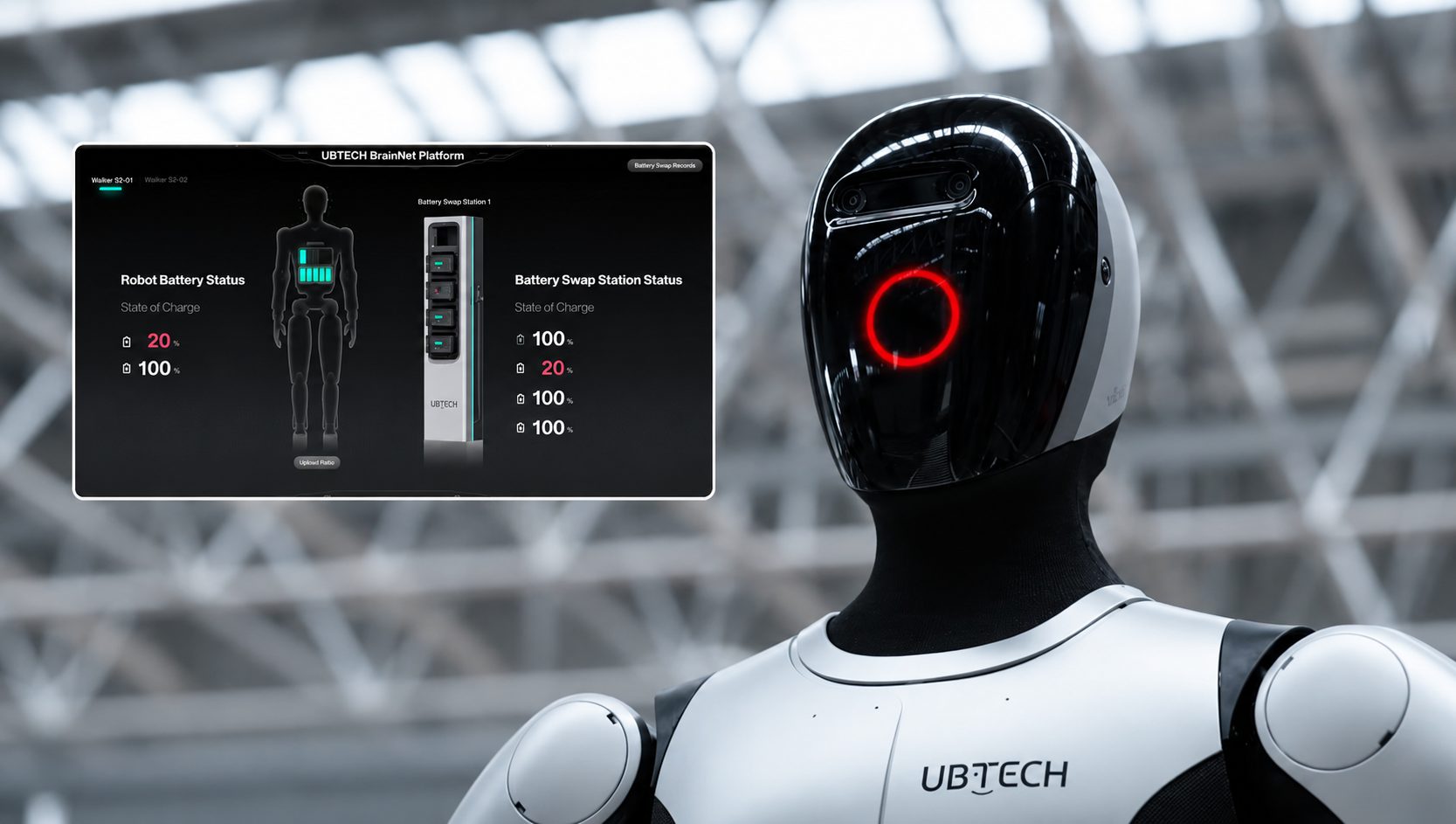
The hardware makes all of this possible. Walker S2 stands 1.76 meters tall with 52 degrees of freedom, lifts 15 kilograms per arm, and runs BrainNet 2.0 AI with stereo vision and depth sensing. The engineering detail that enables continuous border deployment: autonomous battery swapping. The robot docks, replaces its own depleted pack in roughly three minutes, and keeps moving — near-24/7 operation without a human touching the machine.
The Questions That Follow the Robots
Liability, cost, and traveler trust remain unresolved as China frames this pilot as a template for airports and rail stations.
Analysts describe Fangchenggang as a “tough, real-world test,” per Earth.com reporting — coastal humidity, dust, unpredictable human traffic, and zero tolerance for downtime. If Walker S2 handles it reliably, the template moves fast. UBTech has logged 1.1 billion yuan in cumulative Walker orders, and its newer UWORLD U1 Series signals serious mass-production ambitions. China’s stated next targets: airports, railway stations, and seaports.
The shift from robots-in-factories to robots-in-sovereign-spaces feels less like automation and more like recasting a role that’s always carried implicit authority. Interacting with a humanoid at customs hits differently than tapping a kiosk — call it the uncanny valley of border control.
For now, Walker S2 stays firmly in assistance territory. Complex security decisions remain with human officers. But three questions hang unanswered:
- Who’s liable when a robot misreads a cargo manifest?
- Do continuous patrols actually cut costs once maintenance, software updates, and human supervision stack up?
- What happens to traveler trust when the face greeting you at the border isn’t human?
That framing — assistance, not enforcement — matters today. Whether it holds as deployments scale is a different question entirely. Fangchenggang isn’t just a border crossing anymore. It’s the proving ground for where autonomous machines get normalized.