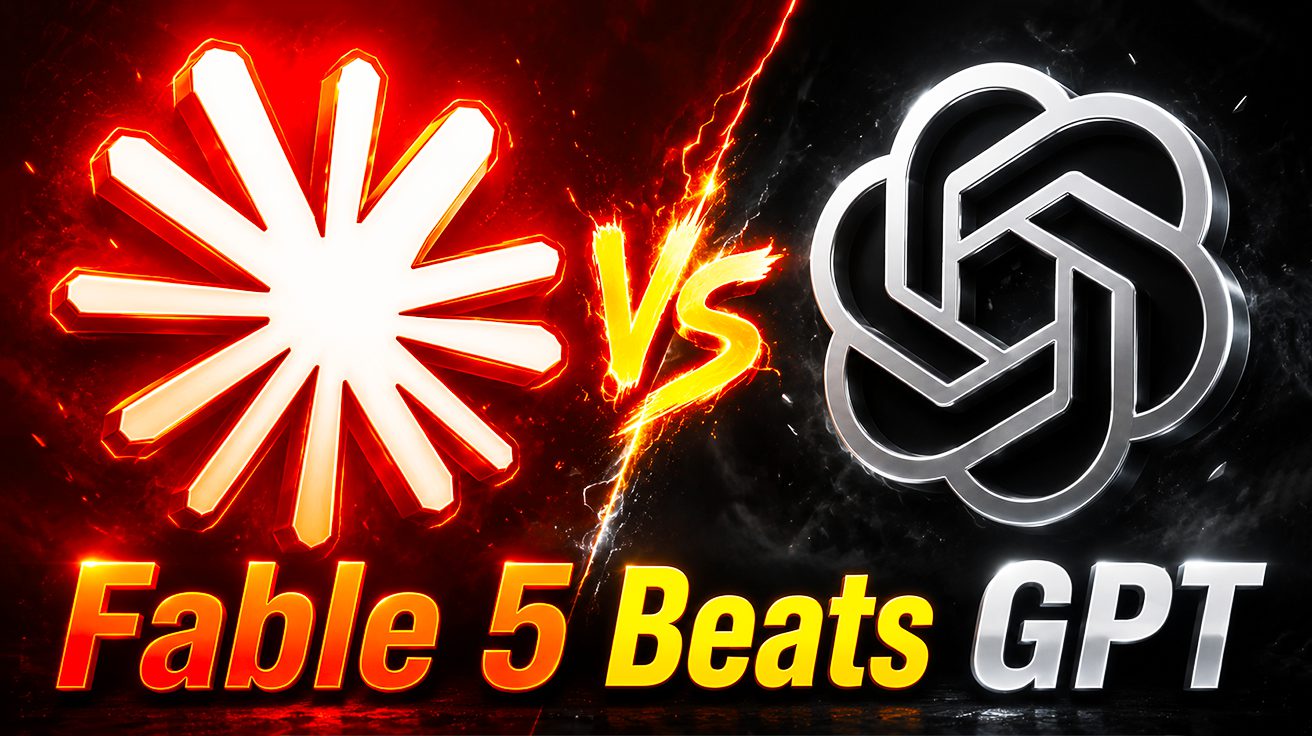
Advanced AI models are no longer just chatbots. They are digital architects for complex operations. Anthropic’s Claude Fable 5 is the company’s first generally available Mythos-class model, a new tier that sits above Opus in the Claude hierarchy. Purpose-built for long-horizon, agentic work, it handles multi-step research and autonomous workflows over days. It supports contexts up to 1M tokens, plans across stages, delegates to sub-agents, and self-verifies its work. In public reviews and benchmarks, Fable 5 consistently scores above Opus 4.8 and GPT-5.5 on complex coding, agents, and long-context reasoning tasks. This especially holds true where self-checking and iterative refinement matter.
5. Claude Fable 5

The most capable widely released Claude model, optimized for agentic workflows and autonomous projects.
Claude Fable 5 sits atop Anthropic’s hierarchy as the company’s first generally available Mythos-class model. This tier rises above Opus in both capability and design intent. The model excels at long-horizon, agentic work: complex coding projects, multi-step research, and autonomous workflows that can run for hours or days. It supports massive contexts up to 1M tokens, allowing it to digest sprawling projects without losing the thread.
Fable 5 can self-verify its output, catching errors before they cascade. Developers navigating intricate build processes find that it dramatically cuts iteration cycles. Where other models generate decent code that lacks final polish, Fable 5 builds refined, visually appealing one-shot games complete with custom sound effects and polish. Pricing is $10 per million input tokens and $50 per million output tokens (roughly 2× the cost of Opus 4.8), reflecting the enhanced capability and refined results it delivers.
4. Claude Opus 4.8
The high-end workhorse that serves as Fable 5’s safety fallback for risky prompts.
Claude Opus 4.8 served as Anthropic’s flagship generally available model before the Mythos tier arrived. It now sits directly below Fable 5 and Mythos 5, but remains a highly capable performer for advanced reasoning and complex writing. Opus 4.8 is not optimized for the same long-horizon, agentic workloads that define the Mythos class, yet it handles everyday advanced tasks with ease.
When Fable 5 encounters high-risk prompts (especially involving cybersecurity and biology), it automatically routes those requests to Opus 4.8. The system effectively makes Opus the industry’s most capable bouncer for sketchy requests. Opus 4.8 will deliver something functionally correct when asked to whip up a basic sales dashboard, but the output often comes with discernible AI tells: off-center titles, inconsistent design elements, or styling that needs manual polish. At roughly half of Fable 5’s API pricing, Opus 4.8 remains a pragmatic choice for everyday tasks where Mythos-tier capabilities are overkill.
3. GPT-5.5
A strong general-purpose model with lower input costs, but often trailing Fable 5 in polish and long-context work.
OpenAI’s GPT-5.5 is a next-generation large language model frequently benchmarked against Claude Fable 5 and Opus 4.8. Public comparisons position GPT-5.5 as a strong general-purpose model. Many independent benchmarks and reviews report that Fable 5 outperforms it on long-context coding, agentic workflows, and self-verification. GPT-5.5’s input token costs are notably lower than Fable 5’s, making it an attractive workhorse for diverse tasks.
Hands-on tests highlight GPT-5.5’s competence at generating functional code and UI layouts. Ask it to generate a mood journal app, and it delivers a solid framework. However, its default design choices often feel less polished: predictable fonts, stark light modes, and styling that echoes an unstyled early-2000s website. Fable 5 tends to produce designs with superior interactivity and a more refined aesthetic. GPT-5.5 provides a robust foundation for many projects, but its visual panache sometimes needs a human touch to truly shine.
2. Claude Mythos 5
The unrestricted Mythos-class counterpart to Fable 5, reserved for high-stakes defense and research use cases.
Claude Mythos 5 shares the same base model and capabilities as Fable 5, differing mainly in safety guardrails and access control. Anthropic describes Mythos 5 as a frontier-level model intended for high-stakes domains like advanced cybersecurity and biology. Capabilities are powerful enough to require restricted access. Unlike Fable 5, Mythos 5 does not run safety classifiers that automatically hand risky prompts to Opus 4.8.
This makes it suitable for specialized defense and research use cases under controlled programs. A government cybersecurity expert needing to analyze a zero-day exploit can use Mythos 5’s unrestricted analytical horsepower for sensitive defensive operations. Access to Mythos 5 is limited to approved organizations via Project Glasswing, Anthropic’s program for government cyber defenders and select biomedical research partners. Mythos 5 sits at the top of Anthropic’s updated model hierarchy, representing the firm’s most capable Claude 5-generation model.
1. Project Glasswing

Image: Unsplash
Anthropic’s restricted-access program granting trusted partners entry to Claude Mythos 5 for sensitive work.
Project Glasswing is Anthropic’s restricted-access program through which Claude Mythos 5 is offered to approved customers. It primarily serves government cybersecurity defenders and select biomedical research organizations. Glasswing is designed to give trusted partners access to Mythos-class capabilities considered too risky for general release, especially in areas like offensive/defensive cybersecurity and advanced biological modeling.
Fable 5 is the publicly accessible version of the same base model. Mythos 5 under Glasswing operates without the additional safety classifiers that normally downgrade certain sensitive queries to Opus 4.8. A research team gaining access to Glasswing can explore novel biological simulations without the typical overrides of public models. It’s like giving them the full chemical kit, not just the version safe for kids. This strategic approach is crucial for advanced, sensitive research and defense applications.