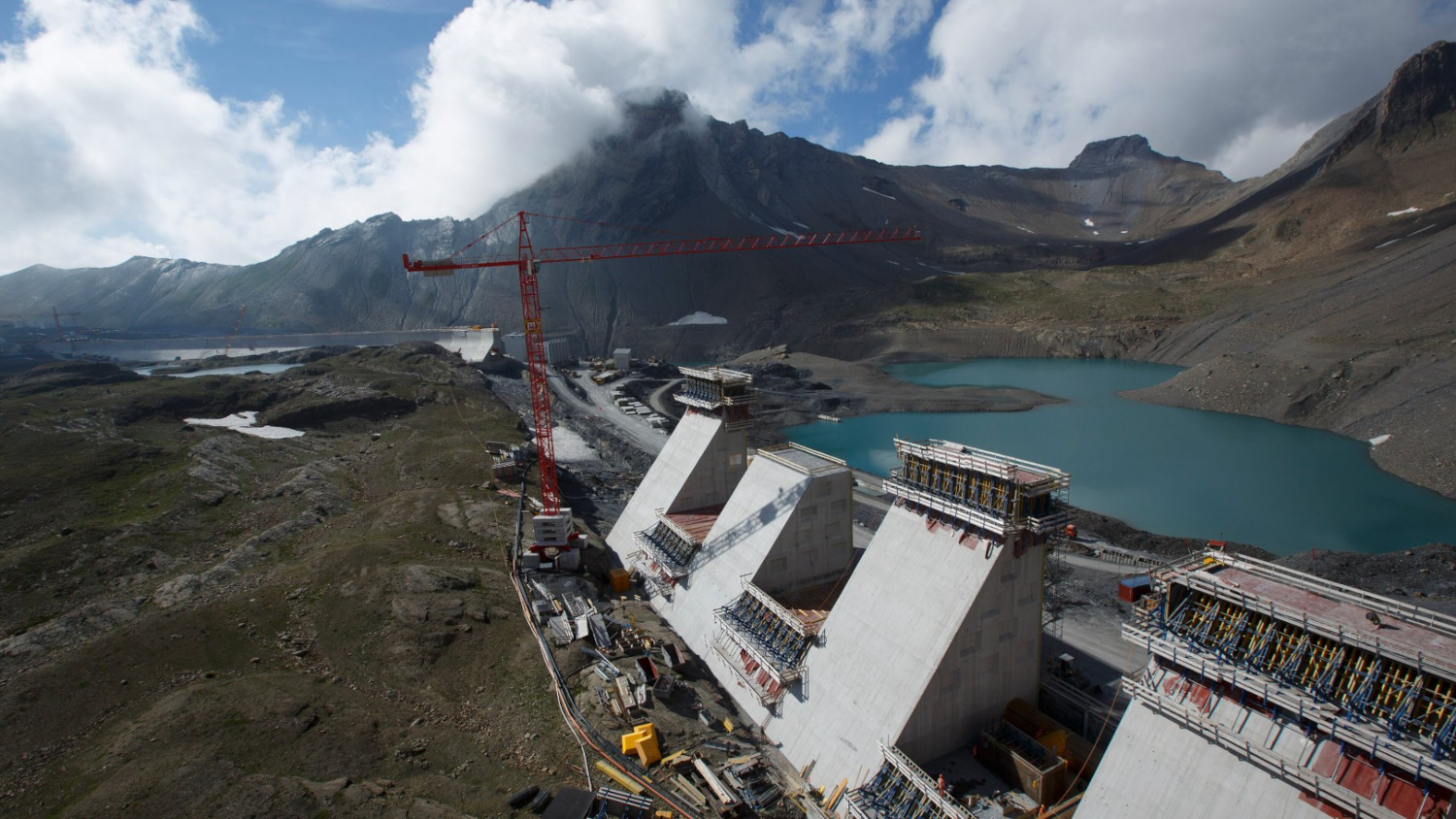
Getting a crane to the Muttsee dam required dismantling it in the valley below, flying the pieces upward by helicopter, and reassembling the machine at altitude. That construction reality captures everything you need to know about AlpinSolar: ambitious, logistically demanding, and engineered for a problem lowland solar cannot easily solve.
The plant, owned by energy companies Axpo and IWB with Denner as its long-term electricity demand off-taker, reached full operation in August 2022. Its first measured year, October 2022 through September 2023, recorded an annual yield of 1,434 kilowatt-hours per installed kilowatt, with winter half-year output reaching 616 kilowatt-hours per installed kilowatt.
That winter figure ran 3.8 times higher than the reference plant near Payerne in the Swiss lowlands, according to Axpo. Reference sites recorded unusually weak results from January through May of that period, which widened the apparent gap. One measured year is a strong result, not a settled verdict.
Why the Mountain Does the Work
Altitude, cold air, and a well-oriented dam face combine to give this installation its winter edge.
Sitting above Switzerland’s fog belt keeps the panels in sunlight that lowland installations may receive less of due to fog and other local conditions. Cold temperatures also improve photovoltaic operating efficiency, and the dam’s orientation supports consistent exposure to winter sunlight.
Panel mounting angles of 51 or 65 degrees encourage snow to slide off rather than accumulate. Engineers deliberately left the lowest section of the dam wall without panels, giving falling snow a clear landing zone.
The Gap Behind the Glass
A carefully maintained inspection corridor behind the panels serves both structural safety and long-term maintainability.
A 1.5-meter corridor, roughly five feet, separates the panels from the concrete dam face. This gap is a safety and maintainability measure: technicians use it to inspect the structure for cracks, including after seismic events, and according to Axpo’s account of the installation, a fissure map is prepared at least every five years.
The corridor also creates a trade-off for the bifacial panels, which are designed to generate electricity from both front and rear surfaces. Measured rear-side optical gain reached approximately 1.5% annually, with the concrete wall limiting rear illumination. Snow-reflected light reaching the front surface compensates in part, but a freestanding installation would deliver better rear-side conditions.
What the Numbers Cannot Promise
Strong seasonal output and subsidy eligibility are related but not the same thing.
AlpinSolar generates approximately 3.3 gigawatt-hours of electricity per year. Under Switzerland’s Solar Express subsidy framework, projects must produce at least 10 gigawatt-hours annually, a threshold the plant does not meet despite clearing the program’s winter performance bar of 500 kilowatt-hours per installed kilowatt.
Replication also requires conditions that rarely converge: an existing dam, an available grid connection, favorable solar exposure, and a committed electricity buyer. Remove any one of those, and the calculus changes before accounting for the helicopter logistics.
A Second Job Starting in 2025
Beyond raw generation, the plant now contributes to Swiss grid stability through an aggregated balancing pilot.
AlpinSolar took on a grid-stabilization role in August 2025 through Swissgrid’s PV4Balancing pilot, according to Axpo. Under the arrangement, the plant can reduce its output when the grid runs a surplus, contributing to what the industry calls tertiary balancing energy. In practical terms, it can throttle down on demand, a service more commonly associated with conventional power company stations.
Because individual solar plants are too small for direct balancing-market participation, the pilot groups AlpinSolar with other photovoltaic installations for collective access.
What It Proves
AlpinSolar is a credible demonstration of alpine solar potential, with site-specific limits worth understanding clearly.
AlpinSolar demonstrates that existing infrastructure, steep panel angles, and altitude can combine to deliver meaningful winter solar output where lowland plants produce comparatively less. The site conditions at Muttsee are specific, the construction demands were significant, and the performance comparison covers a single year with noted caveats. That is a credible beginning, not a ready-made template.