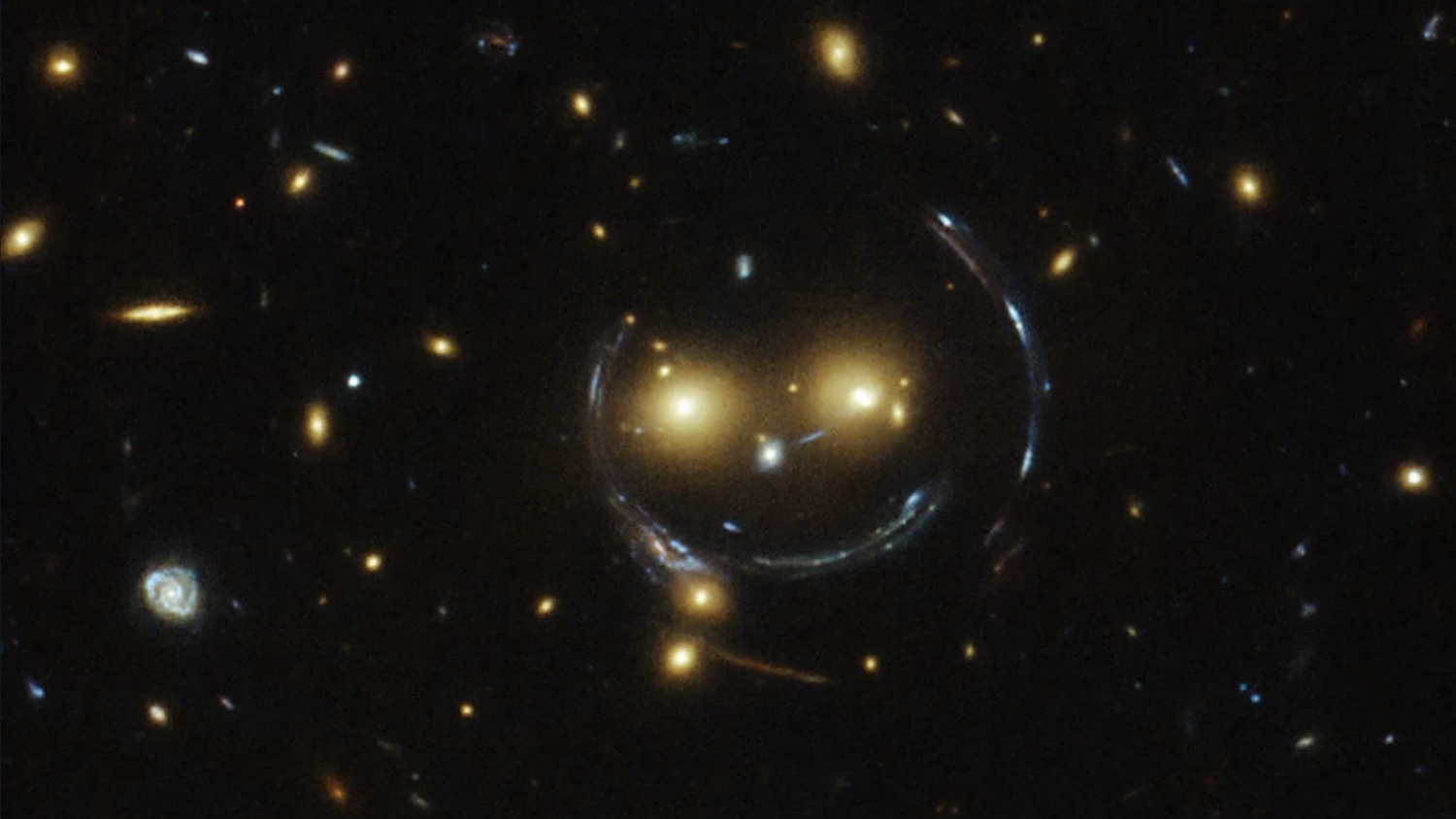
The Hubble Space Telescope’s image of galaxy cluster SDSS J1038+4849, first released by NASA and ESA in February 2015, shows two bright orange points that read as eyes, a faint central smudge suggesting a nose, and a broad curved arc beneath them forming a smile. Your brain does the rest immediately. What’s actually happening, though, is more interesting than the brain’s tendency to read faces into random patterns (pareidolia).
What You’re Actually Looking At
The apparent face is an optical effect, not a physical structure, and each feature has a precise scientific explanation.
The two “eyes” are real: a pair of exceptionally bright galaxies within the cluster. The smile is not.
Those curved arcs are distorted images of galaxies positioned far behind SDSS J1038+4849. They are warped into their current shape by a phenomenon called strong gravitational lensing.
A galaxy cluster is an enormous collection of galaxies bound together by gravity, along with vast quantities of dark matter. That combined mass bends the fabric of spacetime around it. The result: light from more distant background objects is redirected, stretched, and magnified before it reaches Hubble’s cameras.
The apparent smile is not a physical curved structure. Think of it the way a wine glass warps the image of a lamp across a room, except operating across billions of light-years.
According to NASA, the curved features result from the cluster acting as a strong gravitational lens, bending and magnifying the light of background objects into arcs.
The Physics Behind the Face
The image is a working demonstration of Einstein’s general theory of relativity, made visible at galaxy-cluster scale.
When the geometry becomes especially precise, lensing produces something called an Einstein Ring: a near-complete circle of light formed when a distant source, the massive lensing object, and the observer align almost exactly. SDSS J1038+4849 produces a configuration close to that ideal. That symmetry is why the arcs curve so uniformly and why the image has drawn sustained attention beyond specialist astronomy circles.
This is a direct, observable prediction of Einstein’s general theory of relativity, which describes how mass and energy curve spacetime and alter the path that light follows. The smiling cluster is not just a visual curiosity. It is general relativity operating at galaxy-cluster scale, visible through a space telescope.
Hubble captured the image using two instruments: the Wide Field and Planetary Camera 2 and the Wide Field Camera 3, as part of a systematic survey of strong gravitational lenses.
Why Astronomers Care
The lensed arcs do double duty, functioning simultaneously as spectacle and as a practical scientific instrument.
By analyzing how background light is distorted, astronomers can map mass distribution throughout the cluster. That includes matter that emits no light at all.
Lensing also acts as a natural magnifier, allowing Hubble to observe extremely distant galaxies that would otherwise be too faint to detect on their own.
The image’s real argument is a physics one: that mass reshapes the geometry of space itself, and that this reshaping is measurable, predictable, and useful to researchers mapping mass in galaxy clusters and studying the distant universe.