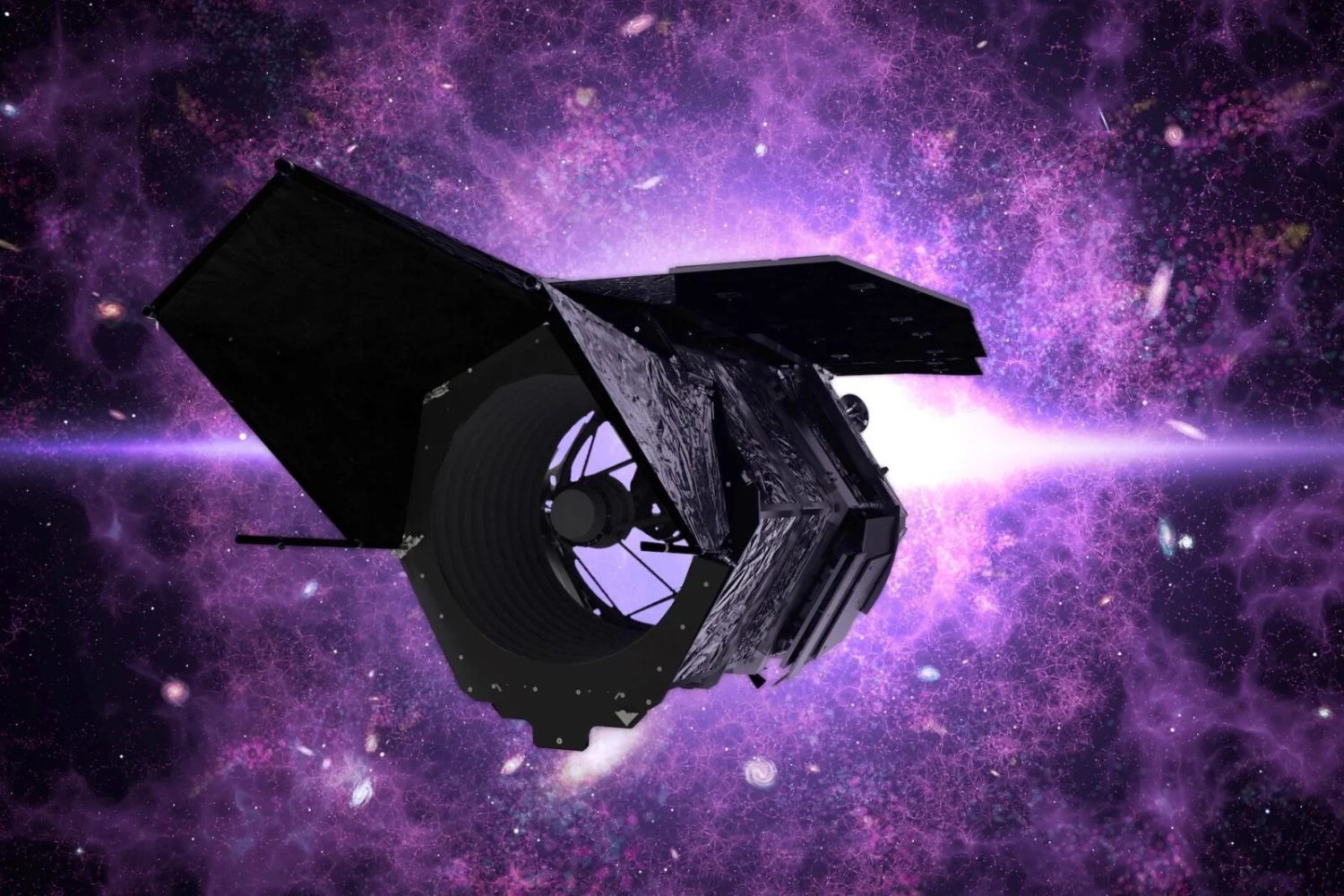
Think of the camera array on your phone. Webb is the periscope telephoto — extraordinary detail, tiny slice of sky. Roman is the ultra-wide: one frame, everything. On Sunday, August 30, 2026 at 7:26 a.m. EDT, a SpaceX Falcon Heavy lifts it off Launch Complex 39A at Kennedy Space Center — a $4 billion observatory heading 1.5 million kilometers out to the Sun-Earth L2 point, the same thermally stable neighborhood Webb calls home. Key specs, stripped of jargon:
- 300-megapixel Wide Field Instrument — field of view roughly 100 times Hubble’s in a single exposure
- Same 2.4-meter primary mirror as Hubble — sharp resolution across panoramic sky, not a narrow tunnel
- Destination: Sun-Earth L2, 1.5 million km out, unobstructed and thermally stable
- Nominal 5-year mission, 10-year goal
- Primary mirror donated by another U.S. agency — a significant factor in keeping costs well below Webb’s
The Two Biggest Questions in Cosmology, Tackled at Once
Roman maps dark matter and probes the source of accelerating cosmic expansion — simultaneously, across billions of galaxies.
Dark matter dominates the matter content of the universe, yet it emits no light. Its gravity, however, bends light from distant galaxies, subtly warping their apparent shapes — a phenomenon called weak gravitational lensing. Roman watches that distortion across hundreds of millions of galaxies at once, reconstructing where dark matter concentrates across cosmic time. That’s a map no telescope has had the field of view to draw before.
Alongside that, Roman tracks Type Ia supernovae — stellar explosions with predictably consistent peak brightness, used as cosmic distance markers — to measure how the universe’s expansion rate has changed over time. Cosmologists currently disagree on that rate, a tension that has resisted resolution for years. Roman may settle the argument. “Roman will measure light from a billion galaxies,” according to NASA.
Hunting Worlds Other Telescopes Can’t Reach
Roman’s microlensing survey monitors tens of millions of stars at once, targeting cold, distant planets that Kepler and Webb simply cannot detect.
For exoplanets, Roman monitors tens of millions of stars toward the inner Milky Way, watching for the faint light-curve ripple that betrays a hidden planet passing in front of a background star — gravitational microlensing. Think of it as detecting a fish by the disturbance it leaves in water, not by seeing the fish itself. NASA anticipates more than 1,000 new exoplanet discoveries from this survey alone, including cold, distant worlds orbiting beyond the equivalent of Pluto’s path — planets that transit-based methods simply can’t reach.
The Tech Demo Nobody’s Talking About
Roman’s Coronagraph Instrument suppresses starlight by up to one billion times, quietly mapping the road to directly photographing Earth-like worlds.
Roman carries a second instrument officially classified as a technology demonstration. That label undersells it. The Coronagraph uses numerically optimized masks, large-format deformable mirrors, and precision wavefront control to suppress a star’s light by factors of up to 10⁻⁸ to 10⁻⁹ — enabling direct imaging of giant exoplanets orbiting nearby stars. According to NASA and STScI documentation, if it performs as designed, it establishes the technical foundation for a future observatory capable of directly imaging an Earth-like planet and analyzing its atmosphere for signs of life.
Roman’s survey data will feed both astronomers and AI-driven pipelines for decades, flagging targets that future observatories can examine up close. Hubble expanded our sense of cosmic beauty. Webb revealed extraordinary depth. Roman delivers scale — and the telescope named after the “Mother of Hubble” may well midwife whatever extraordinary machine comes next.