
For the more than 500 million people worldwide managing osteoarthritis, treatment options stop well short of repair: painkillers, injections, physical therapy, and eventually surgery. A Stanford Medicine study published November 27, 2025 in Science suggests a molecular target that may change that calculus, though significant work remains before any patient benefits.
Researchers identified an enzyme called 15-hydroxyprostaglandin dehydrogenase, or 15-PGDH, whose levels rise in aging or injured cartilage. It breaks down prostaglandin E2, a signaling molecule involved in tissue repair, and its elevated activity may reduce the regenerative signaling that cells need to rebuild.
How the Mechanism Works
Blocking one enzyme appears to prompt worn-out cartilage cells to behave like younger versions of themselves.
Inhibiting 15-PGDH restored repair signaling and altered gene activity in chondrocytes, the specialized cells responsible for producing and maintaining cartilage. The regeneration appeared to come from altering the state and gene expression of existing chondrocytes rather than multiplying stem cells, which distinguishes this approach from most conventional regenerative medicine strategies.
Think of chondrocytes as exhausted workers who stopped doing the maintenance that keeps a joint functional. Blocking 15-PGDH appears to hand them a fresh set of instructions. Advances in joint support technology, such as the robotic knee exoskeleton developed at the University of Michigan, reflect the broader push to address musculoskeletal health from multiple angles.
What the Research Actually Showed
Mouse models and human tissue samples both responded, but no clinical trial has yet tested this approach in living patients.
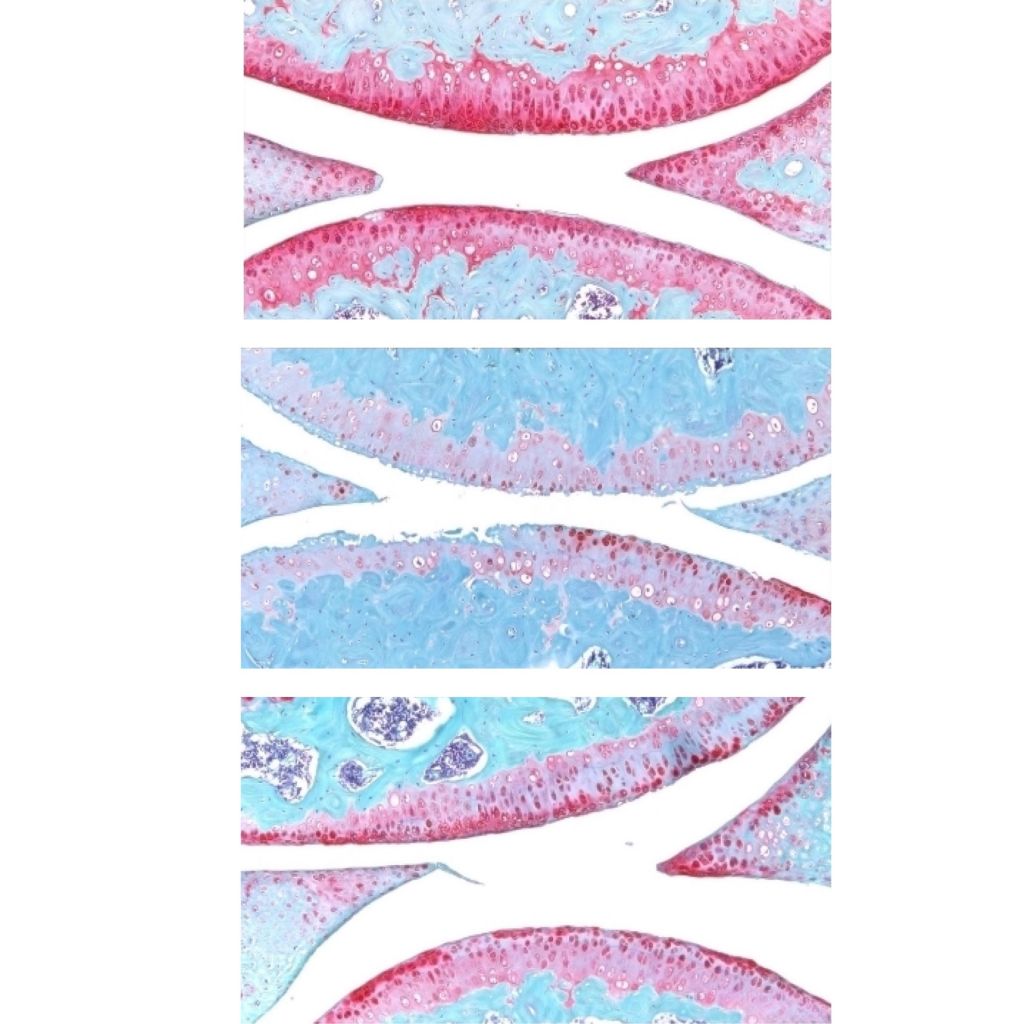
In older mice, both systemic administration and direct knee injection increased cartilage thickness across the joint surface. Mice with injury-modeled osteoarthritis received the inhibitor twice weekly for four weeks and showed reduced disease progression, less pain, and more normal weight-bearing behavior compared to control animals.
The human tissue results added weight to those findings. Cartilage samples collected during total knee-replacement surgeries were treated with the inhibitor for one week. Those samples showed fewer 15-PGDH-expressing cells, reduced breakdown activity, and signs of new articular cartilage production.
That result carries an important distinction: the regenerated material was hyaline articular cartilage, the smooth, load-bearing type joints require, rather than fibrocartilage, which is a lower-quality repair tissue. The tissue work used isolated samples, not patients receiving treatment, and cannot establish clinical benefit, long-term durability, or safety in humans. Separately, researchers working on surprising tissue-level breakthroughs have shown what is possible, as when frozen brain tissue was successfully revived after a week-long deep freeze.
The study was led by Stanford Medicine senior authors Helen Blau and Nidhi Bhutani, with Mamta Singla and Yu Xin Wang among the study’s authors, according to Stanford Medicine’s institutional coverage.
No clinical trial has yet tested 15-PGDH inhibition in living people with osteoarthritis. The appropriate dose, delivery method, treatment duration, and durability of any regenerated cartilage remain unresolved. Prostaglandin signaling affects inflammation and multiple repair pathways throughout the body. Off-target effects will require careful study in longer trials.
Researchers have also not confirmed whether the approach works equally across obesity-related, age-related, and injury-related osteoarthritis. If future trials succeed, delivery could take the form of an oral medication, a local injection, or another targeted therapy, though those possibilities remain hypothetical for cartilage treatment at this stage.
The significance of the Stanford finding is precise: researchers now have a specific molecular target and a plausible biological mechanism, which is where serious drug development begins. That is not a cure for arthritis, and it is not a near-term alternative to joint replacement. It is a well-grounded scientific advance pointing toward a potential disease-modifying treatment in a field that has long lacked one.