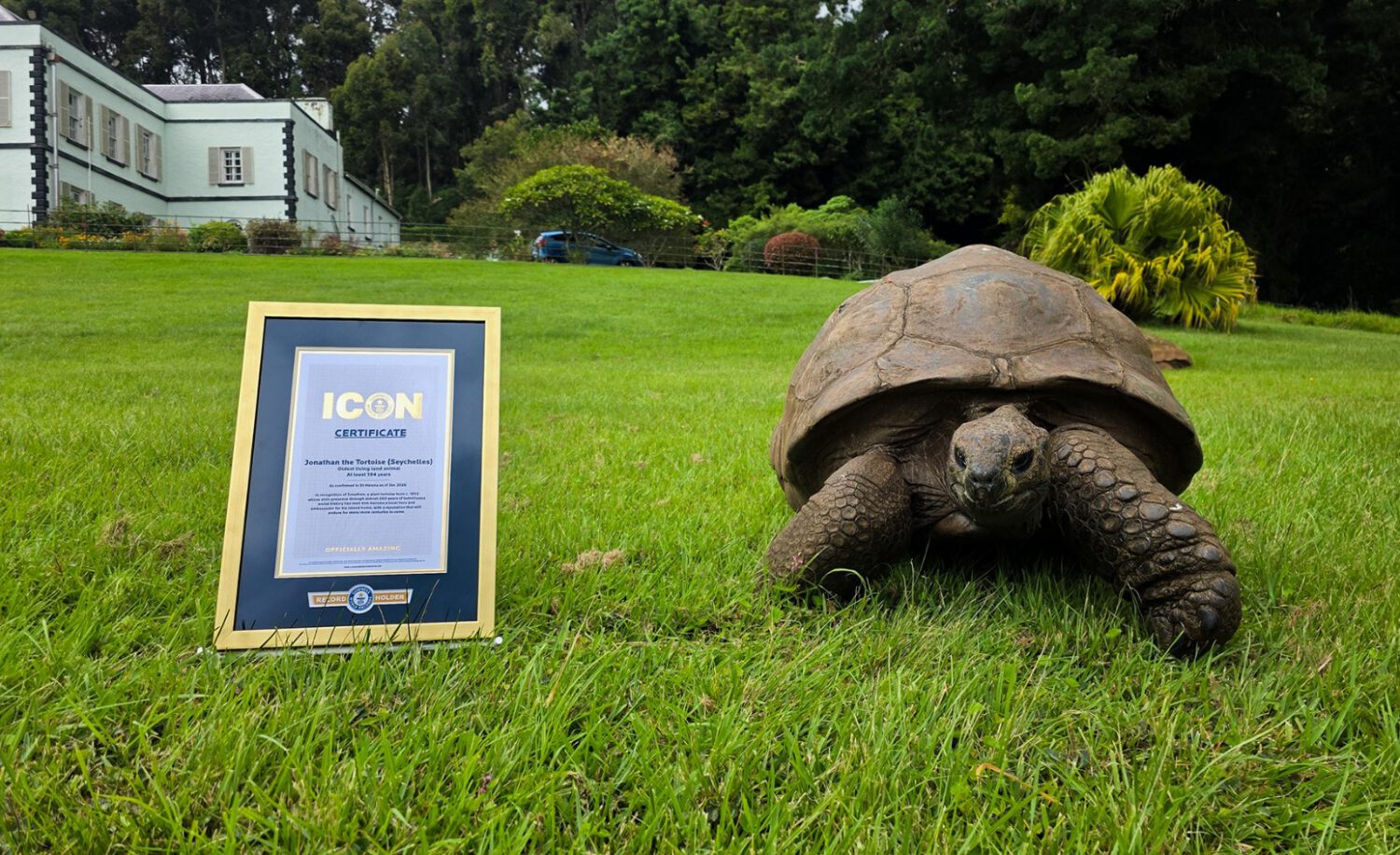
Jonathan the Aldabra giant tortoise was already an adult when Charles Darwin was still alive. Now estimated at 194 years old and still living at the governor’s residence on Saint Helena, he has become something rarer than a record-holder: a biological subject of unusual scientific value.
A study published in Science Advances sequenced his genome and epigenome, searching for patterns that might explain how any living thing survives nearly two centuries. The findings are genuinely interesting and genuinely preliminary.
What His DNA Actually Shows
Researchers identified 287 genetic variants unique to Jonathan, scattered across pathways linked to aging.
Those variants touch DNA repair, telomere maintenance (telomeres are the protective caps at the ends of chromosomes), insulin regulation, and mitochondrial activity (mitochondria are the structures that produce cellular energy). No single variant explains his lifespan. The study suggests a combination of features may help him resist cellular damage over time, not a single master switch.
Getting that DNA was its own ordeal. Drawing blood was considered too risky for an animal his age, so researchers collected samples using cheek scrapings. The samples came back short and contaminated with bacteria. The project then hit further delays from COVID-19, changing access regulations, and incomplete early collections.
Researchers filled the remaining gaps using DNA from a younger tortoise, leaving the final sequence approximately 95 percent Jonathan’s.
The Methylome Signal
One pattern stood out: the regions regulating his mitochondrial genes looked unusually youthful.
DNA methylation refers to chemical tags that influence whether genes switch on or off. Much of Jonathan’s methylome showed the kind of age-related disorder you would expect from an animal approaching its second century.
But methylation in regions controlling mitochondrial genes remained unusually organized. Researchers described that condition as “low entropy,” closer in pattern to a young tortoise than to a nearly 200-year-old one.
The hypothesis is that preserving accurate mitochondrial regulation helps maintain cellular function across an extremely long life. Researchers were careful to flag this as a hypothesis requiring further testing, not a conclusion.
Speaking to Scientific American, Stephen Clark described the study as an early step. He noted that aging involves many interacting biological hallmarks, not a single mechanism waiting to be flipped.
What the Study Cannot Tell You
The research is observational: correlations in one animal, not proof of causation.
Jonathan’s metabolism, body size, species-specific evolution, and environment differ substantially from human biology. Any path from these findings to a human application would require extensive laboratory validation, clinical trials, and regulatory review. That path does not yet exist.
The Living Archive
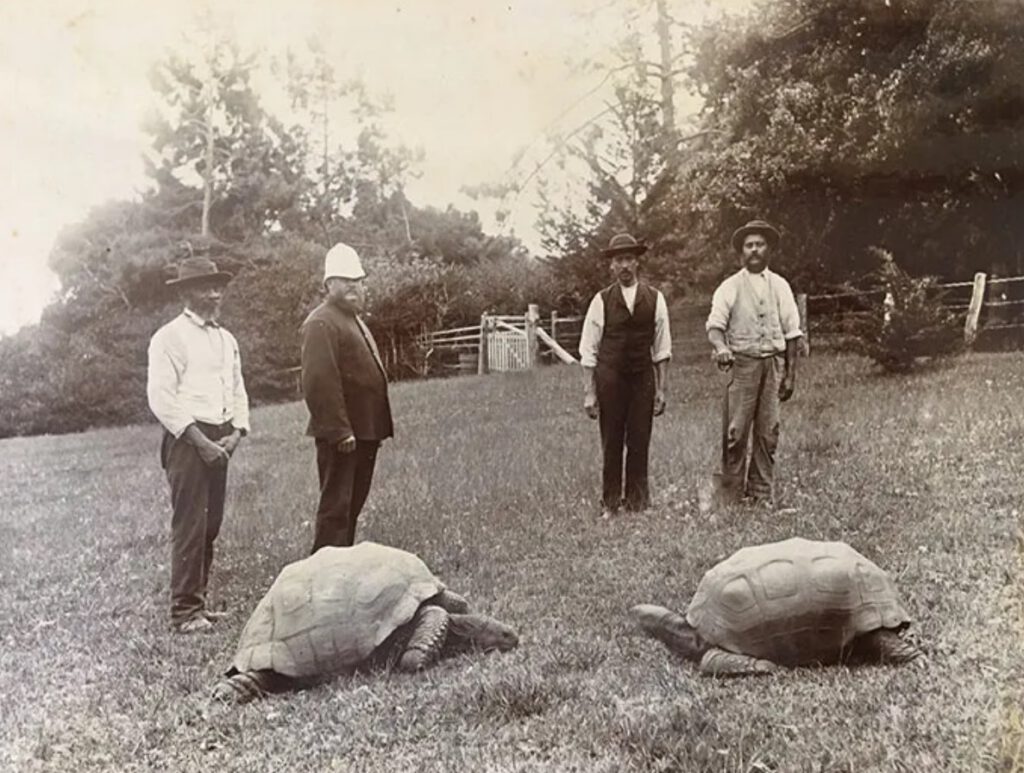
Jonathan’s life spans the age of photography to the genomic era, and his age is still technically an estimate.
He arrived at Plantation House in 1882 as a fully grown tortoise. His age is inferred partly from historical photographs showing him already mature in that decade.
Saint Helena officially recognized December 4, 1832, as his birthday in 2022, though the exact date remains uncertain. The Saint Helena government continues to report that he is alive and well.
The next steps are straightforward, if slow: sequence more exceptionally long-lived tortoises, close the remaining gaps in Jonathan’s genome, and test whether the identified variants actually alter cellular function. This research does not offer a longevity formula. What it offers is a more detailed map of where the biology of extreme aging might be worth exploring, drawn by an animal who has been outliving our best guesses for nearly two centuries.