Catching a star in the act of consuming its companion has long been difficult to observe directly. A study published in Nature on Nov. 18, 2026 presents the strongest evidence yet that researchers have done exactly that , a breakthrough akin to how Airborne LiDAR recently revealed hidden civilizations by making the previously invisible suddenly visible.
A Cosmic Drama 2.5 Million Light-Years Away
The event, designated AT2025abao and nicknamed “Bao,” unfolded in the Andromeda galaxy, about 2.5 million light-years from Earth.
The larger star, informally called Big Bao, was roughly seven times the Sun’s mass and about 350 times the Sun’s radius, placing it among the class of aging stars known as red giants. Its companion, Small Bao, carried approximately 70% of the Sun’s mass.
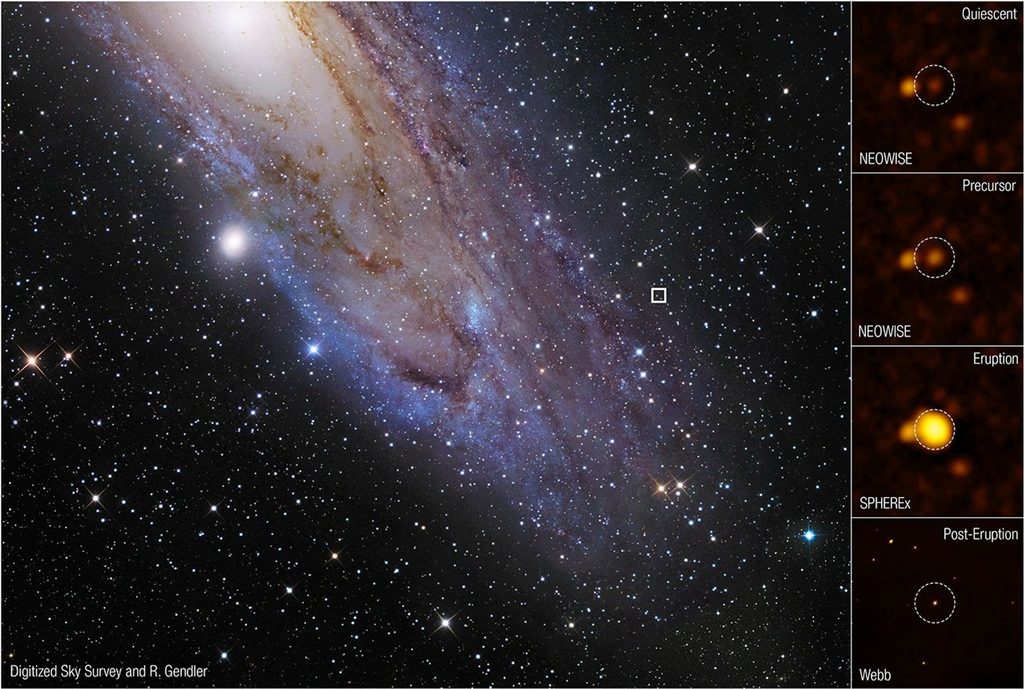
Image: NASA, ESA, CSA, STScI, Viraj Karambelkar (Columbia), Kishalay De (Columbia); Image Processing: Alyssa Pagan (STScI); Acknowledgment: DSS, Robert Gendler
Seven Years of Slow Build
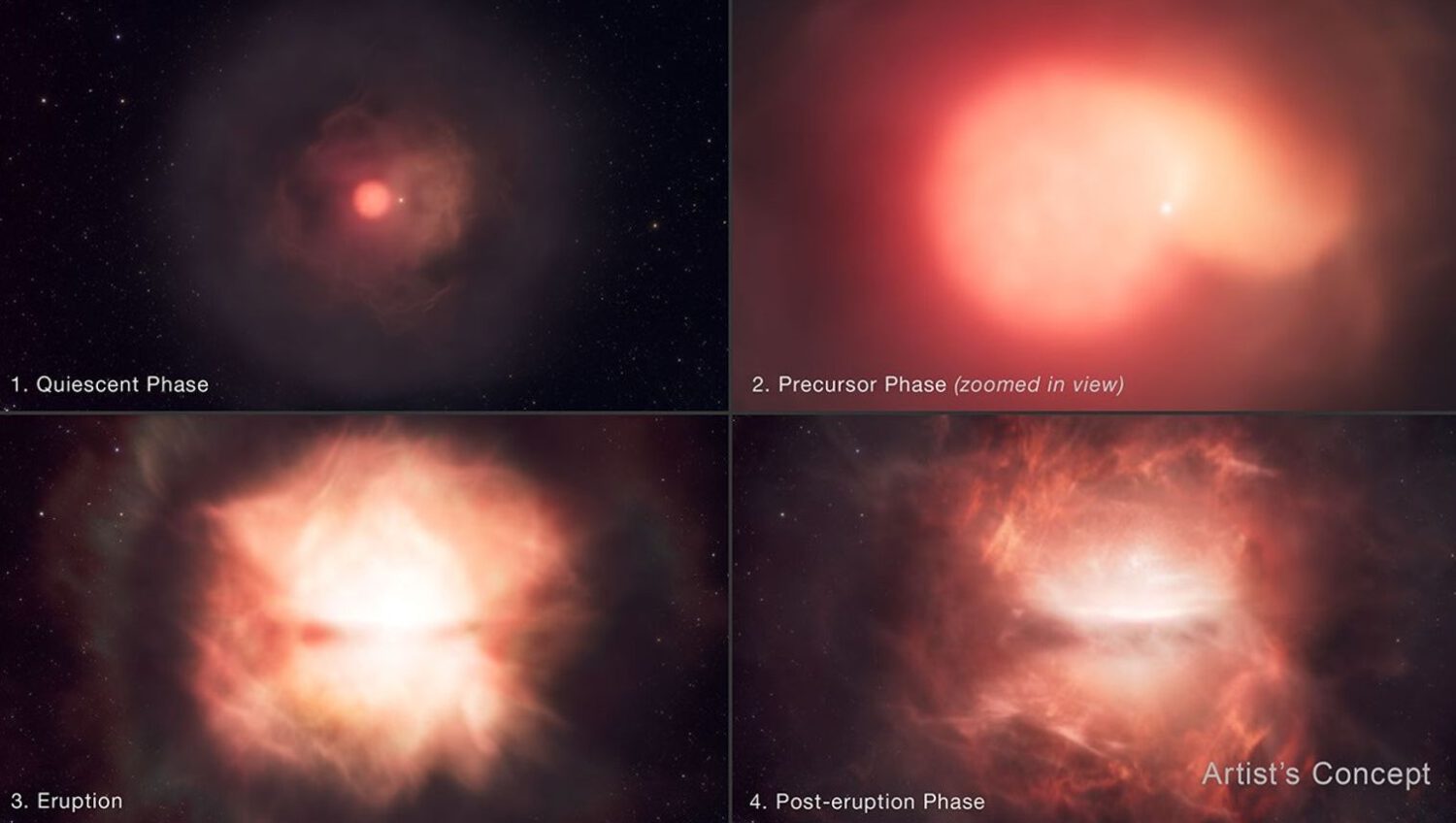
The system did not announce itself dramatically; archival data shows it began brightening gradually around 2018, when Small Bao is believed to have first entered Big Bao’s outer layers.
NASA’s NEOWISE spacecraft and the WINTER telescope at Palomar Observatory helped identify the unusual luminosity increase in 2023. Near the end of 2025, the system produced a major eruption consistent with a luminous red nova.
What Common-Envelope Evolution Actually Means
The proposed mechanism follows an established framework in stellar physics, even if the direct observation of it in progress is exceptionally rare.
As an aging giant star expands, a nearby companion can become embedded in its outer layers. Drag from those layers removes the companion’s orbital energy, pulling it inward. The resulting friction generates heat, which researchers propose helps explain the slow pre-eruption brightening as Small Bao spiraled through Big Bao’s envelope before reaching its core.
Webb Arrived 47 Days After the Eruption
The James Webb Space Telescope provided infrared measurements that helped researchers reconstruct what happened before, during, and after the outburst.
The Zwicky Transient Facility supplied the longer optical record, connecting the years of gradual brightening to the final outburst. The eruption expelled material estimated at 0.1 to 0.2 solar masses, according to the research team, which supports the interpretation that Small Bao penetrated all the way to Big Bao’s core.
What the Evidence Shows
NASA’s primary-source materials characterize the data as demonstrating that the two stars merged, describing the remnant as a newly single, potentially rejuvenated star.
Dust and ejected material currently surround the system, and researchers continue to monitor the remnant as it evolves. The observations are unusually complete, covering the onset of the inspiral through the eruption and its early aftermath, but not every moment of the process was captured continuously.
Why This Matters Beyond Andromeda
Common-envelope evolution is linked to some of the most energetic and consequential processes in astrophysics, and this event offers a rare chance to test models of it directly.
The process may influence the formation of compact binaries and certain supernovae. It is also thought to shape some of the gravitational-wave sources detected by facilities such as LIGO. An observational record this complete gives researchers a direct opportunity to test models that have until now depended heavily on simulations and indirect evidence.
Upcoming facilities, including the Vera C. Rubin Observatory and NASA’s Nancy Grace Roman Space Telescope, are expected to uncover many more transient stellar events. That prospect could make Bao the first entry in a meaningful comparison set, rather than an isolated case without context.