General relativity’s equations genuinely permit paths through spacetime that return a traveler to an earlier point in their own history. That sentence is accurate. What it does not mean is that you can book a ticket to last Tuesday.
The distinction between “mathematically conceivable” and “physically achievable” is the entire point here.
The Wormhole as a Time Machine
Traversable wormholes offer a more localized route to time-machine behavior than anything general relativity had previously suggested.
Kurt Gödel demonstrated in 1949 that Einstein’s field equations could produce closed timelike curves: paths through spacetime that return a traveler to an earlier point in their own history. His solution required a rotating universe with a negative cosmological constant. The assumptions were so far removed from observable reality that the result remained a mathematical curiosity rather than a physical blueprint.
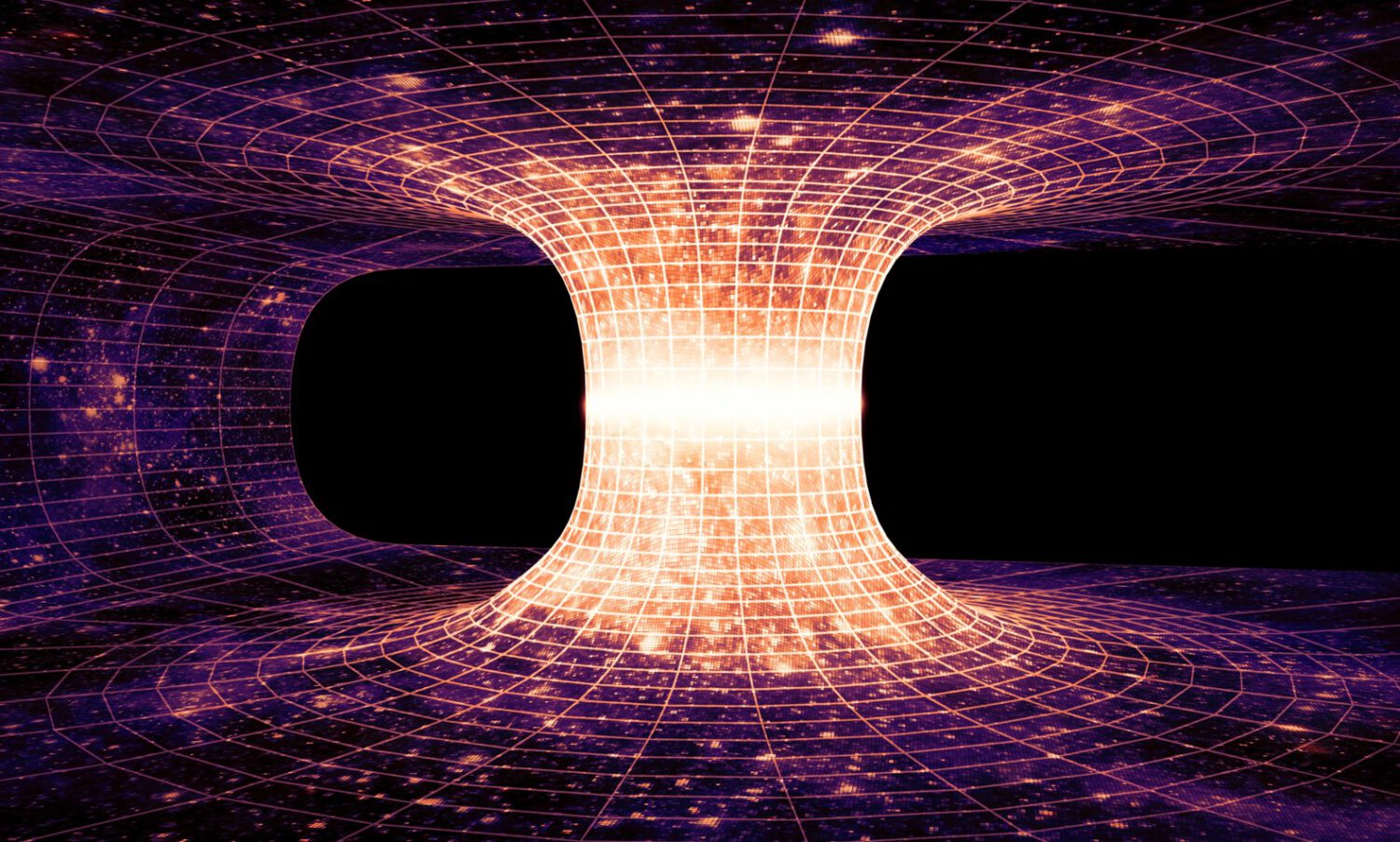
The 1988 paper by Michael Morris, Kip Thorne, and Ulvi Yurtsever shifted the conversation. They showed that a traversable wormhole, a tunnel connecting two separated regions of spacetime, could produce the same time-machine behavior in a localized structure. It would not require the entire universe to behave strangely.
The mechanism works by giving the two wormhole mouths different elapsed times. Move one mouth at relativistic speed while the other stays stationary, and a temporal offset builds between them. Enter through one mouth, and you could exit the other at an earlier moment.
Three unresolved requirements stand between that idea and reality:
- A traversable wormhole (no known mechanism to create one)
- Matter that violates standard energy conditions (quantum field theory permits limited negative-energy effects, but no large-scale confirmed example exists)
- A stable temporal offset between the two mouths (quantum effects may destroy it before it forms)
Each item on that list represents an unresolved obstacle, not an engineering challenge waiting for funding.
Why Physics May Be Its Own Bouncer
Stephen Hawking’s 1992 chronology-protection conjecture argues that the same physics enabling a wormhole may also prevent it from becoming a time machine.
Hawking’s analysis found that quantum effects and gravitational back-reaction near the boundary where causal loops would form could grow very large. That growth may destabilize the entire structure before any time machine completes.
This remains a conjecture, not a proven theorem. A definitive answer requires a complete theory of quantum gravity, and that theory does not exist yet.
The grandfather paradox sits nearby as a central conceptual challenge. If you travel back and prevent the events that made your journey possible, what happens? The Novikov self-consistency principle offers one proposed answer. Only globally self-consistent histories can occur, so a traveler may influence the past but cannot produce a true contradiction. Thorne and collaborators modeled simplified versions of this scenario and found self-consistent solutions, but they established no universal theorem covering every possible configuration.
The math offers one answer to the paradox. Nature has not confirmed it.
What the Physics Actually Tells You
The properties that make wormhole time travel conceivable may be the same properties that make it physically impossible.
Matter that violates energy conditions faces strict constraints from quantum field theory on the magnitude and duration of negative-energy effects. Vacuum fluctuations and gravitational back-reaction, the curvature the structure itself generates, could collapse the throat before any temporal offset stabilizes. Progress on these questions depends on advances in quantum gravity research, not on engineering.
Wormholes are among the clearest theoretical mechanisms physics has produced for generating closed timelike curves. Whether the universe permits that mechanism to operate is, for now, an open question. The answer lives somewhere in the unfinished territory between general relativity and quantum mechanics.