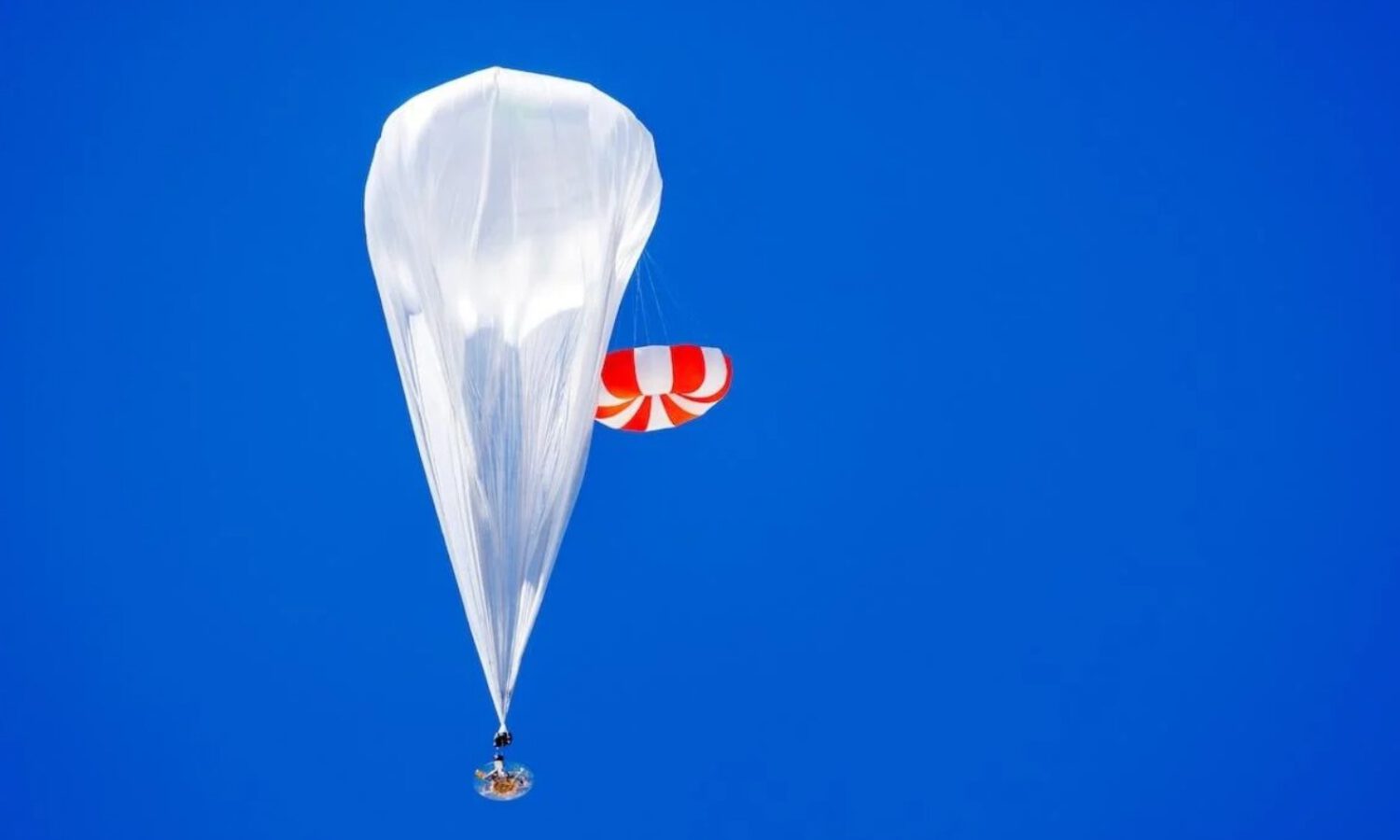
The U.S. military’s vision for delivering cargo anywhere on Earth in 90 minutes got its most recent real-world test courtesy of a high-altitude balloon, a bottle of whiskey, and a software-defined radio dropped over the Utah desert.
Sierra Space is building toward a system that keeps supplies in orbit for up to five years and recalls them on demand, reaching areas that C-17s and C-130s cannot safely enter. The balloon tests, conducted during U.S. Space Command’s Apollo Nexus exercise at Dugway Proving Ground, were the first runs of Ghost hardware in nearly two years.
What Happened Over Utah
Two Ghost vehicles dropped from balloons at different altitudes, carrying payloads chosen to represent real military cargo.
Apollo Nexus is a U.S. Space Command coordination exercise designed to test how military units work together in complex operations. Ghost participated as a live logistics demonstration, not a simulation.
Sierra Space released two Ghost vehicles from high-altitude balloons: one at 35,000 feet, one at 68,500 feet. Ground teams recovered both vehicles after descent.
The payload choices were deliberate. A software-defined radio stood in for sensitive electronics that military units need in the field; the whiskey tested whether liquid cargo survives the descent environment intact. According to Aviation Week, both payloads safely came through the tested environments.
The timeline adds context. Sierra Space reportedly built a Ghost vehicle from scratch and coordinated its participation in the exercise in under four months.
What Ghost Is Designed to Do
The 90-minute delivery figure is a design target that depends on orbital infrastructure the balloon tests did not demonstrate.
The 90-minute delivery figure depends on cargo already staged in orbit, sometimes for years before it is ever called down. That full architecture has not been demonstrated.
Payload capacity is described as roughly five to ten tons, according to Tom’s Hardware. Think communications hardware, ammunition, drones, and field equipment rather than armored vehicles.
Sierra Space senior vice president Erik Daehler framed the operational stakes plainly, telling Aviation Week: “Getting something into theater to the warfighter when they need it is critical.” The company describes space as a logistics node that could route around contested airspace rather than through it.
The Gap the Tests Did Not Close
Balloon drops validated descent and payload recovery, but left the hardest part of the mission untested.
The balloon drops confirmed that Ghost hardware can survive a high-altitude release and that representative payloads reach the ground intact. That is meaningful progress, and it is also a narrow slice of what an operational system requires.
The tests did not replicate orbital velocity near 17,500 miles per hour or the extreme heating of atmospheric reentry, a challenge familiar from the world of hypersonic missiles. They also did not address vacuum exposure during multi-year storage or the full command-and-control chain needed to call a vehicle down on demand.
The Test That Will Actually Matter
An actual orbital deployment and controlled reentry remains the milestone that will determine whether the concept holds up under real conditions.
The next significant milestone is an orbital deployment followed by a controlled reentry. That test will determine whether the thermal protection holds, whether precision landing works at operational scale, and whether the economics of storing cargo in orbit justify the complexity.
Until then, a bottle of whiskey that survived 68,500 feet stands as the program’s most concrete proof point.