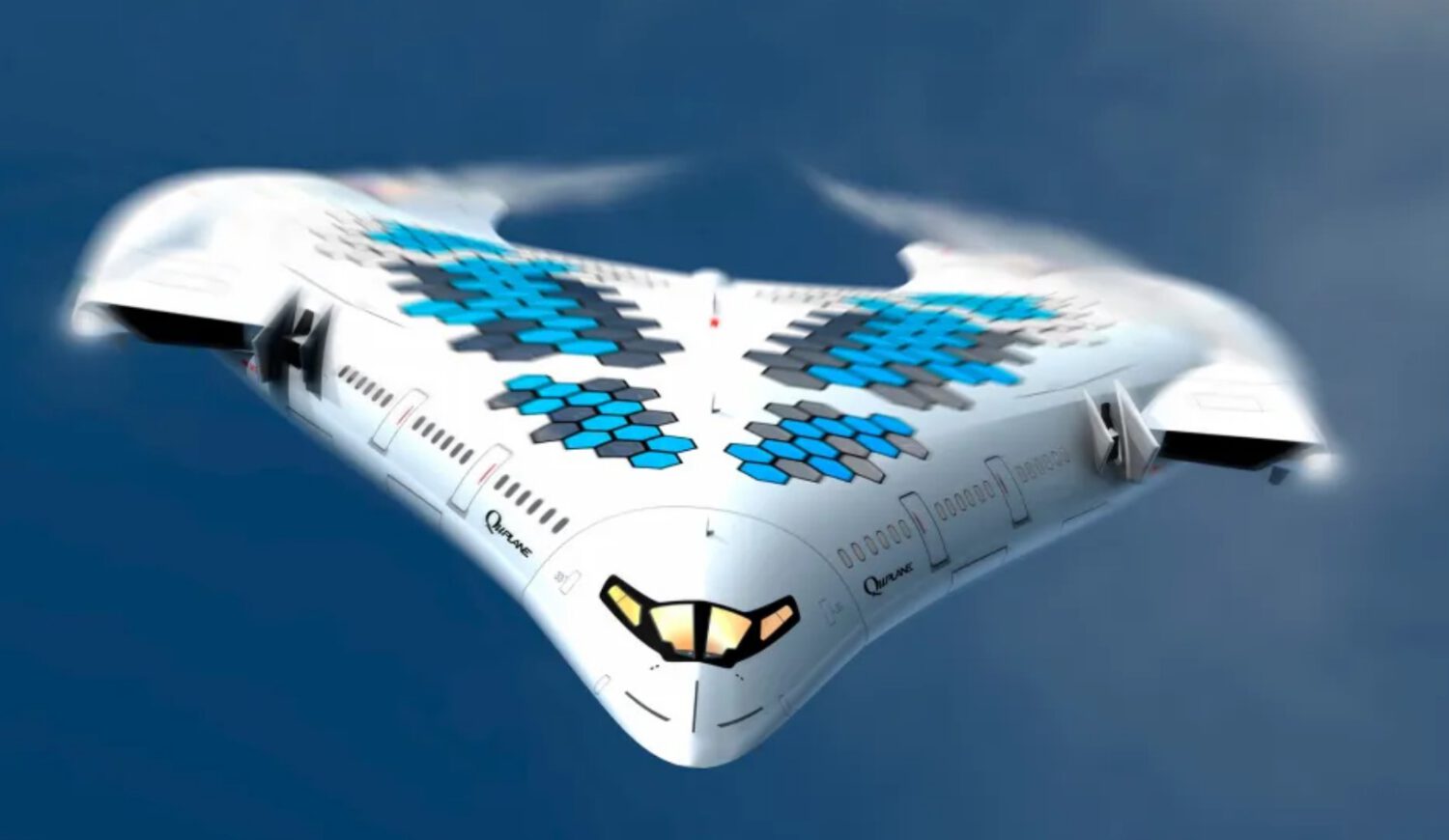
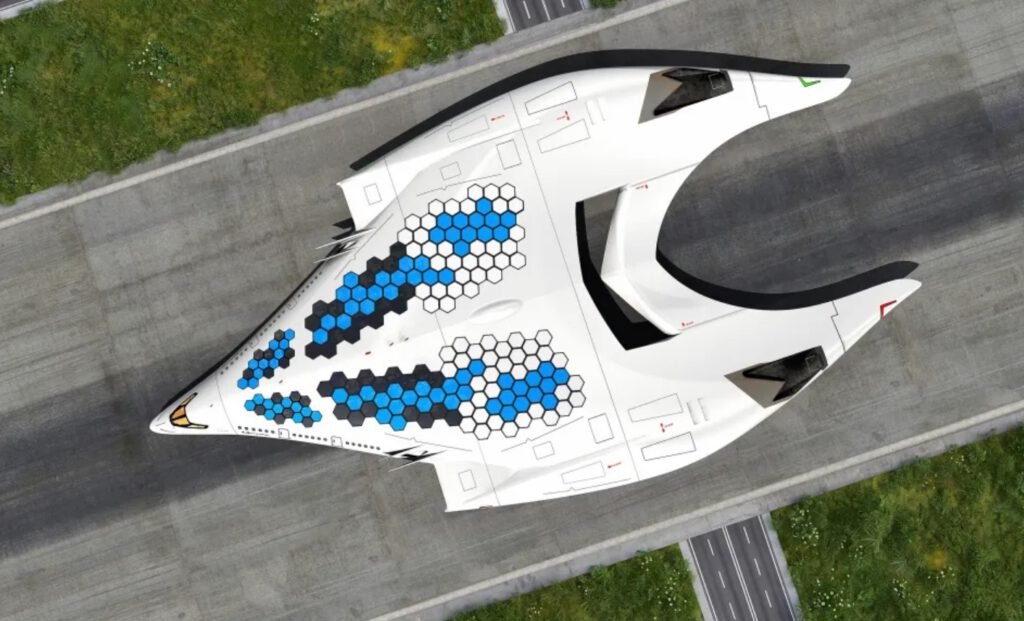
You are at Heathrow at 8 a.m., boarding a plane and clearing JFK customs before your London lunch has fully digested. That is roughly the promise behind the QuPlane, a speculative supersonic aircraft concept credited to designer Oscar Viñals. No flying prototype, airline order, or regulatory certification is identified in the available reporting, and this is a rendered idea with ambitious numbers attached.
The Specs on Paper
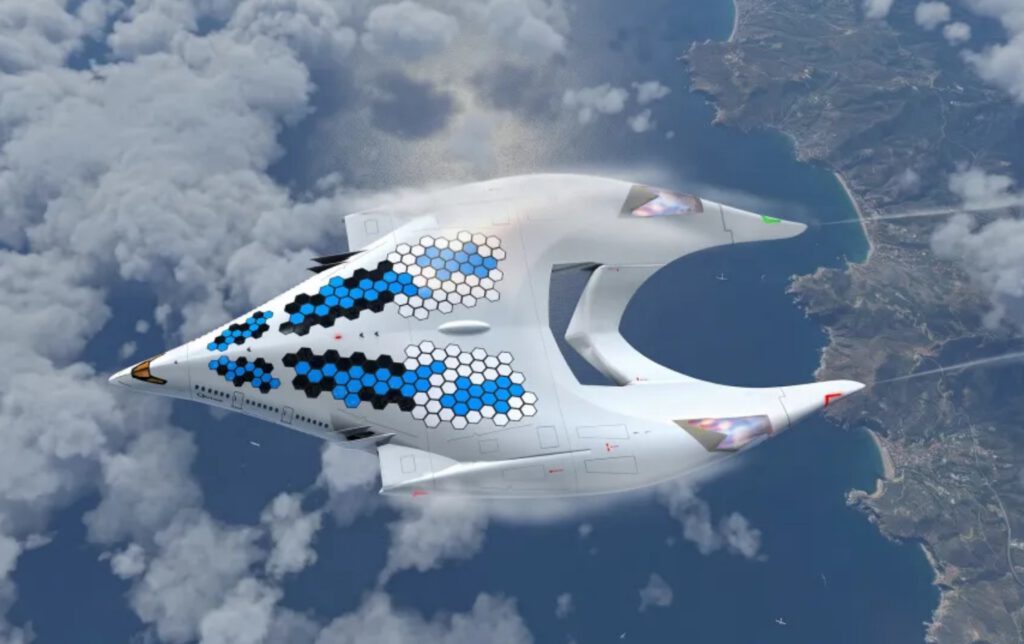
The concept proposes a 222-foot blended-wing-body aircraft carrying up to 200 passengers at Mach 2.1 and 59,000 feet, with a claimed range of 16,000 kilometres.
According to reporting in The Sun, Viñals envisions a fuselage that generates lift directly rather than relying on conventional lateral wings, which the concept claims reduces drag substantially. The proposed cabin features three classes: private First Class suites with beds, Business Class single seats, and economy seats reportedly 19 inches wide. A holographic cockpit, AI-assisted navigation, panoramic transparency, and automated cabin management round out the aspirational spec sheet; none of these represent tested or certified systems.
The Concorde Benchmark
The QuPlane’s proposed speed is not a dramatic leap over Concorde; the bigger claims are capacity and range.
Concorde cruised at approximately Mach 2.02 and operated commercially from 1976 to 2003. It carried more than 2.5 million passengers, with its fastest New York-to-London crossing clocked at 2 hours, 52 minutes, and 59 seconds. The QuPlane’s proposed Mach 2.1 sits close to that number.
Where the concept reaches further is capacity: up to 200 passengers versus Concorde’s fewer than 130. Range is also a larger claim: 16,000 kilometres against Concorde’s roughly 6,667 kilometres. The Congressional Research Service describes Concorde as a technological achievement that was not a commercial success, and that history is the most useful lens for evaluating any supersonic concept that arrives with confident numbers and no committed partners.
The Distance Between a Render and a Runway
Propulsion, sonic boom rules, certification, and economics each represent unresolved barriers between the concept and commercial service.
No engine, manufacturer, or test program is identified for the QuPlane in any available reporting. Sustained Mach 2.1 cruise demands propulsion that simultaneously meets modern noise, emissions, and reliability requirements. Supersonic aircraft operating over land face strict restrictions because of ground-level shock waves, which could limit any viable route network before a single ticket is sold.
Certification would require structural, propulsion, noise, evacuation, and airport-compatibility testing across multiple regulatory jurisdictions. No aerodynamic data, prototype results, delivery timetable, or customer commitments appear in the available reporting. Right now, the QuPlane exists as illustrations and ambition.
Blended-wing-body research and supersonic passenger travel are legitimate areas of aerospace inquiry, and concepts like this can shape engineering conversation. Without demonstrated testing, a customer commitment, or regulatory approval, however, the two-hour London-to-New York figure remains a conceptual target rather than a schedule you can book.