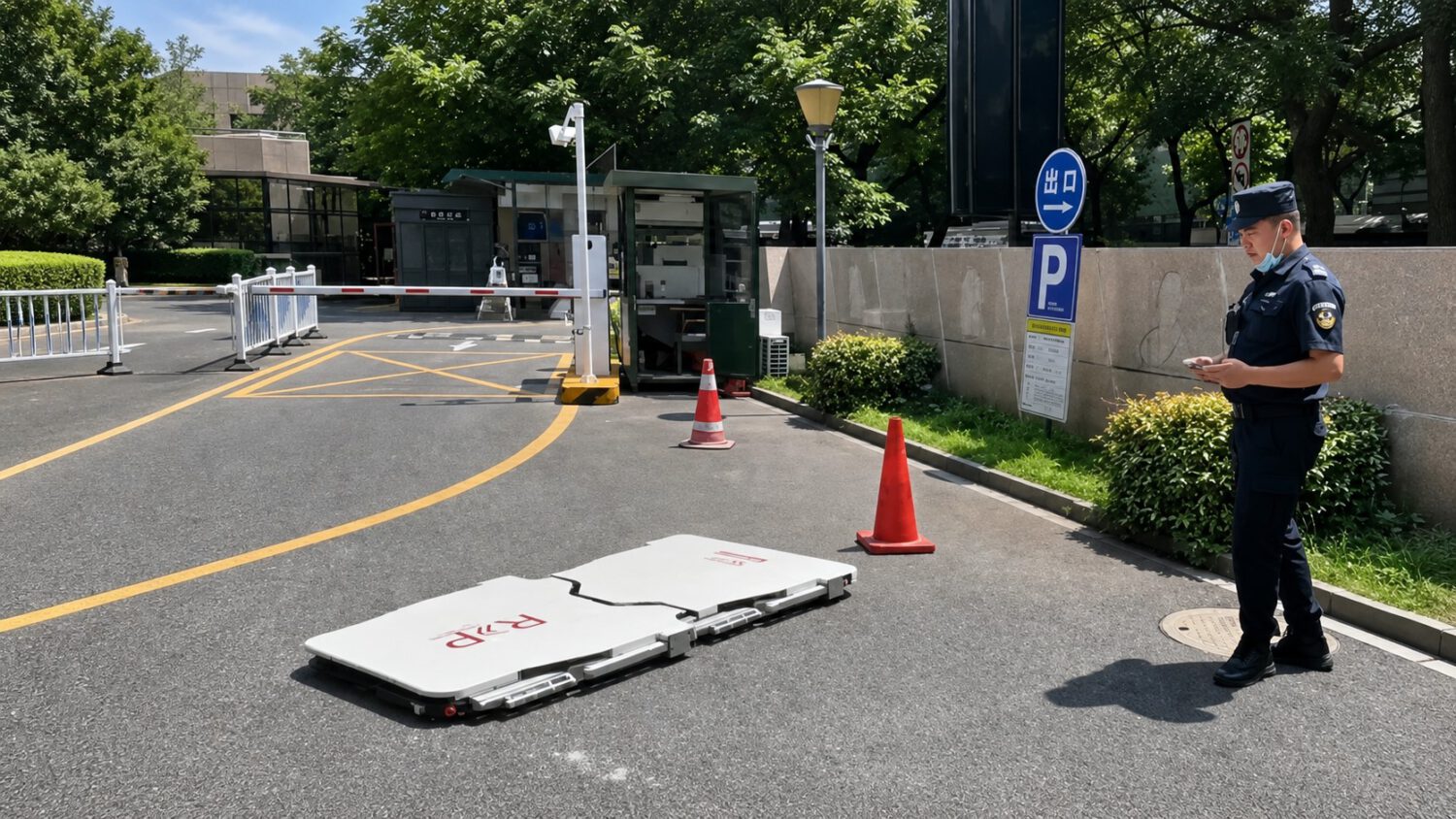
Developed by Shenzhen-based Shanyi Technologies, a low-profile robotic platform called Combo has reportedly been used or trialed by Chinese police and urban-management personnel to relocate illegally parked vehicles. Available reporting describes it as moving obstructing cars to a nearby legal space, though that outcome reflects reported local use rather than a confirmed national policy.
The scale of deployment is not established by official records, and available reporting relies primarily on demonstration footage and manufacturer-distributed materials rather than procurement documents.
How the Robot Moves a Car
The Combo slides beneath a vehicle, lifts it through the wheels, and repositions it without touching the bodywork.
The platform is compact enough to pass beneath a standard passenger vehicle. Once in position, mechanical arms extend to support the wheels, and a hydraulic lifting mechanism raises the car through its tires.
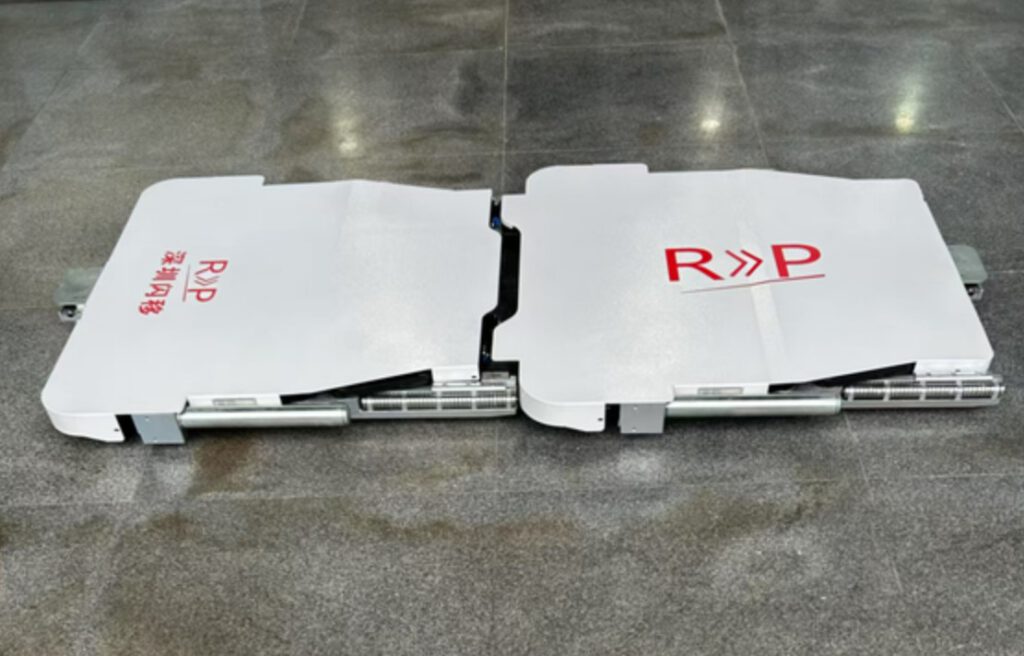
From there, the Combo can move the vehicle forward, backward, sideways, or rotate it in place. Repositioning a car in a narrow alley or crowded urban block without a conventional turning arc is precisely the problem a full-size tow truck cannot solve cleanly.
Manufacturer specifications list a payload capacity of up to approximately 3 metric tons, depending on the model. Supported vehicle lengths reach roughly 6.5 meters on certain configurations, while another listed model supports vehicles up to about 5.5 meters.
Top speed is listed at around 1.3 meters per second, or about 4.6 kilometers per hour. Operating time runs approximately four hours under stated conditions, though loaded runs may shorten that window.
LiDAR and an emergency-stop button are cited as safety features in Shanyi’s published product materials. Some configurations are described as remotely controlled; others are characterized as semi-autonomous. Available evidence does not confirm that all enforcement deployments operate without an officer directing the system.
Why Cities Would Prefer This Over a Tow Truck
The robot’s sideways travel and in-place rotation let it clear obstructions in spaces where conventional equipment struggles to operate.
The Combo’s lateral movement allows it to clear an obstruction in constrained spaces where a conventional tow truck would require significantly more room. That maneuvering advantage is most relevant on narrow city streets and in crowded lots where a full-size truck creates its own disruption.
Relocation also keeps the vehicle nearby rather than transporting it to a distant facility. According to available reporting, robotic relocation does not erase the underlying parking violation; the robot moves the obstruction, but enforcement of the infraction remains a separate matter.
No uniform national penalty schedule was identified in the available sources, so any fine would depend on local rules. Wheel-based lifting may also reduce the risk of bodywork damage compared with conventional towing, though no independent damage-rate testing has been documented in the available material.
What Remains Unresolved
Official records do not establish how broadly Chinese cities have deployed the system, and several practical questions remain open.
Liability for vehicle damage, driver notification procedures, and operational limits on uneven surfaces are not addressed in the sources reviewed. Shanyi Technologies also lists dealerships, parking facilities, roadside assistance operations, and automobile factories among intended markets, which suggests enforcement is one use case among several rather than the platform’s sole commercial purpose.