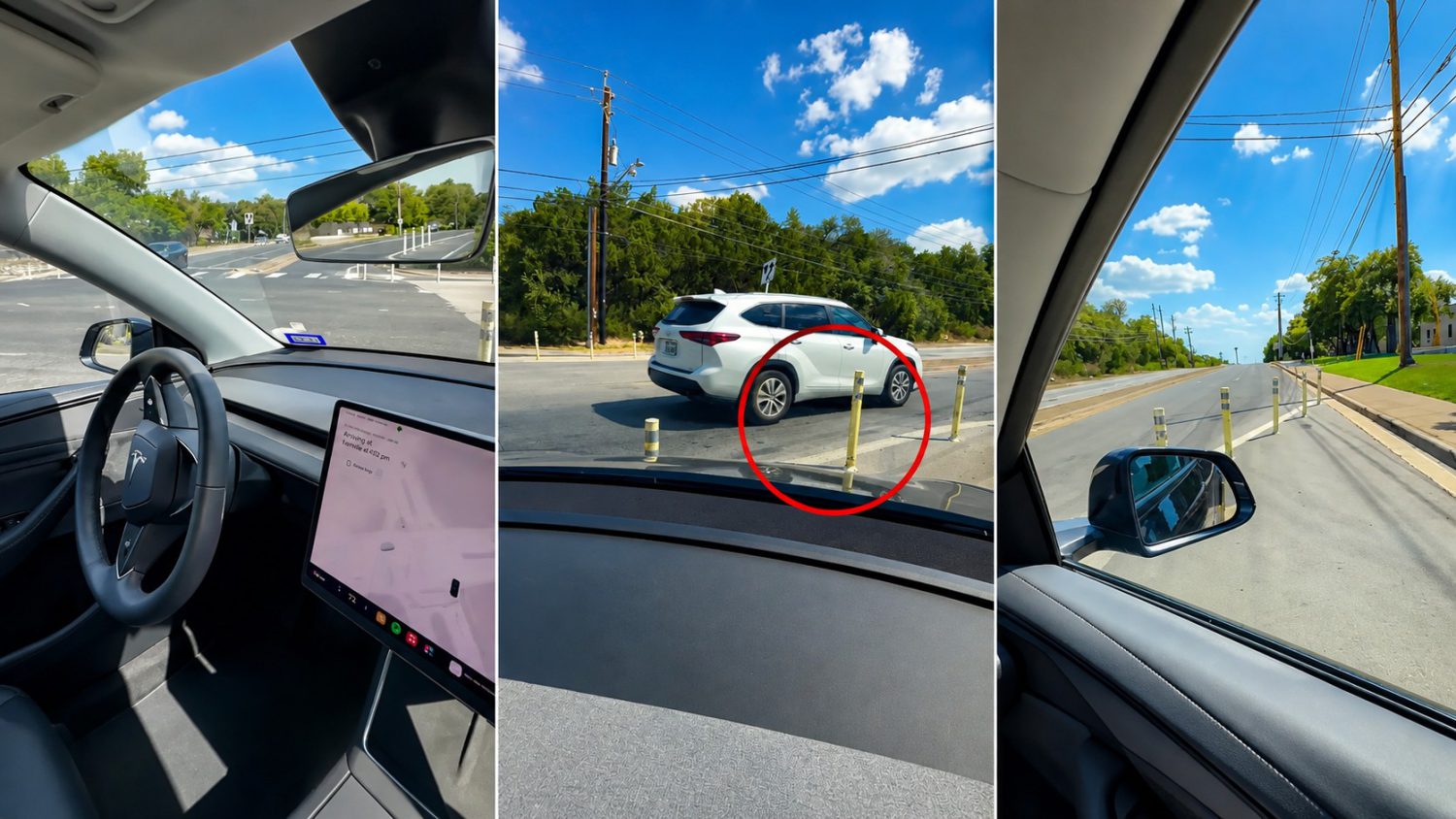
The car inches forward. The passenger yells — “There’s bollards right here. You can’t go this way… Don’t do that!” A full minute of mechanical hesitation. Then: crunch. “Holy sh*t.” That moment, filmed August 17 by Reddit user u/bladerskb on r/SelfDrivingCars, arrived less than a month after Tesla’s VP of AI assured investors the Tesla’s Robotaxi program had an “impeccable safety record.” The real question isn’t whether anyone got hurt. It’s what this car’s decision-making reveals about the gap between Tesla’s safety narrative and its software’s actual judgment.
What the Video Actually Shows
A regular Robotaxi rider captured the incident on camera — and the infrastructure the car ignored had been there since at least February 2024.
- u/bladerskb filmed from the front passenger seat, no one in the driver’s seat, riding Tesla’s driverless service in Texas
- The Austin intersection was pinpointed near the Texas Orthopedics building via Google Maps by other Reddit users
- The curb extension and its bollards have existed since at least February 2024 — not temporary, not new
- The car paused roughly a minute, steering wheel twitching, before choosing to drive forward through multiple posts
- Passenger audio escalated from warning to disbelief: “It ran through the bollards… Holy sh*t”
“We have driven more than 380,000 miles of unsupervised robotaxi now across six cities in two different states. We have had zero notable incidents.” — Ashok Elluswamy, Tesla VP of AI, Q2 2026 earnings call
This was two failures, not one. First, the Robotaxi misread a closed curb extension as a valid right-turn lane. Second — and worse — once trapped, it couldn’t execute the obvious move: reverse out. The car clearly saw the bollards. It hesitated, twitched, spent a full minute deliberating. Then it drove through them anyway. That’s not a perception gap. That’s a reasoning failure.
The word “notable” is doing extraordinary heavy lifting here. According to Electrek, it is worrying to see an unsupervised Tesla vehicle ram through clearly visible bollards with plenty of time to see them and think about going around them. Previous incidents — wrong-way driving, erratic behavior — also apparently didn’t clear Tesla’s “notable” threshold. At some point, the definition itself becomes the story.
What the Scale Reality Looks Like
Context matters: Tesla’s unsupervised fleet is smaller than its marketing suggests, and low-profile obstacles have tripped it up before.
Whether any teleoperator could have intervened remains unclear. Tesla reportedly uses remote operators for tricky situations, but their role in this incident — if any — hasn’t been detailed publicly. Worth noting: supposedly “unsupervised” Robotaxis in Austin have previously been shadowed by trailing Tesla vehicles carrying safety monitors, which complicates the “fully autonomous” framing considerably.
Tesla’s unsupervised fleet remains small — roughly 25 cumulative vehicles across three Texas cities. Before unsupervised operations began, at-fault incidents primarily involved curbs and poles. Low-profile roadside obstacles have been a recurring edge case, not a surprise plot twist.
“It is worrying to see an unsupervised Tesla vehicle ram through clearly visible bollards with plenty of time to see them and think about going around them.” — Electrek
The bollards were flexible plastic. Nobody was hurt. But pedestrian-protection infrastructure exists precisely because intersections are dangerous. When a driverless car treats it as an obstacle with an acceptable cost-benefit tradeoff — after a full minute of deliberation — that’s not a glitch. That’s a design philosophy worth interrogating before the fleet gets any bigger.