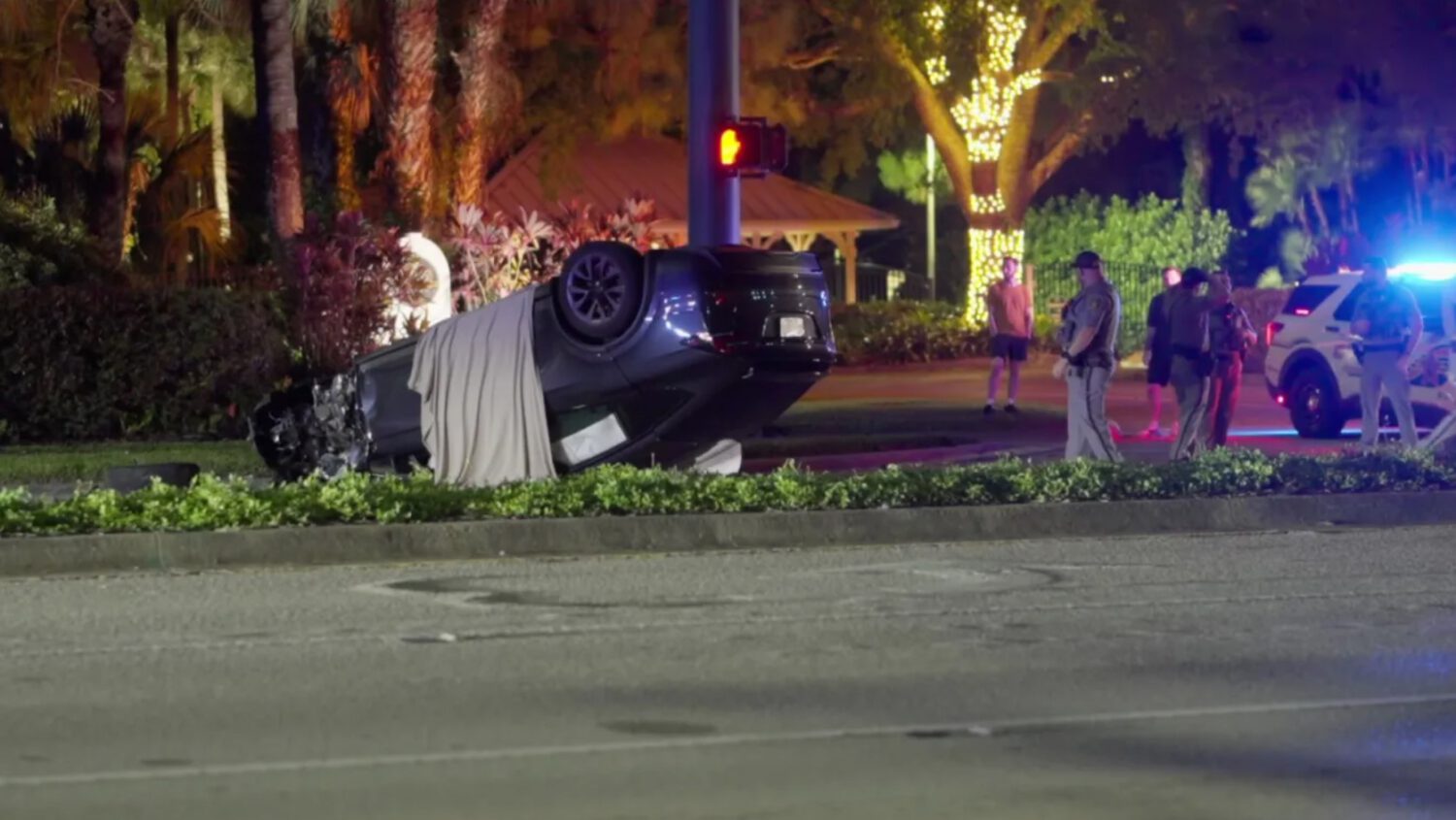
A woman is dead, Tesla’s federal filing confirms a driver-assistance system was engaged before impact, and the narrative describing what happened is redacted as confidential business information.
A Fatal Crash in Naples, and a Federal Filing That Raises More Questions Than It Answers
The basic facts are clear; what the system was doing in the final seconds is not.
Just before midnight on September 30, 2026, a 2025 Tesla Model X traveling east on Golden Gate Parkway in Collier County, Florida, left the road, struck a traffic-signal pole, and overturned. A 50-year-old female passenger from Fort Myers died at the scene, while the 48-year-old driver survived with non-life-threatening injuries.
The publicly released Florida Highway Patrol account, per Electrek’s reporting, did not identify a cause or attribute the crash to impairment, speed, or driver-assistance technology. Tesla’s federal filing tells a different story, or at least the beginning of one.
What Tesla Told Federal Regulators
Tesla’s filing established system engagement and reported key crash details, then withheld the account that would explain them.
Under NHTSA’s Standing General Order, automakers must report qualifying crashes involving Level 2 driver-assistance systems when those systems were engaged during the 30 seconds immediately before the crash through its conclusion. Tesla submitted a report for this crash.
The filing marked the system’s engagement status as “Verified Engaged.” That designation means Tesla’s telematics confirmed a covered driving-automation system was active shortly before the collision, though the filing does not independently establish which specific product, Autopilot or Full Self-Driving, was in use.
Tesla reported a pre-crash speed of 39 mph, a collision with a pole, airbag deployment, and damage to the vehicle’s front and top. Tesla also indicated it learned of the crash through its own telematics rather than through law enforcement or media reporting.
The filing further reported that the vehicle’s event data recorder, telematics records, and video footage were available. The narrative describing the crash sequence, the software version running at the time, and whether the roadway fell within the system’s operating domain are all redacted. Tesla withheld each as confidential business information, according to the reported filing.

What “Verified Engaged” Does and Does Not Mean
The designation confirms recent system activity; it is not a finding of fault or cause.
NHTSA’s reporting requirement is triggered by system engagement within a defined window before a crash. It establishes that the system was recently active, not that it caused anything.
What that activity means for this specific crash remains unknown to the public, because the account that could explain the system’s behavior in the seconds before impact has been withheld.
A Timestamp Gap That Could Obscure Cases
Tesla’s UTC filing timestamp crossed midnight, placing the record under a different calendar date than the local crash date.
Tesla recorded the incident at 03:41 UTC on October 1, 2026. That converts to 11:41 p.m. local Florida time on September 30, roughly two minutes before the Florida Highway Patrol’s reported time. This creates a risk that searches limited to local calendar dates could overlook or misclassify the record.
The Transparency Gap
The data that could answer the most important questions about this crash is not available to the public.
Tesla’s telematics data could clarify whether the driver or the system was steering before impact. It could also show whether the driver received any warnings and what the vehicle was doing in the final seconds.
The driver survived and could potentially provide a firsthand account. The cited reports do not say whether Florida Highway Patrol investigators obtained Tesla’s raw video and event-recorder data or received only a manufacturer summary.
Placing This in the Broader Data
This crash is one of a record number of Tesla driver-assistance incidents in the latest federal data release.
Electrek’s analysis of the most recent NHTSA data release identified 264 Tesla driver-assistance crash reports for September 2026, exceeding the previous reported monthly high of 236 reports in July. NHTSA cautions that its published figures can include duplicate reports, multiple filings for a single crash, or multiple reported collision objects; raw counts require careful interpretation.
The available public materials do not disclose whether investigators obtained Tesla’s underlying data, what it showed, or why the public narrative remains sealed.