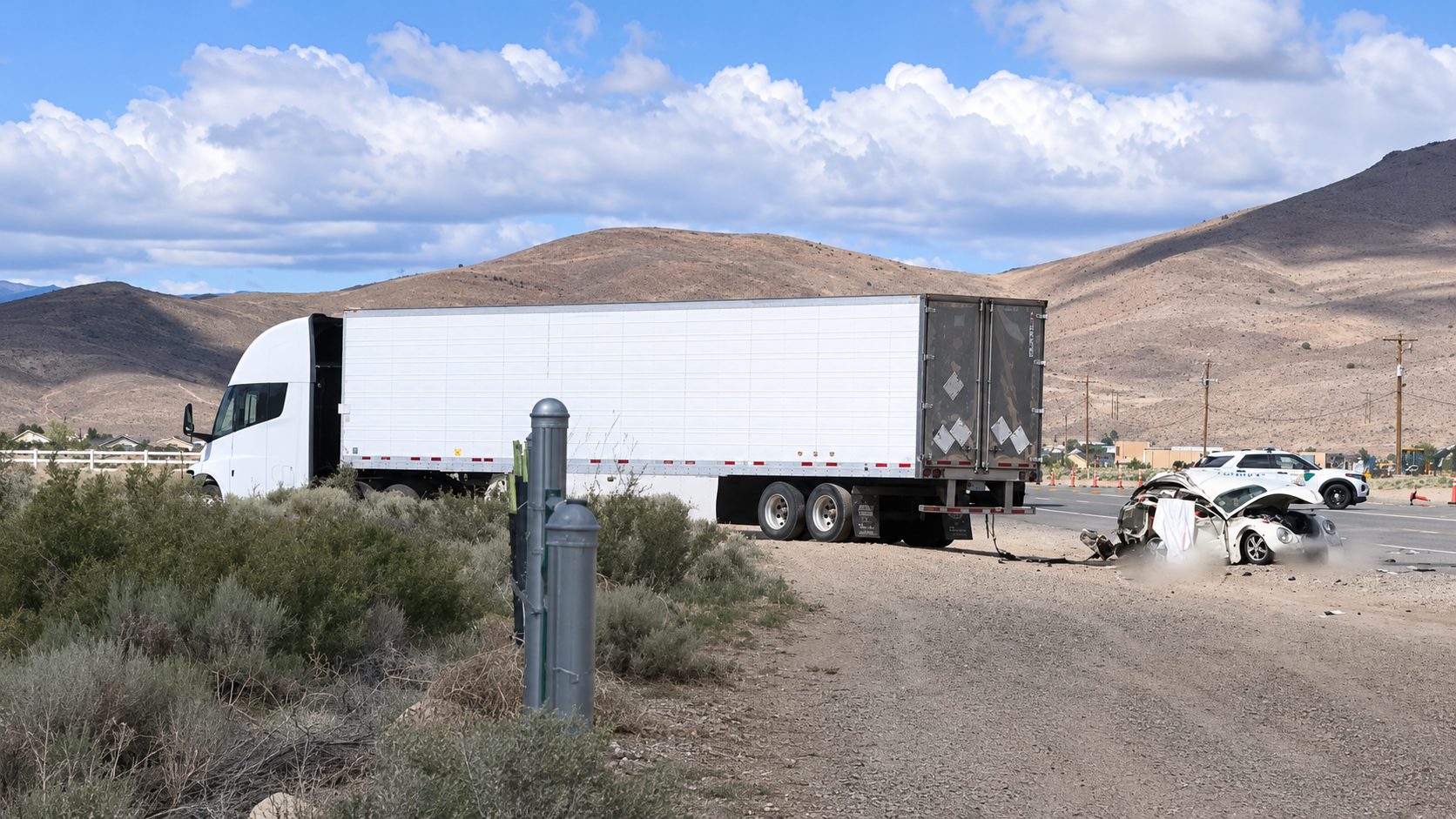
At 7:20 a.m. on June 28, a Tesla Semi struck two vehicles stopped at a red light on U.S. Route 50 in Dayton, Nevada. An SUV and a classic Volkswagen Beetle. The couple in the Beetle were pronounced dead at the scene. A third person was airlifted with life-threatening injuries. Preliminary statements to the Lyon County Sheriff’s Office suggest the Semi’s driver may have fallen asleep, according to reporting by Electrek and the LA Times. Full Self-Driving was not active. This marks the first known fatal crash involving Tesla’s electric Class 8 truck.
Tesla markets the Semi as “designed for autonomy” with active safety features including Automatic Emergency Braking. The question investigators now face is straightforward: did those systems activate, and if so, why wasn’t it enough to stop an 80,000-pound truck from killing two people at a traffic light?
When the Last Line of Defense Fails
AEB is supposed to catch exactly this scenario — a rear-end collision with stopped vehicles — but Tesla’s own manuals warn the system was never designed to prevent crashes outright.
Think of AEB as a backup, not a bodyguard. Tesla’s passenger-vehicle owner manuals explicitly state the system “is not designed to prevent a collision” — only to reduce severity. The Semi reportedly shares the same camera-based hardware family as Tesla’s cars, but Tesla has never published Semi-specific AEB specifications, according to the LA Times. Whether the system even activated remains part of the Nevada State Police investigation.
“Limitations of forward collision avoidance systems…when vehicles are traveling at high speed or are faced with vehicle shapes the system has not been designed to detect.” — NTSB summary cited by the LA Times
A loaded Class 8 truck weighs up to 80,000 pounds. IIHS data shows AEB cuts rear-end crashes by roughly 50% on passenger cars in good conditions — but stopping distances scale brutally with mass. Even a meaningful speed reduction may not prevent fatal outcomes when that much kinetic energy meets a stopped Beetle.
Here’s what you need to know:
- The crash occurred June 28 at approximately 7:20 a.m. on U.S. 50 at Traditions Parkway, Dayton, Nevada
- Two occupants of a Volkswagen Beetle were pronounced dead at the scene; a third person was airlifted with life-threatening injuries
- Preliminary statements suggest the Semi driver may have fallen asleep; Nevada State Police is leading the formal investigation with no final report issued
- Tesla’s Semi began customer deliveries in December 2022; FSD is not available to customers on the truck
- Federal regulators are currently weighing a mandate requiring AEB on vehicles over 10,000 pounds
Two competing narratives are already forming. One camp says this is human failure — drivers fall asleep in conventional semis regularly, and no AEB system guarantees prevention in every heavy-truck scenario. The other points to Tesla’s own branding: if you market a truck as “designed for autonomy” with advanced safety systems, a rear-end collision with stationary vehicles at a red light is the textbook scenario your technology should address. Safety critic Dan O’Dowd publicly alleged that Tesla’s driver monitoring failed to detect the sleeping driver and that AEB failed to stop the truck — though that remains advocacy, not an official investigative finding.
Those data logs — if Tesla releases them — will matter more than any press statement.
Federal regulators already weighing AEB mandates for vehicles over 10,000 pounds now have a fatal crash to cite. Tesla hasn’t documented Semi-specific AEB performance in public spec sheets. Until Nevada State Police conclude their investigation, fleet operators and regulators must weigh Tesla’s published safety claims against an unresolved fatal crash.