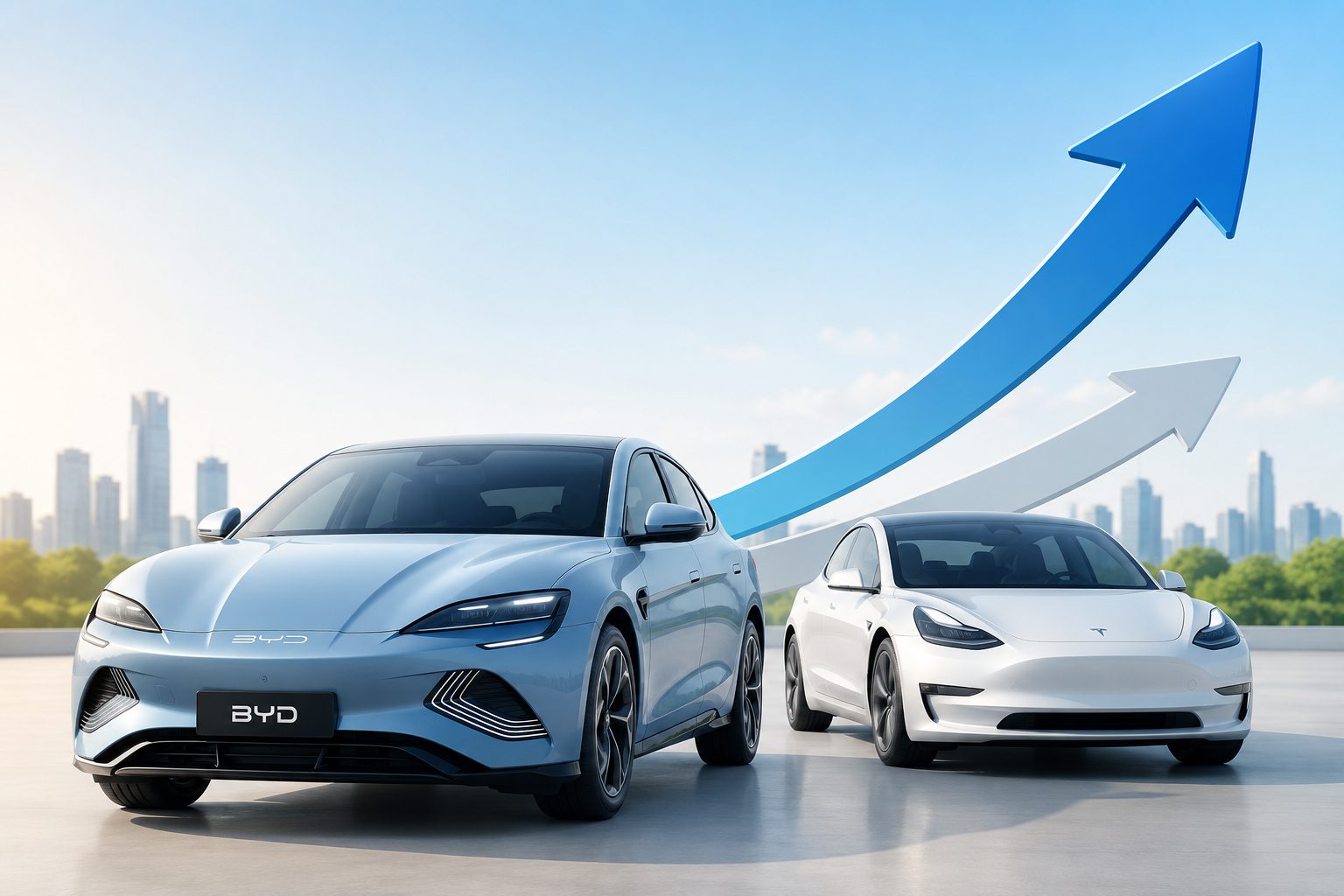
BYD delivered 557,090 battery-electric vehicles in the three months through June. Tesla, according to Bloomberg analyst consensus, is expected to land somewhere around 397,000 total deliveries for the same quarter. That gap — roughly 160,000 vehicles — isn’t a rounding error. It’s a continent’s worth of cars. And it confirms what the 2025 full-year numbers already suggested: BYD moved 2.26 million BEVs last year versus Tesla’s 1.64 million, per compiled global sales statistics. The EV leadership story you grew up with has a plot twist, and it arrived without a press conference.
The Numbers Don’t Lie
Even Wall Street’s most optimistic Tesla forecasts can’t close the quarterly gap with BYD’s battery-electric deliveries.
Where analysts disagree is only on how much Tesla trails. Bloomberg consensus sits near 397,000 deliveries. Electrek’s compiled sell-side estimate runs around 406,000. Goldman Sachs, the most bullish voice in the room, projects roughly 420,000 — a solid 9.3% year-over-year increase. None of those numbers touch BYD’s Q2 output.
One important distinction worth making: BYD sold 4.6 million total vehicles in 2025, but nearly half were plug-in hybrids. This comparison counts only fully electric cars — the metric that actually matters for BEV credibility.
Tesla still dominates the US market, and its Supercharger network remains the gold standard for charging infrastructure. Global volume, though, runs on a different scoreboard. EV Volumes projects 22.7 million EV sales worldwide in 2026, up modestly from 21.6 million in 2025. Growth is decelerating. In a maturing market, incremental share goes to whoever competes hardest on price — and BYD’s vertically integrated battery production, built around its proprietary blade-battery technology, is purpose-built for exactly this fight.
Europe Is Where the Story Gets Interesting
BYD’s March sales in Europe surged 150.9% year-over-year, pushing the brand to third place in regional EV rankings.
Armed with affordable models like the Dolphin targeting mainstream buyers and fleets, BYD is winning over European drivers who never previously considered a Chinese car brand. According to Autovista Group, that March surge landed BYD among Europe’s top three EV sellers. It’s the Hyundai circa 2010 playbook — dismissed early, dominant later.
While Tesla’s brand, software ecosystem, and autonomous driving ambitions still carry genuine weight in premium segments, the broader market appears to be splitting along predictable lines. Think streaming-wars logic: Netflix and Spotify serve different needs without directly canceling each other out. Tesla may own the luxury-software lane. BYD owns volume.
For observers who have measured EV leadership by software cadence or interior design scores, quarterly delivery numbers deliver a cold correction. BYD isn’t trying to be Tesla. It’s trying to be everywhere Tesla isn’t — and that strategy is working.