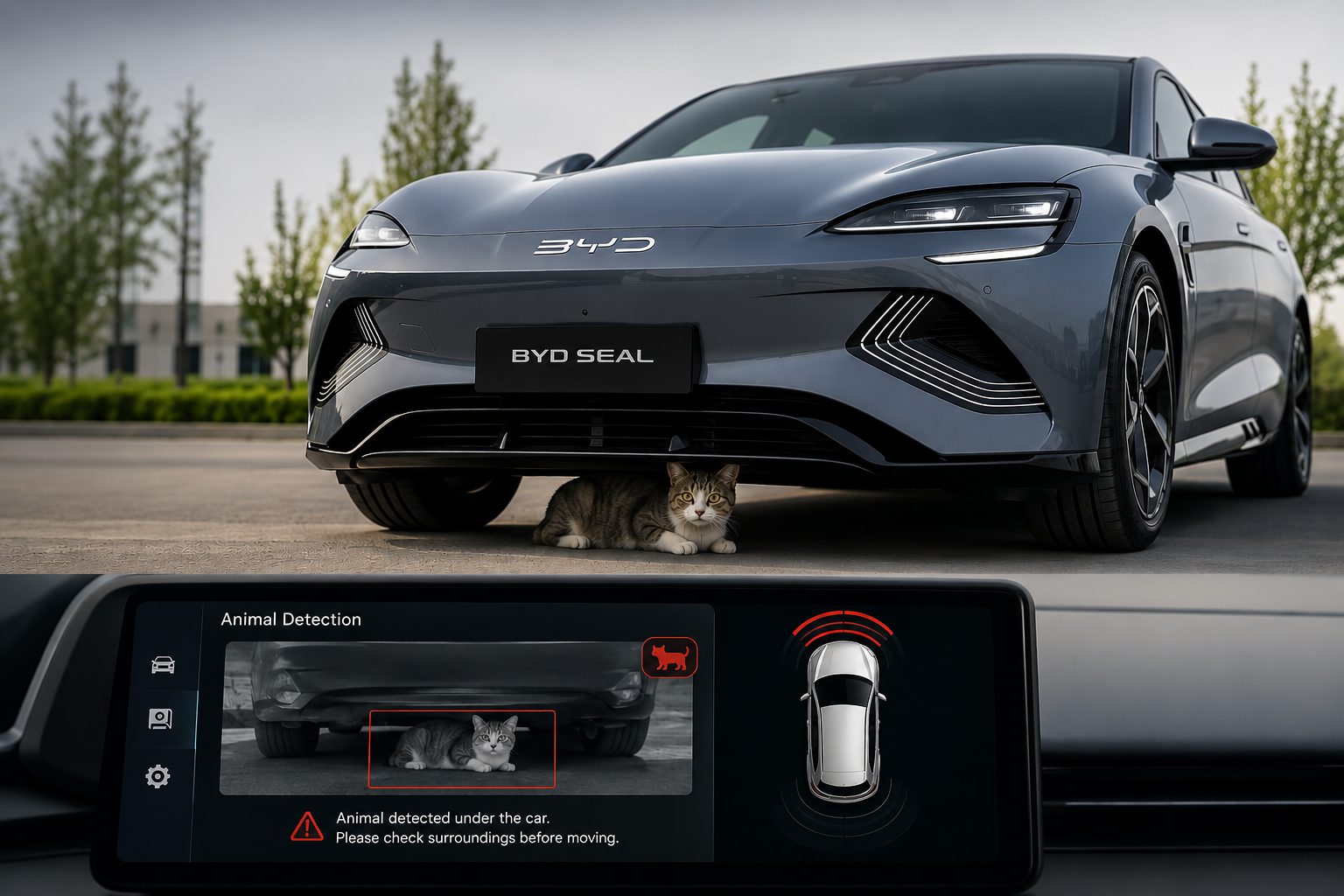
Playing hide-and-seek under parked cars shouldn’t be a life-or-death game, but children hiding under vehicles poses serious safety risks. BYD has published a patent for an AI system that spots living beings beneath parked vehicles before you shift into drive—addressing a blind spot that even the fanciest surround-view cameras miss.
Smart Baseline Imaging Beats Guesswork
The system captures reference photos when parked, then spots changes before you move.
Here’s how BYD’s underbody detection actually works: When you park and power down, cameras mounted under your vehicle snap baseline images of the ground beneath. Think Ring doorbell logic, but pointing down instead of out. Before you drive away, the system takes fresh photos and compares them to the stored reference, isolating only regions that changed rather than analyzing the entire underbody frame every time.
Patent CN122200729A, filed with China’s National Intellectual Property Administration, describes this two-stage approach as change detection followed by AI classification. The first pass spots differences from the baseline. The second pass determines whether those changes represent a person, pet, or just wind-blown debris. This method reduces false alarms from shadows, leaves, and other environmental noise that plague traditional motion sensors in the messy space beneath vehicles.
Targeting the Most Dangerous Blind Zone
Underbody accidents happen because this space is invisible to drivers and most sensors.
The patent targets scenarios that haunt parents and pet owners: children crouching under cars, cats seeking shade beneath engines, or people resting against wheels. Standard backup cameras show what’s behind you, but struggle to see someone lying directly underneath your battery pack.
According to CarNewsChina, BYD has a radar-based cabin monitoring system that detects forgotten occupants inside vehicles. Together, these patents cover both sides of the car safety equation—who’s trapped inside and who’s hiding underneath. While not explicitly linked, this underbody tech fits within BYD’s DiPilot “God’s Eye” sensor fusion platform, which already handles intelligent parking and navigation assistance across multiple models.
Unlike controlled cabin environments, underbody spaces present brutal computer vision challenges: inconsistent lighting, road debris, weather exposure, and constantly changing shadows. BYD’s baseline comparison approach aims to filter this chaos by focusing only on meaningful changes rather than fighting the environment itself.
Patent publication doesn’t guarantee production deployment, but it signals BYD’s broader push toward 360-degree vehicle awareness. Smart vehicle safety continues expanding beyond traditional zones, potentially making underbody monitoring as standard as backup cameras.