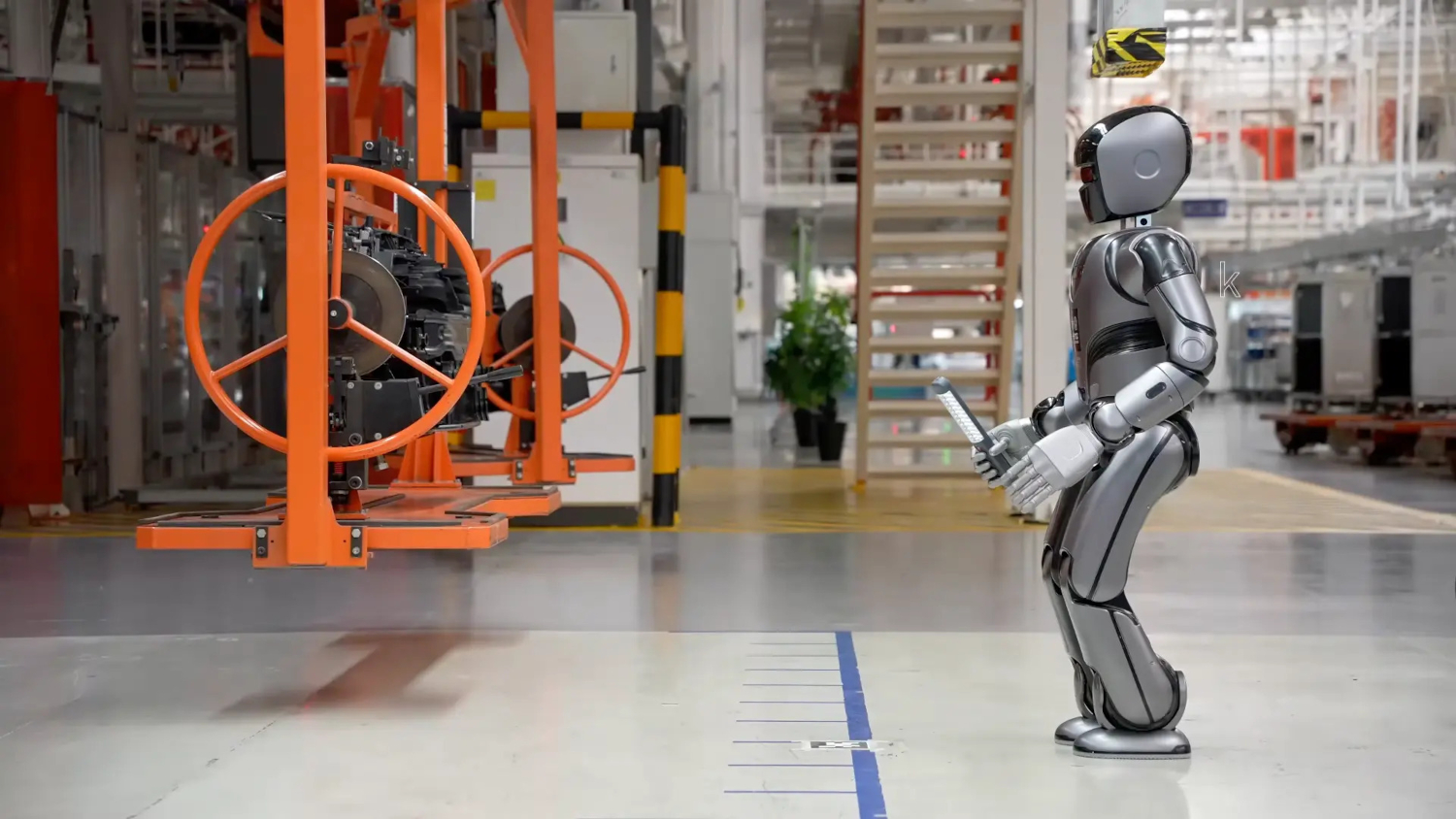
Signing a strategic cooperation agreement on October 8, UBTECH Robotics and FAW-Volkswagen have broadened their partnership beyond quality inspection into the more complex territory of factory logistics and smart manufacturing, part of a broader wave of humanoid robot deployment across industries.
No deployment has been confirmed, no order volume announced, and no timetable for routine operation has been disclosed.
How This Started
An earlier Qingdao collaboration gives this agreement a real foundation rather than a cold start.
FAW-Volkswagen opened production-line scenarios at its Qingdao factory to UBTECH in July 2024, where the Walker S robot was tested on tasks including bolt tightening, component installation, and parts handling.
That earlier phase also put the Walker S Lite through vehicle quality-inspection training at Qingdao, connecting the robot directly to the plant’s automation-control system. The new logistics agreement builds on that track record.
What the Agreement Actually Covers
Joint development, testing, and demonstration are the program’s defined scope, not confirmed deployment.
Factory logistics is broad territory, potentially covering component movement, workstation replenishment, parts sorting, and production-line supply. Those are illustrative possibilities; the companies have not specified which tasks will be targeted in testing.
What you will not find in the announcement is a deployment date, an order count, or a confirmed production site. Humanoid platforms may offer greater adaptability than some fixed-purpose systems, particularly as vehicle configurations become more varied and production layouts shift to match them.
UBTECH commissioned a 14,000-square-meter humanoid robot factory in Liuzhou, Guangxi on September 12, with a stated annual capacity of more than 10,000 Walker S and Cruzr robots, roughly one every 10 minutes according to the company. That capacity supports larger industrial pilots, but it does not represent a FAW-Volkswagen order. No such order has been publicly announced.
What Remains Unknown
The gap between a testing agreement and routine factory operation remains wide, and the unknowns are significant.
UBTECH and FAW-Volkswagen have not disclosed which humanoid model will be used in the logistics program. They have also not named which of FAW-Volkswagen’s five production bases (Changchun, Chengdu, Foshan, Qingdao, or Tianjin) will host demonstrations, or how many robots will be involved.
The companies have not confirmed which specific logistics workflows will be tested, what safety certification status applies, or when any of this transitions from demonstration to regular production use.
UBTECH describes its industrial platform as combining an embodied-intelligence “brain,” a motion-control “cerebellum,” robotic hardware, and swarm intelligence. Its software architecture is reportedly built around foundation, world, and action models, according to the company. Whether that architecture holds up across shifts, layouts, and edge cases is among the questions these trials may help assess.
The Measure That Matters
Progress will be real only when demonstrations give way to confirmed, repeatable work on an actual production floor.
Right now, this partnership is a development and testing program. The real signal of progress will come if and when it moves past demonstration scenarios into named production tasks, repeatable performance metrics, a defined robot fleet, and confirmed regular operation at a specific FAW-Volkswagen facility. Until then, the October 8 agreement is a credible next step in a real working relationship, with most of the hard questions still open.