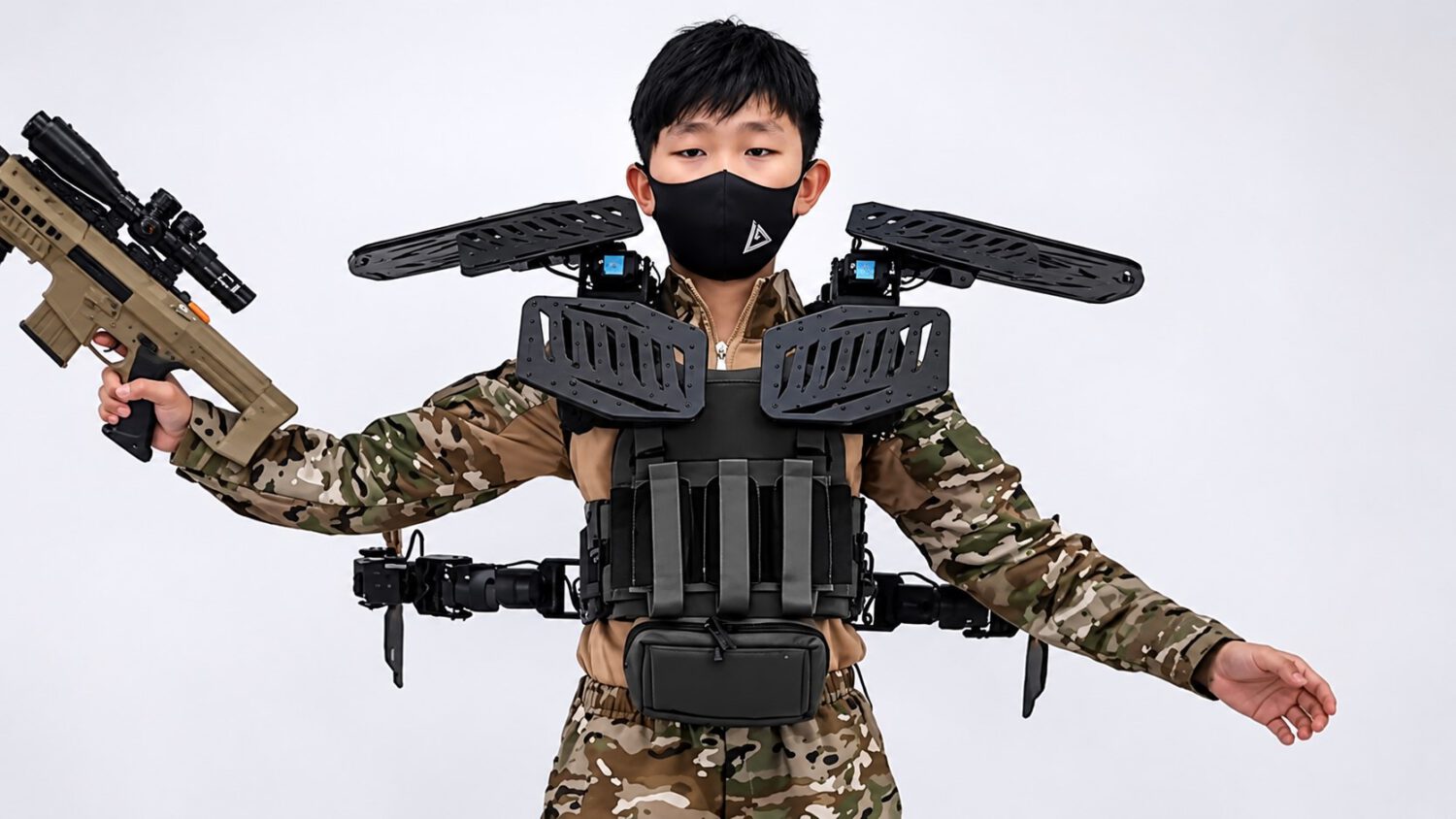
Video circulating online appears to show a student-built wearable platform that converts from a standard backpack into a modular robotic system. According to the footage and an accompanying brief, the build includes a shoulder-mounted turret, a thermal-imaging camera, a laser designator, and a robotic arm controlled by voice commands. Gadget Review could not independently verify the student’s identity, school, or the operational status of any module.
Why Combining These Elements Is Hard
Packing motors, sensors, batteries, and a robotic arm onto a human body creates problems that engineering teams spend years solving.
The core challenge is not any single module. It is making all of them coexist on a wearable frame without overwhelming the person underneath.
Weight, heat, cable routing, actuator torque, and the wearer’s range of motion all compete against each other at once. Stanford researchers working on a comparable wearable system called ModPack identified exactly these constraints in their published work on compact wearable integration.
Structural load transfer is one piece of that puzzle. A well-designed backpack frame can redirect system weight from the shoulders into the hips and spine. That linkage also has to move with the wearer rather than resist them.
The brief describes a mechanical connection between the frame and the user’s upper body intended to do exactly that. No testing data is available to confirm how well it performs.
Joint sensing is another layer of difficulty. The brief says the student used hall-effect sensors to track fast arm movements. Hall-effect sensors detect changes in magnetic fields and can provide real-time position feedback, which is a legitimate technique used in robotics. The specific arrangement and accuracy in this build remain unverified.
The Modularity Point
Swappable payloads are not just a cool feature; they reflect a design philosophy that serious robotics researchers also use.
Researchers at Stanford documented a comparable system called ModPack, a wearable backpack that serves as a common computing and power core for bimanual mobile-robot teleoperation. Different modules handle haptics, joint control, active perception, and mobile operation, all connecting to the same base. The student’s reported design appears to follow the same logic, according to the circulating brief.
The principle is straightforward: build one reliable wearable core, then swap the tools rather than rebuilding the entire platform for every new application.
The Autonomy Question Matters
Voice commands and genuine autonomous decision-making are very different things, and the distinction matters here.
The brief describes voice-controlled operation of the robotic arm. That phrase could mean the arm executes specific spoken commands, or it could describe scripted responses to recognized phrases. It does not establish that the arm perceives its environment and makes independent decisions.
A 2018 C4ISRNET report on a Japanese backpack robot with similar visual characteristics described that system explicitly as a teleoperation device, not an autonomous machine. The same distinction applies to this prototype until a credible source confirms otherwise.
What Remains Unconfirmed
The viral version of this story moves faster than the verified one.
Student identity, school affiliation, battery endurance, payload capacity, safety certification, and any military connection are all unverified as of this reporting. The hardware modules, including the turret and laser designator, should be understood as components demonstrated in a prototype context. Dramatic appearance is not evidence of operational readiness.
What is clear is that the engineering ambition on display spans structural mechanics, sensor integration, modular design, and human-machine interfaces. Whether this build delivers on every claimed specification is an open question. Even so, that combination of engineering problems inside one student project is worth watching.