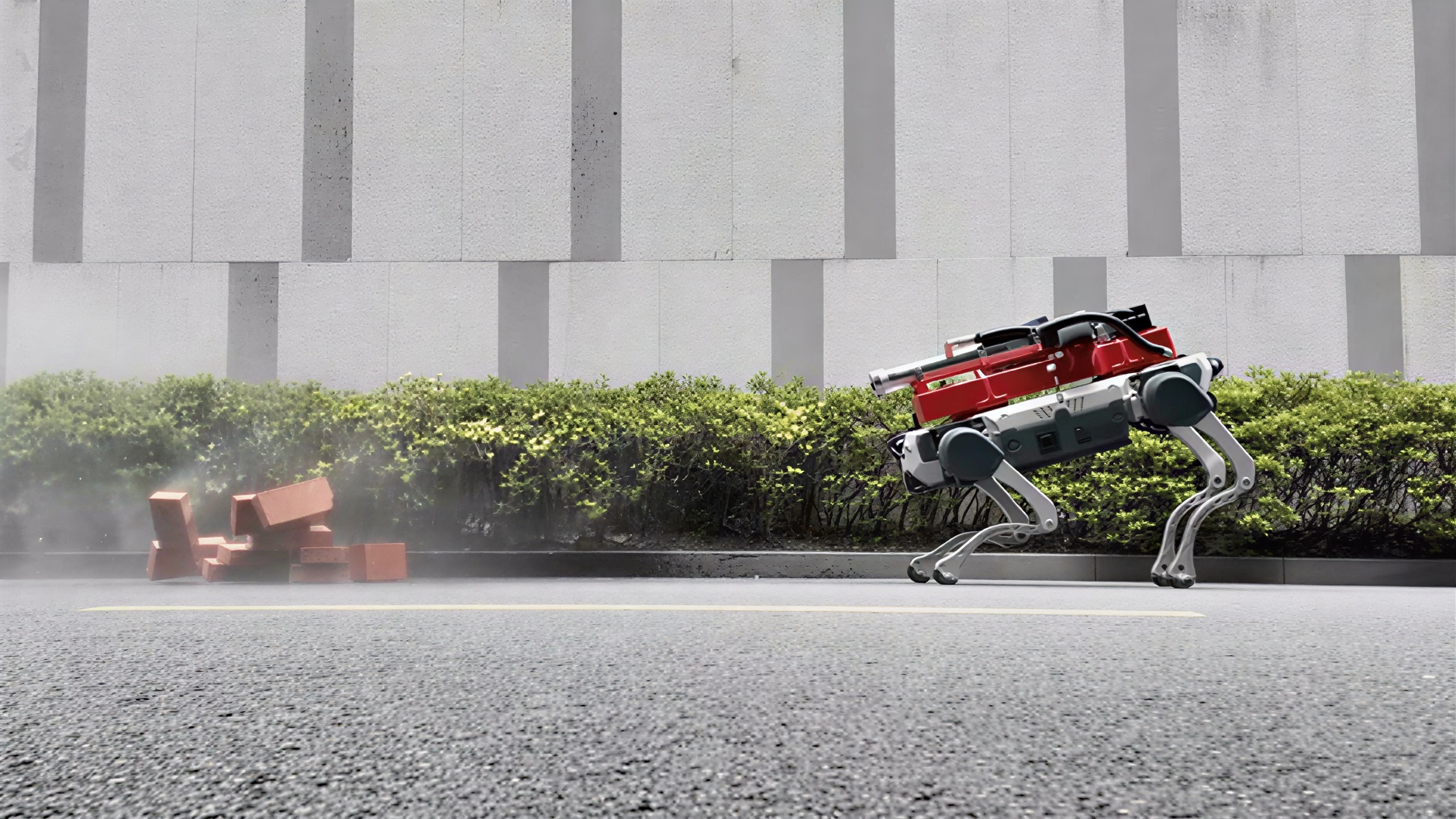
At the edge of an industrial fire zone, temperatures climb past what any bunker gear can handle. That’s exactly where DEEP Robotics wants its new Pulse Firefighting Robot Dog to step in — a four-legged machine built to suppress flames while human crews stay clear of the kill zone. This isn’t a concept render. The system has entered pilot integration with fire brigades as part of DEEP’s broader Emergency Firefighting Solution, according to a company press release reported by Yahoo Finance.
Precision Firepower on Four Legs
The pulse water gun trades brute-force hosing for surgical suppression at up to 60 meters.
Mounted with a high-pressure pulse water gun, the robot emits micron-level water mist rather than continuous streams. That matters in facilities packed with sensitive equipment — server rooms, substations, chemical storage — where flooding causes as much damage as the fire itself. Spray patterns and angles adjust remotely, and the wireless cannon works with water or foam, according to DEEP Robotics.
- Effective range: up to 60 meters via wireless water cannon
- Navigation: LiDAR and dual-spectrum cameras for smoke and low-light targeting
- Thermal protection: dual-layer spray cooling for near-heat operation
- Reference platform: X30 quadruped, roughly 50 kg, 85 kg payload, IP67-rated
- Operational temperature range: −20°C to 55°C
The robot dog doesn’t operate alone. Scout robots map the scene first, the pulse unit suppresses the fire, and logistics robots haul air cylinders and breaching tools — each platform handling a specialized role in a coordinated emergency workflow. Brand manager Qian Xiaoyu told Fire Apparatus Magazine that quadruped robots “are intended to replace firefighters in high-risk areas for tasks like detection, search for survivors, and hazardous material assessment.”
Where Steel Meets Its Limits
Fires above 500°C remain firmly in human territory — and independent benchmarks don’t exist yet.
Here’s the honest part. The robot cannot survive inside a fully developed fire core exceeding 500°C, as Fire Apparatus Magazine noted. Its real operational model is standoff suppression — attacking from outside or entering post-fire for reconnaissance. No third-party performance testing has been published. Pricing and broader commercial availability remain undisclosed.
Fully developed structure fires still belong to humans, for now. Alongside robotics, parallel advances in life-saving device technology are similarly narrowing the window of human exposure in extreme scenarios.
DEEP is building beyond the quadruped, too. The DR02 humanoid robot — IP66-rated, capable of sprinting while carrying fire extinguishers — targets chemical plant and industrial scenarios. Together, these platforms represent what DEEP calls a “steel and algorithms” defense system designed to absorb the deadliest risk from human crews.
Emergency response is quietly entering a phase where the most dangerous first steps get handed to machines — much like the robotic knee exoskeleton designed to reduce physical strain on workers in hazardous environments. Whether your local fire department adopts robot dogs next year or next decade, the direction is unmistakable.