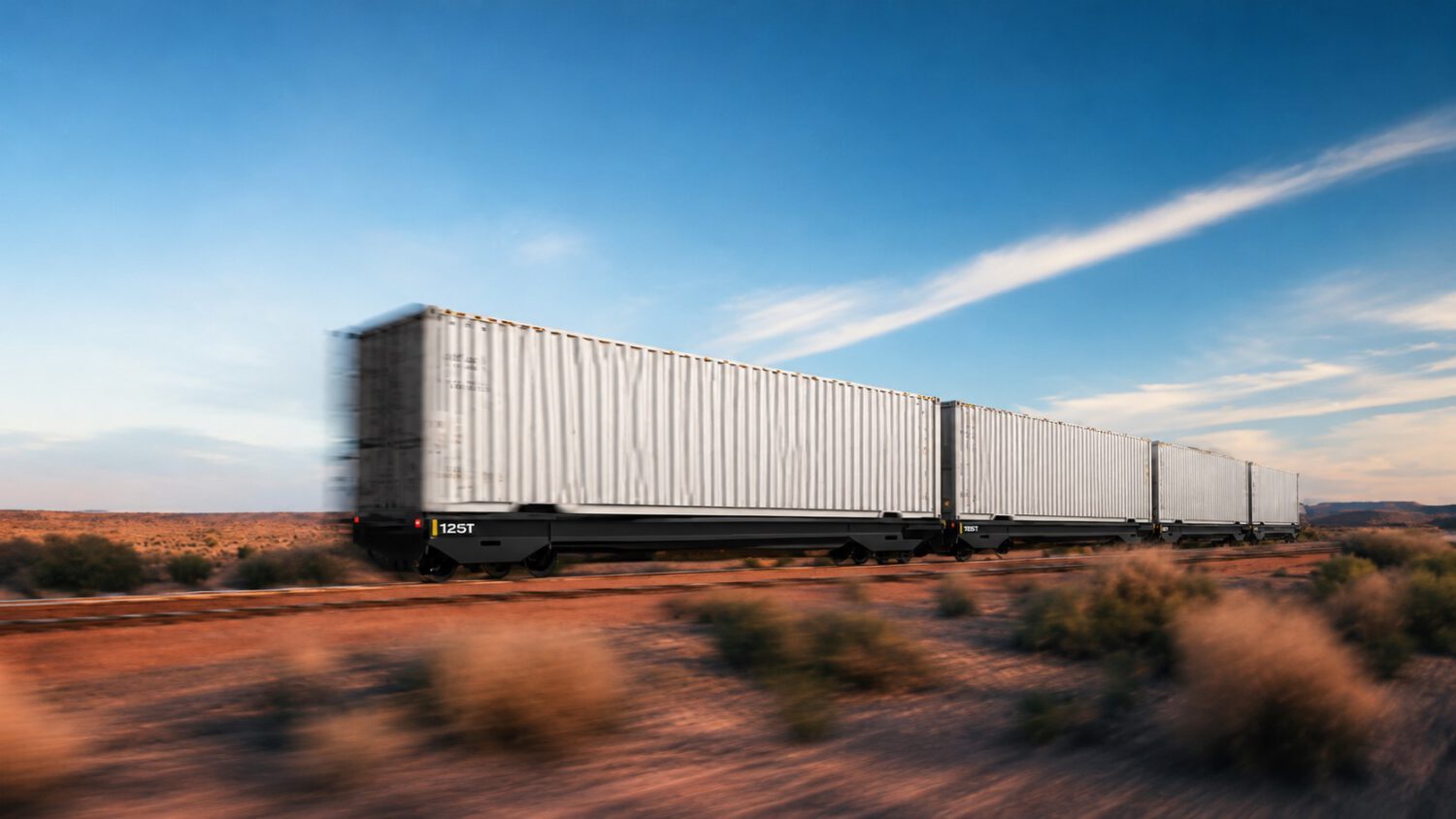
Parallel Systems is targeting shorter, lower-density freight routes, particularly those under 500 miles, that the company says are difficult for conventional rail to serve competitively. Conventional rail struggles on those routes: assembling a full consist, coordinating a locomotive, and serving lower-density corridors all work against the economics. Parallel Systems, founded in 2020 by former SpaceX engineer Matt Soule, is betting autonomous, battery-electric rail vehicles can change that equation. Investors just handed the company $100 million to prove it.
What the Panther Vehicle Actually Does
Parallel’s design places propulsion, batteries, and autonomous controls beneath standard shipping containers, removing the need for a dedicated locomotive under the company’s intended operating model.
Each Panther vehicle is self-propelled, carrying its own battery pack, motors, and autonomous control hardware integrated below a standard intermodal container. Vehicles can operate independently or coordinate into groups automatically, forming and splitting based on route and demand. That is the core structural departure from conventional rail: no single locomotive, no fixed consist, no waiting to assemble a full train before freight moves.
Because the Panther accepts standard shipping containers, the system can work within existing intermodal freight practices. Terminal and charging infrastructure may still require adaptation, but shippers would not need new container formats or different packaging.
Testing on Active Track Near Savannah
A 160-mile Georgia corridor, operated with Genesee and Wyoming, is where Parallel is stress-testing its safety controls before commercial payloads follow.
Parallel is currently running its system on approximately 160 miles of railroad in Georgia, near the Port of Savannah. Short-line railroad operator Genesee and Wyoming operates the track, and the Federal Railroad Administration is involved in oversight of the pilot, according to TechCrunch reporting and company statements. The company says the Georgia program is focused on verifying safety controls and operating procedures in real-world railroad conditions before commercial payload operations expand.
The Specs Parallel Claims, and What Remains Unverified
The 500-mile range figure is a company-stated design target; independent verification has not been reported.
Parallel says its Panther vehicles are designed to travel up to 500 miles on a single charge, according to the company. That figure should be read as a design target, not confirmed production performance. The company has not publicly disclosed a complete manufacturing timetable or how many vehicles the new financing will support.
Battery-electric propulsion would reduce direct emissions compared with diesel locomotives, but the net climate impact depends on electricity sources, battery production, and utilization rates. The available reporting does not fully assess those variables.
Who Is Backing the Bet
AVP led the $100M Series C, bringing Parallel’s total funding past $200 million after a $38 million Series B in 2025.
The Series C was led by AVP, with participation from Hillspire, Agility Global, Cobalt Capital, Anthos Capital, Congruent Ventures, Riot Capital, and Collaborative Fund. The round brings total funding to more than $200 million, according to the company. Parallel says the capital will fund manufacturing scale-up and acceleration into international markets.
CEO Matt Soule described the financing as a “major inflection point” for the company and the short-haul logistics industry, according to DC Velocity.
What Proof Actually Looks Like
The most meaningful validation will not come from a funding announcement; it will come from disclosed operational data on real freight corridors.
If the Georgia results hold, shippers moving goods under 500 miles could eventually have a rail option that better matches truck flexibility on cost and scheduling. Key numbers have not been publicly reported: payload capacity under load, energy consumption, uptime, turnaround time, and cost per container-mile. Until those figures are public, Parallel remains a well-funded, technically serious company with a specific thesis about freight rail, still in the process of proving it.