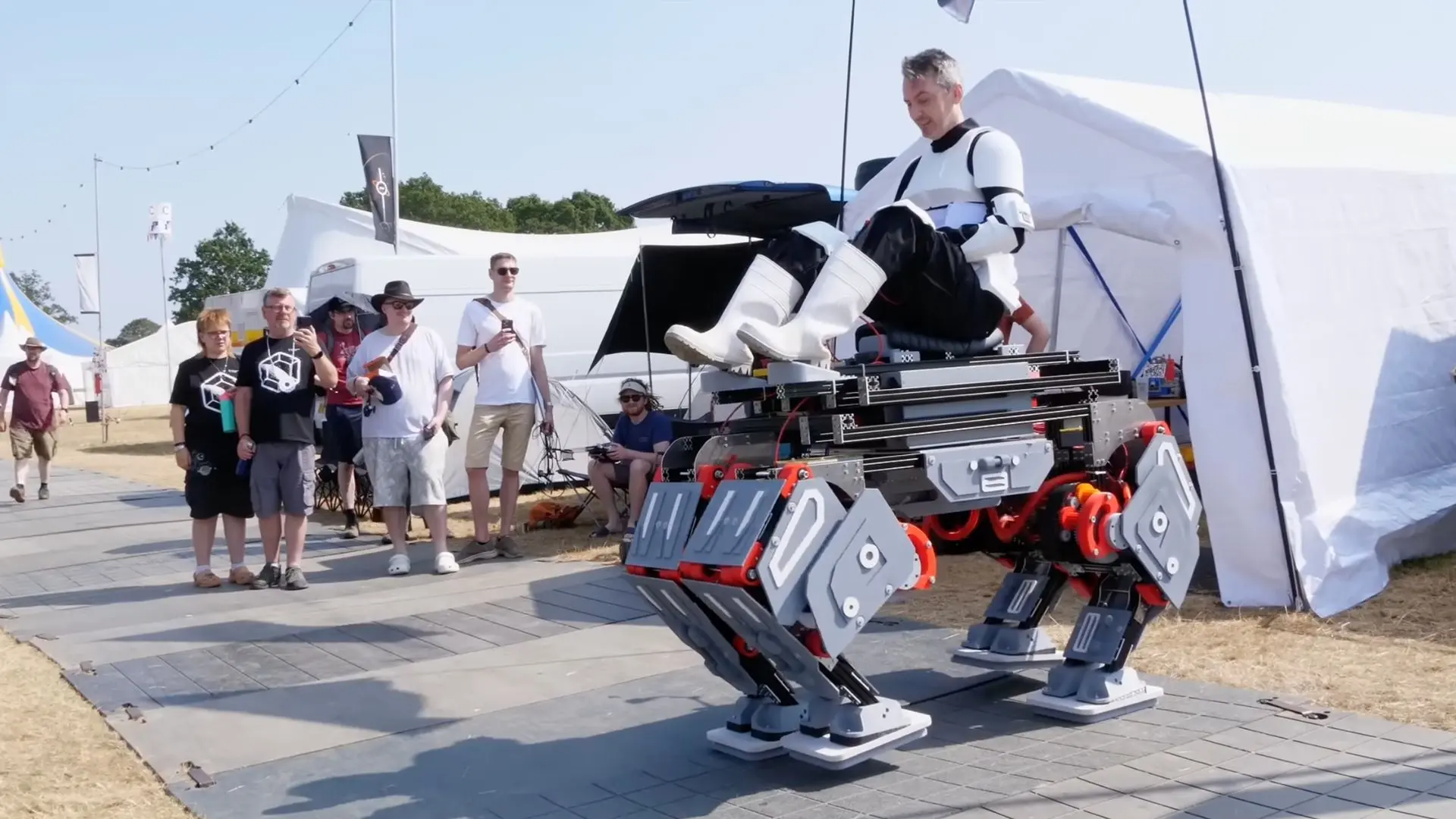
A walking machine carries an adult human across a festival field — mechanical legs churning in diagonal pairs, surprisingly stable, genuinely impressive. Then one foot drops into a hollow. The beans inside the foot shift. The sole curls. The whole machine rolls over. That’s the Mid-Walker: a legitimately clever rideable robotics quadruped built by YouTuber James Bruton, tested at Electromagnetic Field Camp, and honest about exactly where walking robots still fall apart.
How It Stays Upright on Flat Ground
The Mid-Walker’s diagonal gait is elegantly simple on level surfaces — and that simplicity is precisely what uneven terrain exposes.
The gait is mechanically linked — diagonal leg pairs move together, keeping two feet on the ground at all times. On flat surfaces, that’s stable enough to carry a rider without drama. The moment terrain changes height, the center of mass shifts unpredictably, and the machine starts working against itself. What feels solid on pavement becomes a genuine balance problem on grass.
Key design details, according to Interesting Engineering:
- Rider sits on a sliding seat mounted on desk-drawer sliders, driven by a 2-kilowatt motor controlled by an ODrive; a ball screw shifts weight toward whichever foot is carrying the load
- Earlier feet used hard materials with wedge-shaped plywood soles — lower motor load, but poor terrain conformity
- Bean bag–inspired feet built from ripstop kite fabric, dried beans, TPU-printed drawstrings, and 3D-printed 20-sided dice
Field testing confirmed what the design’s geometry practically guarantees. The bean bag feet performed better on flat ground, conforming and gripping reasonably well. In a hollow, the beans migrated, the sole curled inward, and the machine tipped. Overfilling the feet made it worse. Zip ties offered only partial improvement. The core problem remains: the foot needs to conform to terrain and stay rigid under load simultaneously — two things that don’t naturally coexist in the same material.
What Comes Next for the Mid-Walker
Bruton’s next design moves lean toward passive mechanical cleverness rather than adding more motors to an already complex system.
The iterative path forward includes BB pellets, vacuum-rigidifying feet, and ultimately passive two-way pivot ankles that self-level before mechanical clamps lock them in place. No test results exist yet for the ankle concept — that chapter is still being written, and it would be worth watching whether a passive mechanical solution can handle the load without a dedicated control system driving it.
What Bruton has built isn’t a product. It’s a public engineering log — searchable, forkable, and available for the maker community to modify and push further. The XRobots GitHub repository reportedly hosts the project files, though that claim isn’t independently confirmed by a primary source. Either way, the Mid-Walker’s failures are as instructive as its successes. In rideable robotics, the breakdowns tell you more than the highlight reel ever will.