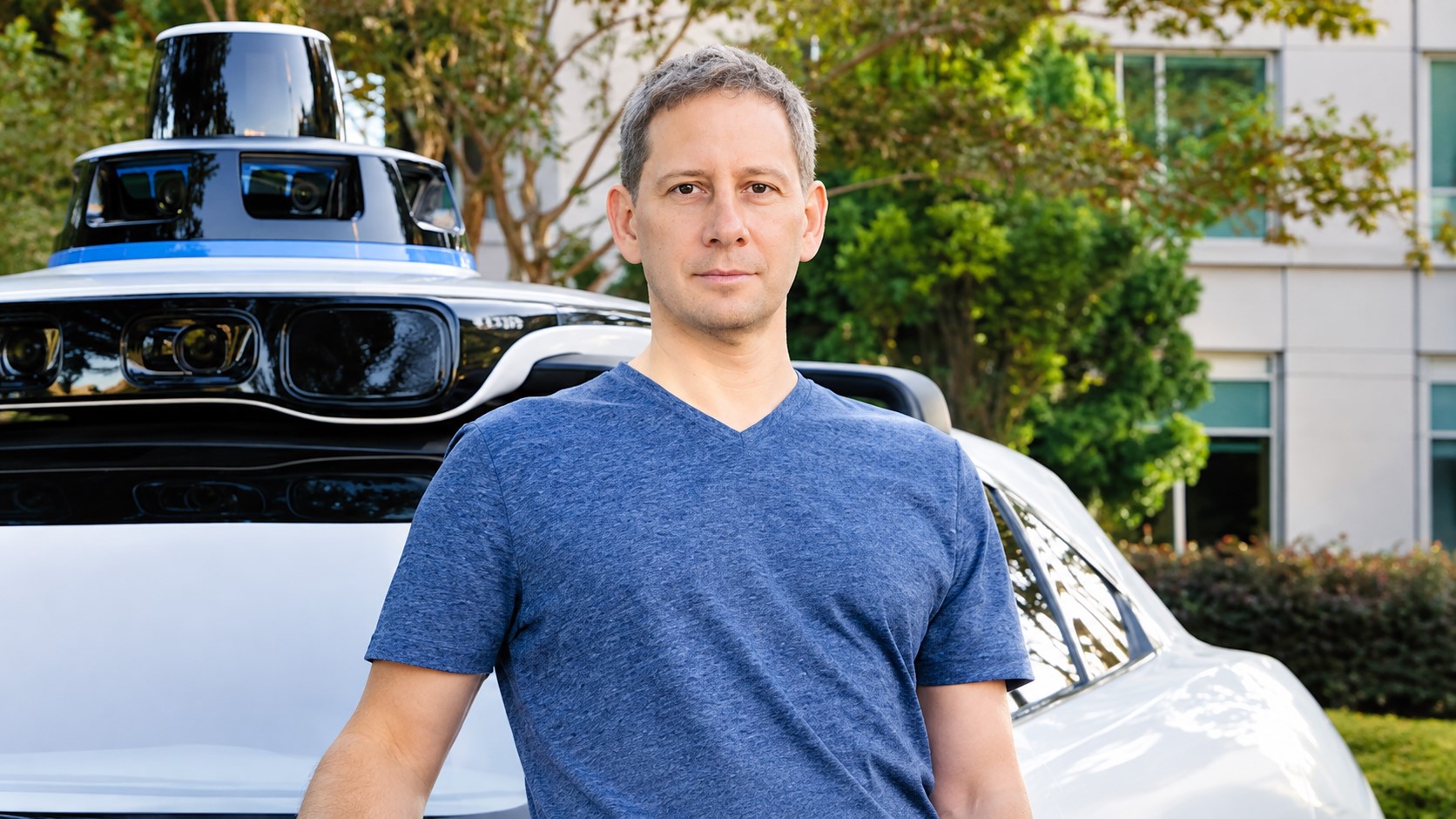
A dust storm rolls through Phoenix at dusk. The camera feed on a self-driving car sees almost nothing — a wall of brown static. Lidar cuts through the haze and picks out a pedestrian at the roadside, clear as a barcode scan. That scenario, drawn from real Waymo footage, anchored Waymo co-CEO Dmitri Dolgov’s Y Combinator Startup School talk in early August 2026. His argument was precise: cameras alone can build a solid driver-assist product, but they cannot reach the safety levels required for unsupervised robotaxis carrying passengers.
When Cameras Go Blind
Physics and failure modes explain why passive sensing hits a ceiling before true autonomy.
- Cameras are passive sensors. They degrade in darkness, glare, dust, and low contrast. Lidar actively measures 3D structure regardless of ambient light. Radar punches through fog, rain, and snow.
- A single leaf blocking a lens can stop a camera-only car cold. Dolgov showed a Waymo vehicle with an obstructed windshield that drove itself safely back to the depot using lidar and radar alone.
- Waymo fuses all three sensor types through separate encoders into one unified scene — what Dolgov calls “vastly superior to what you get with any one sensor.”
Each additional “nine” of safety — moving from 99% to 99.9% to 99.99% — costs roughly ten times more effort than the last. Camera-only delivers impressive early results, like a viral recipe video that looks flawless on your phone but collapses under actual restaurant-volume pressure. “Weak sensing just leads to a safety curve that flattens out way too early,” Dolgov said. Tesla removed radar in 2021 and ultrasonic sensors in 2022, committing entirely to camera-based “Tesla Vision.” Its Austin robotaxi operates within geo-fenced, speed-limited zones — a setup critics characterize as a demo rather than scaled autonomy.
The numbers sharpen the point. Waymo has logged around 220 million rider-only miles with 94% fewer serious-injury crashes than human drivers — roughly 17 times safer — and serves about 500,000 paid rides weekly across approximately 15 US cities. Tesla’s robotaxi has accumulated roughly 380,000 fully driverless miles over the past year, about what Waymo’s fleet logs in a single day. Tesla’s reported crash rate sits approximately three times worse than human drivers, according to reporting by Business Insider and Electrek, though Tesla disputes that its camera-only approach is structurally limited.
The Cost Argument Is Expiring
Sensor prices have fallen far enough that “lidar is too expensive” no longer holds up as a long-term objection.
Dolgov addressed the cost criticism directly. Waymo is on its sixth hardware generation, with sensor costs falling sharply each cycle. Betting against lidar based on today’s prices, he suggested, means betting against a number with “a fairly short shelf life.” The all-in vehicle cost reportedly approaches $60,000, narrowing the historic gap with a bare EV. Former Waymo CEO John Krafcik described Tesla as having “handcuffed its AI” by stripping sensors, leaving its cameras with effective acuity around “20/60 or 20/70” — a level that reportedly wouldn’t pass a standard DMV vision test.
This isn’t a software-iteration problem. It’s the difference between Silicon Valley’s “ship it and optimize later” ethos and the aerospace-grade engineering discipline that applies when two-ton vehicles move at highway speed with no human backup. Camera-only systems may remain structurally capped at supervised driver-assist while sensor-fused robotaxis steadily scale toward your daily commute — and regulators are beginning to ask the same questions Dolgov raised publicly.