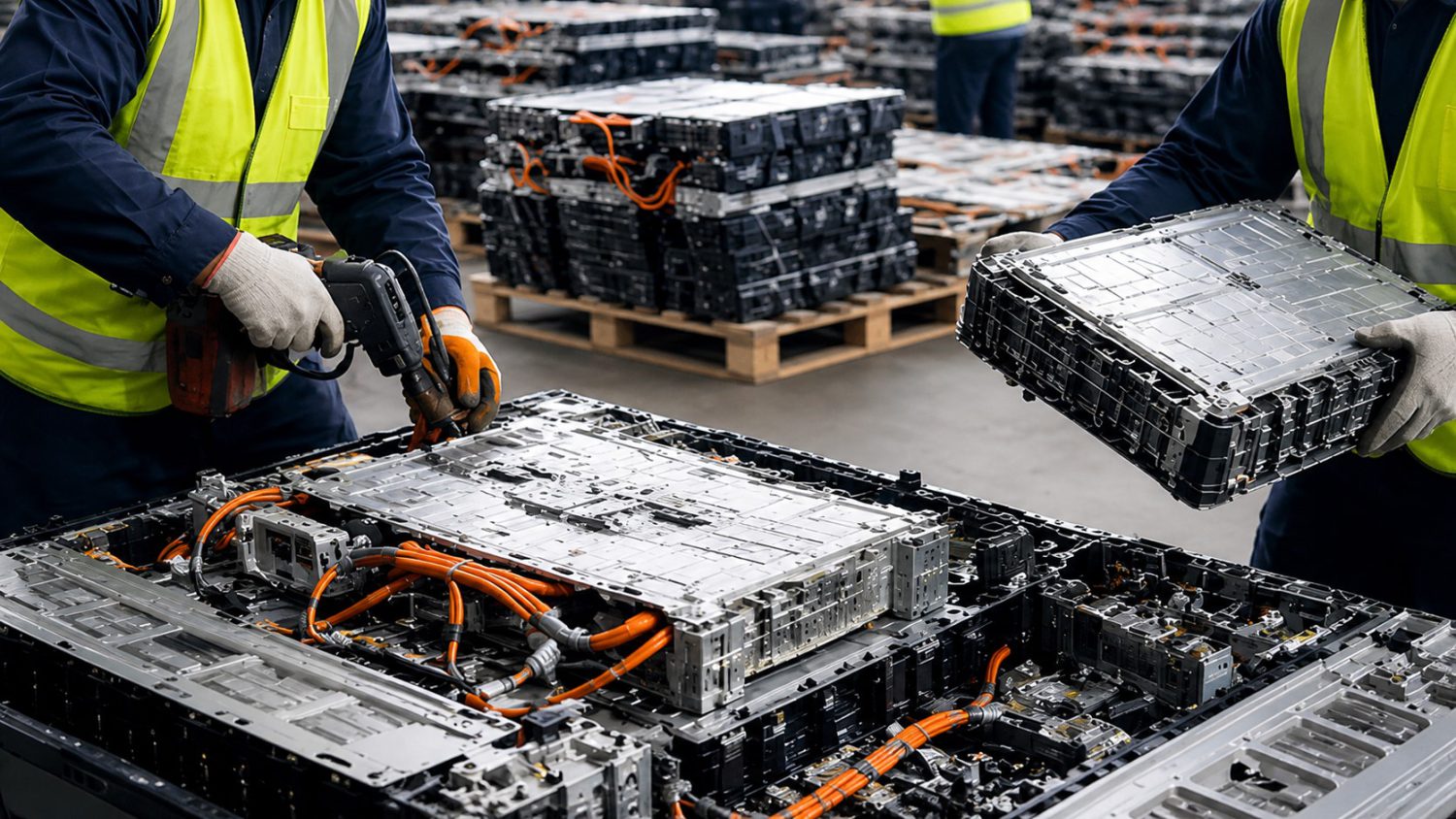
Your EV battery pack doesn’t die all at once. It fades quietly over years of charge cycles until the range drops enough that automakers and fleet operators pull the pack and send it to be shredded.
The electrodes inside are often still physically intact. They’re just coated in the wrong stuff.
Cornell University researchers published a method on June 9, 2026, in Energy & Environmental Science that treats those electrodes as repairable components rather than scrap metal, and early lab results are hard to ignore.
The timing matters. First-generation EVs are hitting end-of-automotive-life in growing numbers, critical mineral supply chains remain under pressure, and conventional battery recycling carries significant energy and cost burdens.
How the DEER Process Works
A chemical bath strips the capacity-killing crust from aging electrodes without touching the structure underneath.
Cornell’s method, called Direct Electrode-to-Electrode Regeneration (DEER), starts by opening spent lithium-ion cells and removing the NMC cathodes and graphite anodes while keeping them attached to their current collectors. Those harvested electrodes then go into a separate electrochemical cell containing a solvent called DMI (1,3-dimethyl-2-imidazolidinone).
DMI is a high-donor-number solvent chosen for a specific reason: it dissolves the solid electrolyte interphase (SEI), the passivating layer that builds up on electrodes over charge cycles and progressively chokes capacity. The solvent does this without damaging the underlying electrode structure.
“By using an electrochemical solution to regenerate their electrodes, the recycled batteries can regain up to 95% of their original power and last longer when reused, the researchers demonstrated,” according to Cornell University’s official news release.
Lab tests show the rebuilt cells also degrade more slowly. According to TechSpot’s coverage of the study, untreated degraded cells lose capacity at roughly 0.072% per cycle, while DEER-treated cells degrade at approximately 0.042% per cycle for around 800 cycles.
A second regeneration round can restore about 90% of original capacity, suggesting the electrodes may be refurbishable more than once.
One shortcut the team tried didn’t work: injecting DMI directly into intact cells produced poor results. Disassembly is required.
Cost Comparison Against Conventional Recycling
The numbers look promising, but they come with caveats that matter at industrial scale.
Conventional EV battery recycling shreds packs into what the industry calls black mass, then recovers metals through high-temperature smelting or chemical leaching. The electrode structure is destroyed entirely in the process.
Cornell’s analysis puts DEER-processed cells at roughly $15.25 per kilogram, compared to approximately $26.31 per kilogram for conventional pyrometallurgical or hydrometallurgical routes. That represents a potential 40 to 45% cost reduction under the studied assumptions.
The caveat is significant: DMI accounts for about 63% of DEER’s process cost in Cornell’s model, and the published figures do not include any savings from recovering and reusing the solvent. Industrial economics remain unproven.
Limits and the Road to Scale
Lab results are one thing; the gap between a promising process and an EV service bay is wide.
DEER works best when capacity loss is driven by SEI buildup. Batteries suffering from lithium inventory loss, cracked particles, or structural damage still require conventional recycling.
EV packs are typically retired at 70 to 80% of original capacity. Many electrodes at that point are structurally sound, making them reasonable DEER candidates.
As of mid-2026, the process remains at laboratory scale, with no commercial deployments, industrial pilot lines, or licensing agreements reported. Scaling up requires automated disassembly systems, solvent recovery infrastructure, and quality controls rigorous enough to meet automotive safety standards.
Multiple sources, including Cornell’s own framing, position DEER as a complement to conventional recycling, not a replacement.
Battery technology has a long history of closing the lab-to-industry gap more slowly than headlines suggest. What DEER offers, at minimum, is a credible alternative pathway: one where worn-out EV electrodes get a second life instead of a furnace, and where demand for freshly mined lithium, nickel, and cobalt faces at least some pressure in the right direction.