Notice a new camera surveillance bolted to a signal pole near your commute? A parking zone that now has different rules for delivery fleets versus personal vehicles? That is not routine maintenance. Cities are actively re-engineering streets as digital infrastructure designed to serve autonomous and connected vehicle fleets, and the changes are already underway in corridors near you.
The Instrumented Street
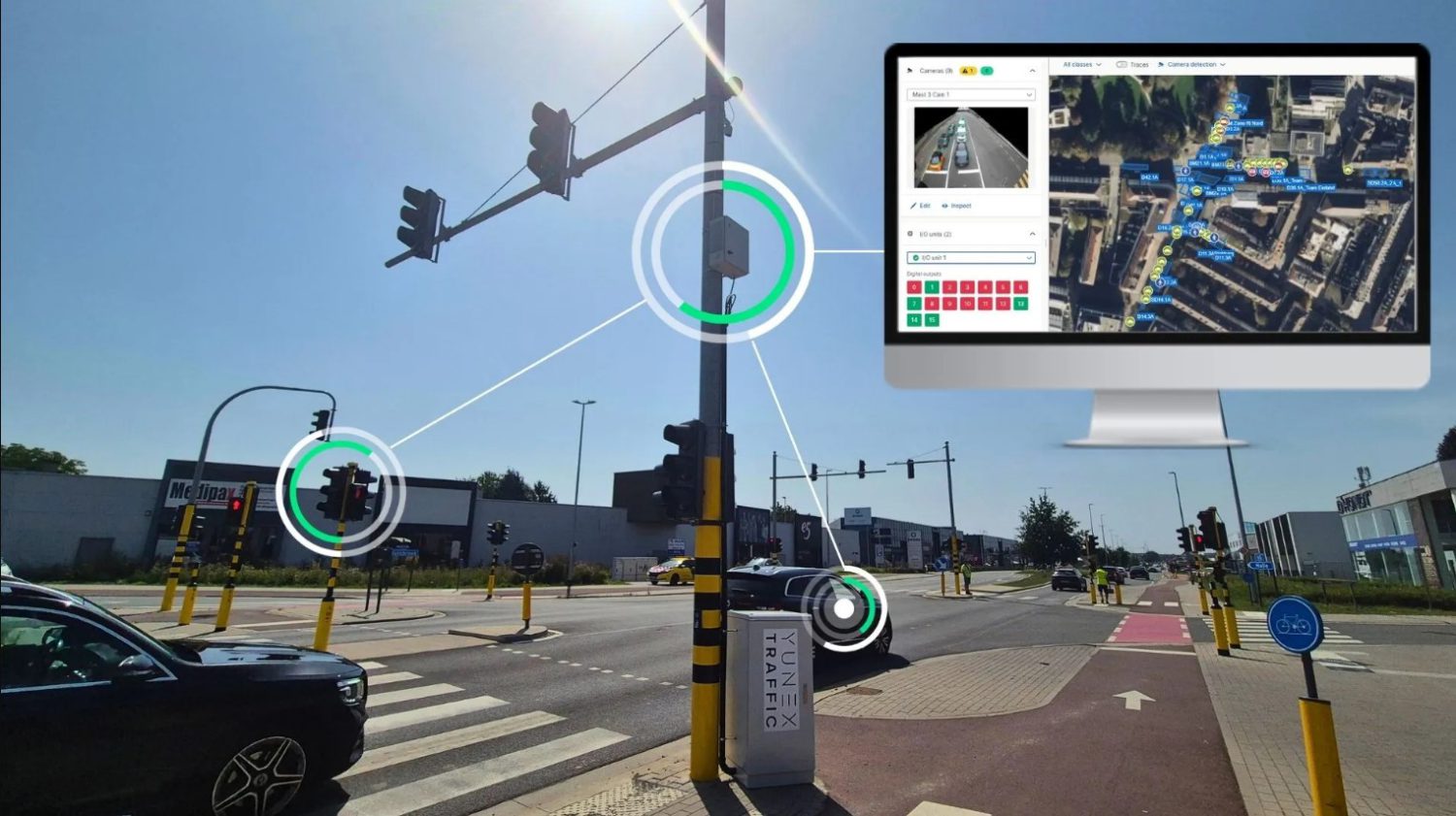
Smart intersections now track everything moving through them and share that data directly with vehicles.
Yunex Traffic’s awareAI platform uses AI video analytics to build what the company calls a real-time digital replica of intersection activity, continuously detecting and classifying pedestrians, cyclists, vehicles, and e-scooters, according to Yunex’s product documentation.
Its RSU2X roadside units then exchange that data directly with connected vehicles via V2X communications, effectively extending the car’s sensing range beyond what its own cameras can see.
A partnership between Yunex and Bosch goes further, pairing video sensors with roadside units. Those units broadcast C-V2X warnings about stopped vehicles, congestion, and pedestrians in crosswalks to connected drivers and autonomous systems, according to the Yunex-Bosch partnership announcement.
Through a separate partnership with HERE Technologies, Yunex feeds traffic light timing and count data into green-wave coordination tools. Connected vehicles can then adjust speed and catch continuous green lights along an entire corridor.
The street, in other words, is doing sensing work on behalf of the car. It is no longer simply directing traffic.
The Digitized Curb and the AV Lane
Curb space is becoming a metered, camera-monitored asset tied directly to dedicated AV corridor design.
Automotus mounts cameras on existing streetlight poles and logs the precise dwell time of every vehicle at the curb. Its platform invoices fleet operators by the minute, applies dynamic pricing based on local demand, and issues citations automatically without a human officer present, according to the company’s curb management and cities pages.
Automotus states its platform is “private by design,” blurring faces and capturing license plates only for payment and enforcement purposes. Even so, every curb stop becomes a timestamped, geo-tagged transaction record stored inside a proprietary system.
Automotus frames its pitch this way, according to its curb management page: “Our curb management solutions help cities, airports, fleets, and businesses increase revenue while creating more sustainable, equitable streets.”
Curb systems like this are not isolated products. A CAV corridor concept document describes smart curbs as integral elements of connected and automated vehicle corridors, explicitly tied to vehicles carrying certified AV/ADAS systems capable of continuous data sharing with surrounding infrastructure.
Policy literature on AV corridor design calls for dedicated or semi-dedicated lanes supported by roadside units, HD mapping, and V2X connectivity. The stated goal is to minimize interference from vehicles that are not networked into the system.
Connected fleets that qualify for green-wave signal priority move through these corridors more efficiently than ordinary drivers. Your commute, by design, is lower in the queue.
Tesla may be targeting paid Cybercab robotaxi rides in Austin. The infrastructure described above is what makes that kind of service operationally viable at scale. By the time a Cybercab picks up its first fare, the street beneath your commute may already have been rebuilt to receive it.