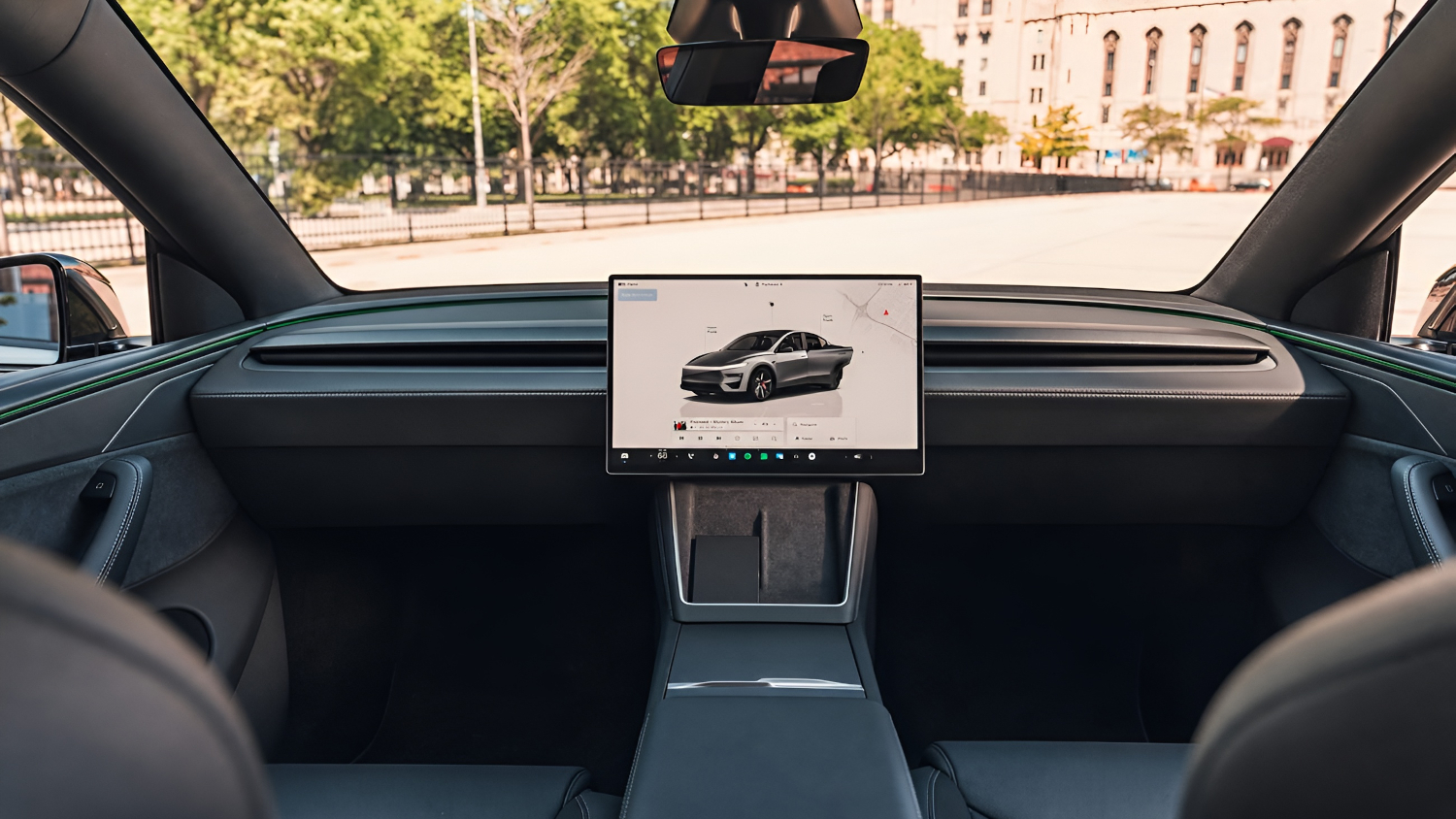
Speaking at the New York Times DealBook Summit, Elon Musk said Tesla plans to build an autonomous Model Y with no steering wheel and no pedals, designed to carry six or seven passengers. Tesla disclosed no launch date, price, production location, vehicle name, or answer to the most basic commercial question: will consumers be able to buy it, or will it operate within Tesla’s robotaxi fleet?
The Seat Count Is Not the Story
What makes the proposal unusual is not the passenger capacity but the complete removal of human controls.
Tesla already sells the long-wheelbase Model Y L in the United States, reported as listed from $61,990, with a six-seat configuration. The meaningful difference in Musk’s proposal is not how many people fit inside. It is the removal of human controls entirely, making the vehicle dependent on autonomous operation rather than offering autonomy as an option alongside conventional driving. Readers weighing the total costs of an electric vehicle may find those comparisons useful context.
Filling the Gap the Cybercab Leaves Open
Musk’s rationale rests on a passenger-capacity gap that the two-seat Cybercab cannot address.
Musk framed the proposal as a companion to the two-seat Cybercab, Tesla’s purpose-built autonomous vehicle. His reasoning: the Cybercab covers roughly 90% of passenger miles because most trips involve only one or two people, but families and larger groups need something bigger. That logic holds as far as it goes, since a two-seat robotaxi is a poor fit for a school run or an airport trip with luggage.
What Consumers Actually Want Is Complicated
Available research suggests consumers distinguish sharply between autonomous vehicles that retain human controls and those that do not.
Cox Automotive’s 2026 Autonomous Vehicle Study distinguishes between vehicles that retain human-driving capability alongside autonomy and Level 5 vehicles with no controls at all. Specific preference percentages cited in reporting on the study were not independently verifiable from accessible excerpts and should be treated as unconfirmed until the full study is reviewed.
A Regulatory Problem Tesla Has Not Solved Yet
Removing pedals raises specific compliance questions that Tesla has not yet resolved even for its existing two-seat Cybercab.
Federal Motor Vehicle Safety Standard 135 addresses service-brake performance with reference to a foot-operated brake. According to reporting from Electrek and EVXL, NHTSA has already opened an audit into how Tesla certified the Cybercab as compliant with that standard. A second pedal-free vehicle would face the same scrutiny.
One available regulatory route is the Part 555 exemption that Zoox pursued for its purpose-built autonomous vehicle. That pathway caps production at 2,500 units per year, a ceiling that is incompatible with any mass-market ambition.
The Contradiction Tesla Has Not Addressed
Tesla’s current robotaxi operations rely on vehicles that retain conventional controls, which raises a question the new proposal does not answer.
According to available reporting, Tesla’s robotaxi service has operated using vehicles that retain conventional controls. Removing those controls adds regulatory complexity and reduces versatility. No technical or economic justification for that trade-off appeared in Musk’s announcement, leaving the rationale for a fully control-free design publicly unsupported.
Where This Proposal Actually Stands
The vehicle Musk described is a stated plan with no production date, no price, and no regulatory clearance.
What Musk described at the DealBook Summit is a concept: unpriced, undated, and with no production vehicle shown or announced. It also depends on regulatory approval that Tesla has not yet secured for a comparable vehicle already under federal audit. The capacity problem the proposal addresses is genuine, since no two-seat vehicle can transport a family. Whether this design is the right solution, or the most practical one, remains entirely open.