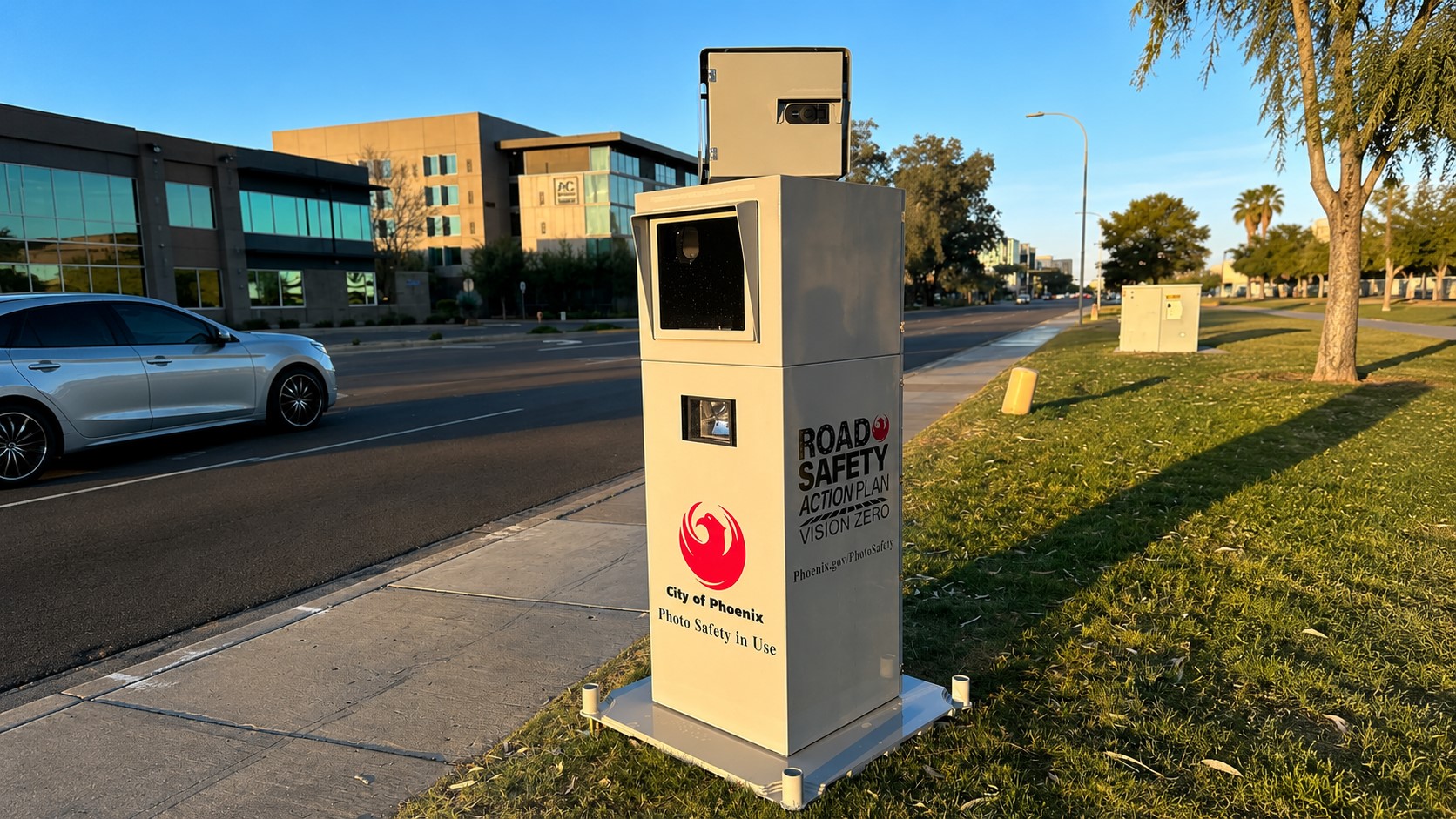
You’re doing 46 in a 35 on Camelback Road. No sirens. No flashing lights. Just a quiet radar unit clocking your speed and snapping your plate. Weeks later, a $250 citation arrives in your mailbox — not from a police officer, but from Verra Mobility, a private company the Phoenix City Council hired to run the entire operation. They install the cameras, process your images, mail your ticket, and if you ignore it, send someone to your front door to serve you in person. Welcome to automated enforcement, Phoenix-style.
What Triggers a Ticket – and What It Costs
The thresholds are specific, the locations keep moving, and the math is straightforward.
On standard corridors, cameras fire at 11 mph or more over the posted speed limit. In 15 mph school zones, that threshold drops to just 5 mph over. The base civil penalty runs around $250, consistent with Arizona civil traffic statute caps.
- 17 cameras citywide, rotating based on crash data and speed history
- Nine corridor cameras shift locations roughly every six months
- Eight school-zone cameras rotate weekly during the academic year
- Cameras activated February 23, 2026; citations began March 25, 2026, after a 30-day warning period
- Verra Mobility handles installation, operations, violation processing, mailing, and in-person service
Locations span Thunderbird Road, 32nd Street, 7th Street, Baseline Road, Bell Road, and several others across the city. Phoenix frames this as Vision Zero infrastructure — data-driven placement targeting corridors with the worst crash records.
According to the city’s published program materials, the initiative is “revenue neutral, meaning the city is not out to make money off this. It’s designed to pay for itself.” The contract pays Verra Mobility $3,000 per camera per month across all 17 units. A reported $20 per paid ticket also flows to the vendor — a structure consistent with how national photo-enforcement contracts are often written, though this specific figure has not been independently confirmed in public records.
Safety Program or Surveillance Franchise?
A model where vendor revenue scales directly with citation volume raises questions worth asking.
Arizona tried statewide freeway cameras before and removed them after significant public backlash. Now Phoenix is attempting a version of the same idea, this time with a vendor whose income scales with ticket volume — a structure critics argue misaligns enforcement incentives with public safety goals. Anecdotal community reports suggest that agents serving tickets in person have arrived resembling package delivery workers, though this has not been confirmed as official policy. What is confirmed: Verra Mobility necessarily handles your name, address, plate data, and violation images as part of routine operations.
If crash numbers drop, cities across the country will study this model closely. If they don’t, Phoenix will have handed a private company access to your personal data and a financial incentive to keep citations flowing — with little public benefit to show for it.