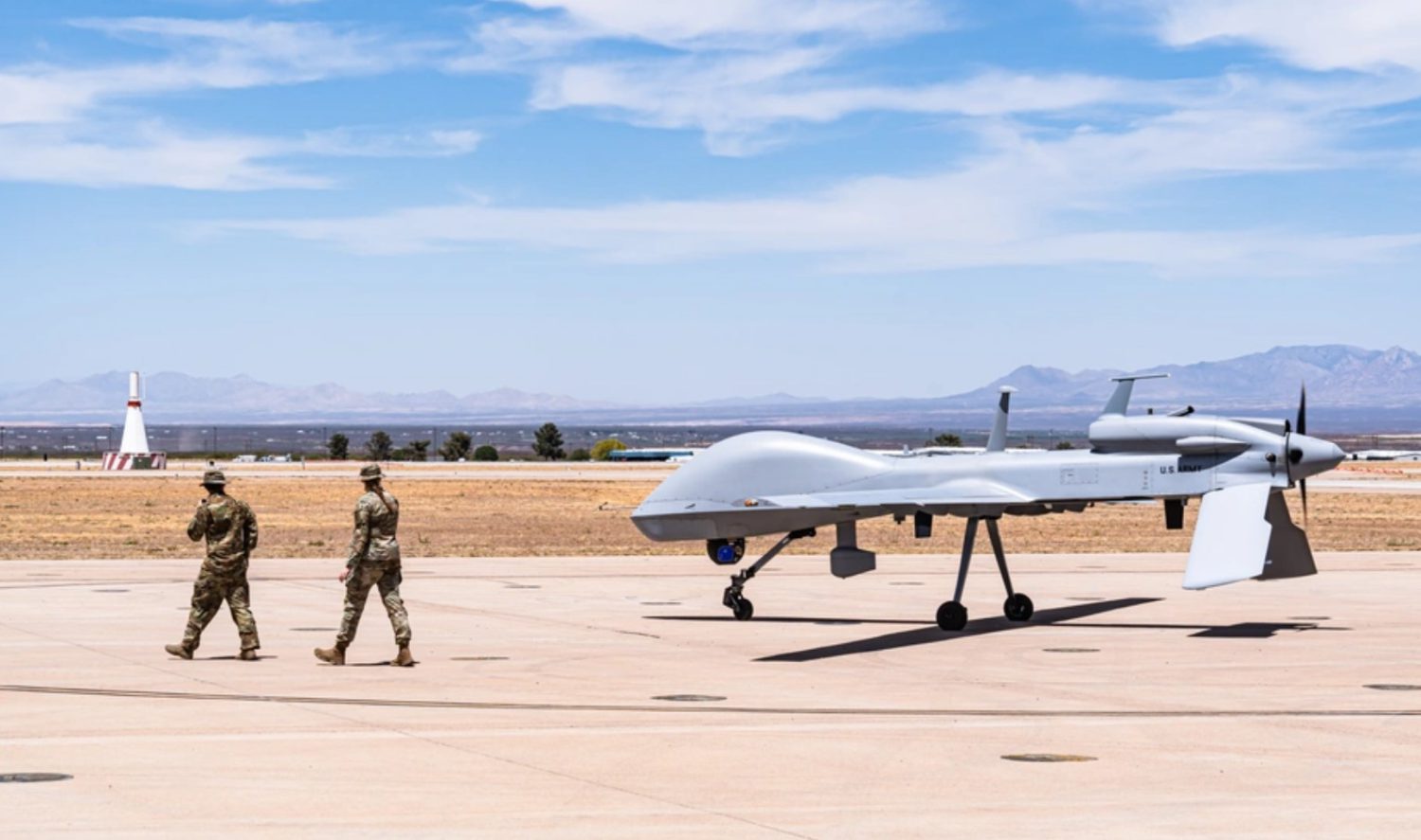
A military aircraft assessed by reporters as most likely an MQ-1 Predator has reportedly been conducting repeated flight circuits over the Arizona border communities of San Luis and Nogales. The MQ-1 is a drone associated with battlefield reconnaissance missions in Iraq and Afghanistan, not routine domestic operations. These flights have drawn comparisons to other covert digital monitoring efforts, including a surveillance app built by U.S. operatives to target foreign separatists.
Those flights reportedly fall under Operation Ardent Vanguard, a U.S. Northern Command mission. That mission implements a 2025 presidential directive requiring the military to assist the Department of Homeland Security with southern border security. What the aircraft collects, who controls that data, and whether any of it involves U.S. residents remain publicly unanswered questions.
What Was Observed
Reporters found a military aircraft making repeated circuits along Arizona’s southern border using a registration number with no public records attached.
Reporting by the Arizona Mirror found an aircraft flying repeated circuits along Arizona’s southern border. The aircraft used a deregistered registration number, and a Freedom of Information Act request to the Federal Aviation Administration returned no records for that registration, according to the Mirror.
The aircraft was assessed as most likely an MQ-1 Predator, though NORTHCOM declined to confirm the aircraft type or specific flight details, citing operational security.
According to the Tucson Sentinel, the aircraft is reportedly operated by the 1st Combat Aviation Brigade and 1st Aviation Regiment, both reportedly based at Fort Huachuca. Those units carry extensive overseas experience from operations in Iraq and Afghanistan.
What the Military Says, and What Remains Unknown
NORTHCOM denied conducting domestic surveillance but left key questions about sensors, data, and collection practices unanswered.
NORTHCOM stated that the border-security mission “does not conduct domestic surveillance” and that its personnel do not record, photograph, or surveil U.S. citizens. That statement did not address which sensors the aircraft carried, how long any collected data is retained, or which agency owns it.
Available reporting does not establish whether the aircraft carried wide-area imaging equipment, cell-site simulation technology capable of tracking mobile devices, or any weapons system.
Jay Stanley, a senior policy analyst with the ACLU’s Speech, Privacy and Technology Project, said the deployment raises serious concerns about military surveillance capabilities being “turned inward” on the United States, according to the Tucson Sentinel. Stanley said any meaningful oversight framework must address the purpose, geographic scope, duration, persistence, retention, and sharing of collected information , concerns echoed by documented cases of apps secretly tracking users without public knowledge.
DHS did not answer questions about data ownership, retention periods, or procedures designed to prevent incidental collection involving U.S. persons.
The Legal Question
Existing court precedents on aerial observation do not resolve whether persistent, wide-area military monitoring of civilian communities crosses a constitutional line.
Two 1986 Supreme Court decisions, California v. Ciraolo and Dow Chemical Co. v. United States, held that specific observations made from publicly navigable airspace did not require warrants in those circumstances. Both cases involved conventional aerial observation rather than persistent, automated monitoring systems.
A more recent precedent cuts closer to the current situation. In Leaders of a Beautiful Struggle v. Baltimore Police Department, the Fourth Circuit held that Baltimore’s wide-area aerial surveillance program constituted a warrantless search, because its imagery covering roughly 32 square miles per frame could reveal the full pattern of an individual’s movements over time.
The legal status of the Arizona flights cannot be determined from publicly available information. It depends on undisclosed facts: sensor type, collection scope, mission duration, data retention, and whether imagery or signals data has been shared with law enforcement.
What oversight applies to these flights, whether they are continuing, and whether either agency will address the questions that DHS and NORTHCOM declined to answer are matters the public record has not yet resolved.