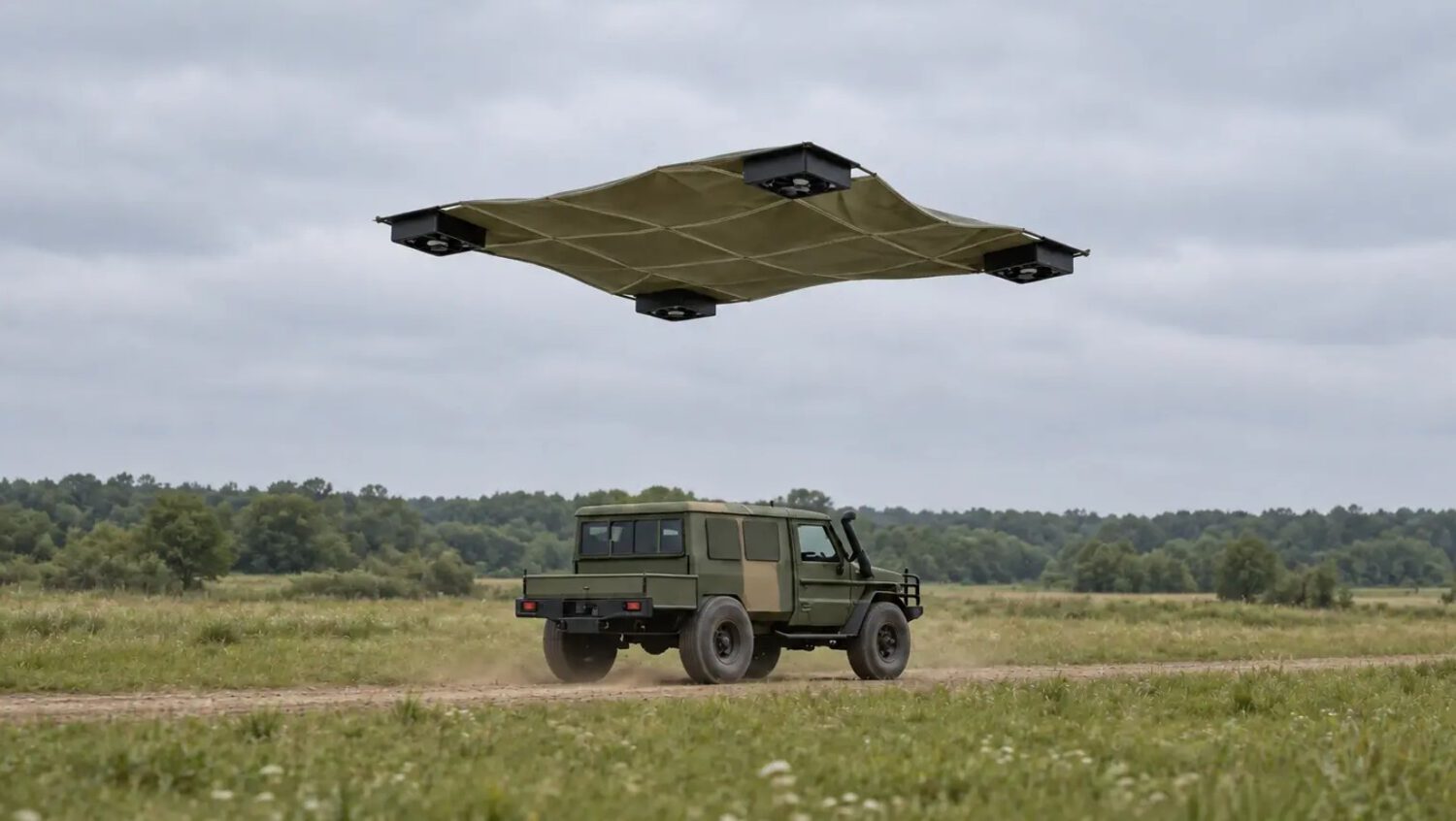
Static camouflage must be moved or repositioned to maintain coverage as a vehicle travels. Vigil Autonomy says its Air Cover platform solves that problem by maintaining overhead concealment autonomously during transit, targeting both thermal-infrared and synthetic-aperture radar signatures: two detection modalities that conventional visual camouflage does not address.
The Company Behind the System
Vigil Autonomy is a small Austin-based firm with roots in autonomy research and counter-drone work.
Vigil Autonomy describes itself as an Austin-based autonomy and counter-uncrewed-aircraft-systems company. Founder Matt Goodman’s public profile lists experience in computer vision, robotics, machine learning, and autonomous systems.
How the Platform Is Configured
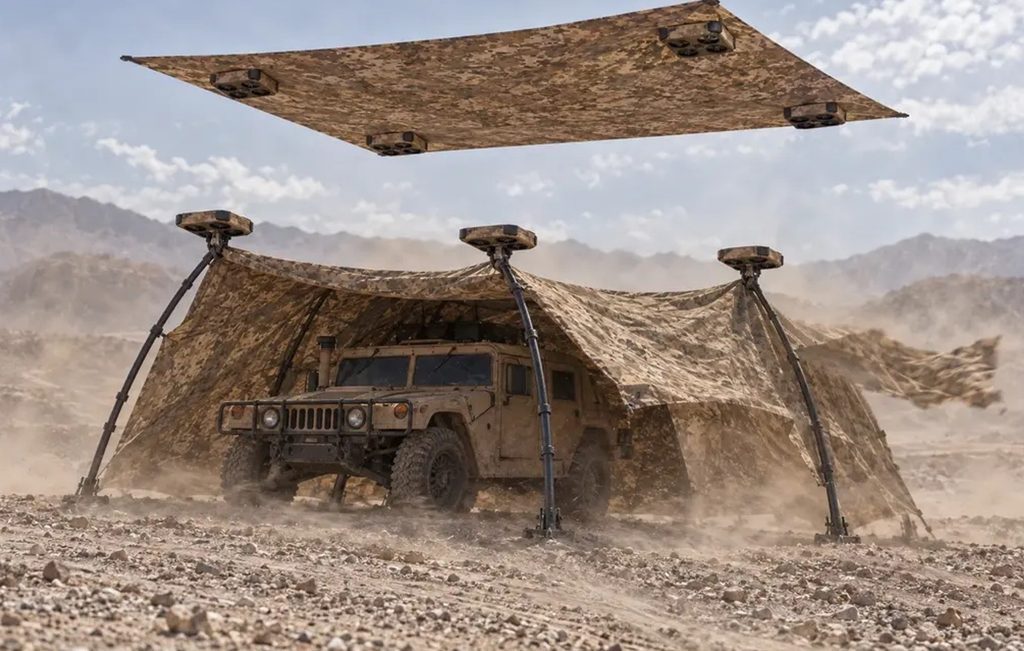
Air Cover flies low overhead and scales from individual soldiers to full vehicles.
According to the company, Air Cover operates at a maximum altitude of 10 meters, flying autonomously above the covered asset as it moves. Three configuration scales are listed: personal, unit, and vehicle, indicating a modular architecture rather than a single fixed-size canopy.
The Dual-Signature Problem
Heat signatures and radar returns are separate detection challenges that visual camouflage does not solve.
Thermal-infrared signature management concerns how a vehicle or person appears to heat-sensitive sensors. Synthetic-aperture radar management concerns how the target is detected or characterized by radar imaging. Air Cover is claimed to address both, though the company’s reviewed public materials provide no disclosed test data or performance measurements for either category.
Manufacturer Specifications
A 120-minute flight duration and 10-meter ceiling are cited by the company; neither figure has been independently confirmed.
Air Cover is rated for up to 120 minutes of autonomous flight and operates at or below 10 meters, according to the company. The reviewed public materials do not disclose the conditions under which those figures were measured, payload configuration, or wind tolerance.
Repositioning and Decoy Options
The canopy can reportedly transfer to another vehicle without being dismantled, and an active-lift decoy mode is listed.
The cover canopy can be repositioned or reassigned to a different vehicle without requiring disassembly, according to Vigil. An optional active-lift function supporting decoy operations is also listed; the reviewed public materials do not specify that decoy’s radar, thermal, or visual characteristics.
Potential Operational Value
Mobile persistent cover could reduce the labor burden of traditional camouflage, though no deployment data exists.
Autonomous persistent cover, if it performs as described, could reduce the burden of erecting, moving, and dismantling camouflage for logistics, resupply, and command vehicles. Vigil has not published quantified labor savings or deployment timelines.
What the Evidence Record Does Not Yet Show
No independent test results or third-party evaluations were identified in the reviewed public materials.
The reviewed materials omit payload capacity, covered footprint dimensions, navigation method, communications architecture, and weather ratings. Describing Air Cover as an independently validated operational capability is not supported by the available record; the more accurate framing is a company-stated, unverified design.
If the system performs as Vigil describes, it would mark a meaningful shift: camouflage that repositions itself rather than waiting for a crew to move it. That outcome remains prospective until field demonstrations or independent testing enter the public record.