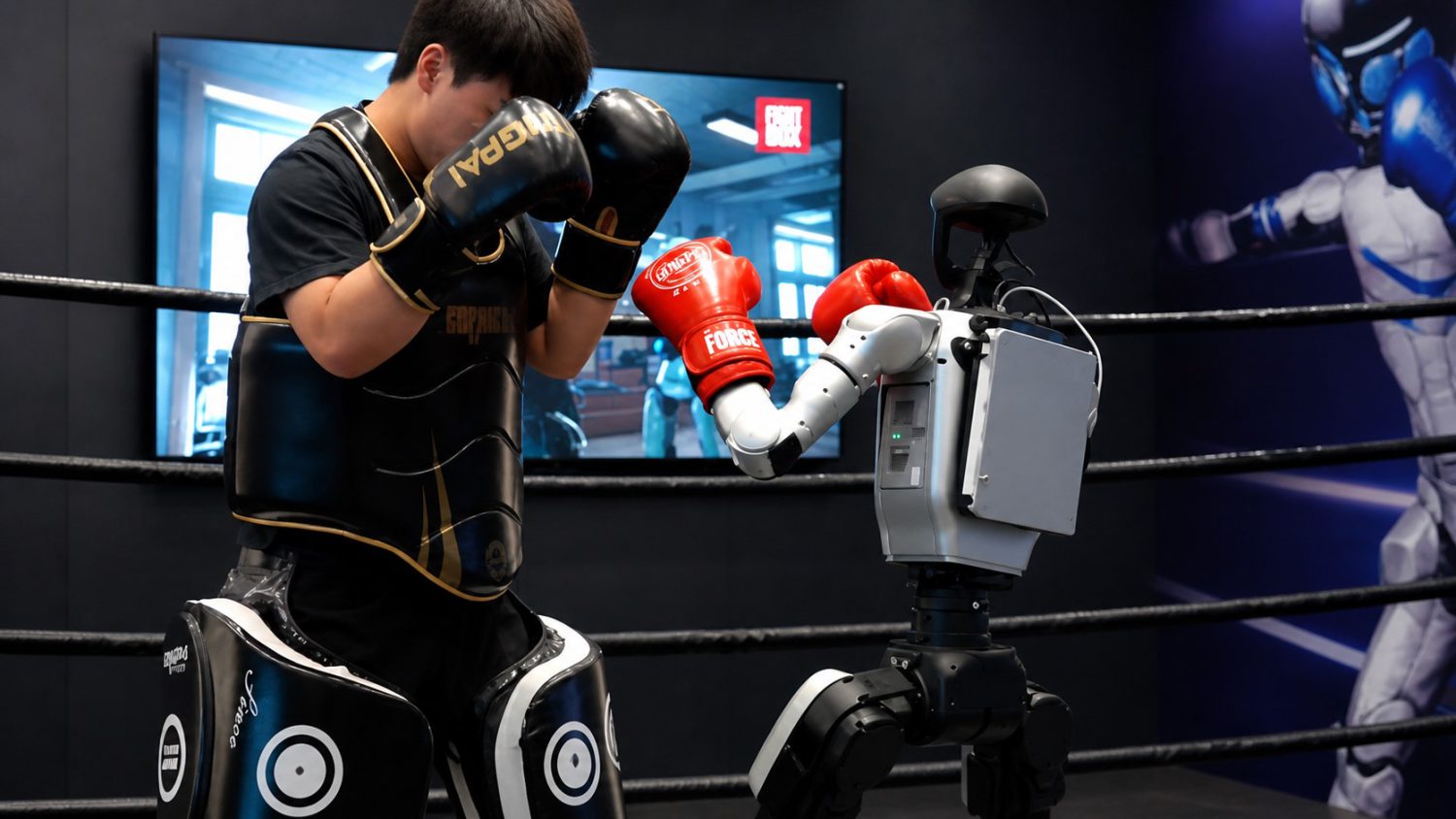
A humanoid robot throws a punch at a human opponent. No joystick. No VR headset. No operator hunched over a laptop off-camera. That’s what Unitree Robotics published around September 7, 2026 — footage of its G1 humanoid sparring with a human trainer, reportedly running an AI system called UnifoLM-X2-1.0. Unitree calls it “the world’s first real-time world-model–driven fully autonomous humanoid robot combat.” That’s their language. Independent verification doesn’t exist yet, and that gap matters more than the punches.
How the AI Actually Works
UnifoLM-X2-1.0 doesn’t just react to what it sees — it forecasts what comes next, then moves.
Standard robot control is reactive: sensor sees thing, system responds. UnifoLM-X2-1.0 supposedly works differently. According to Unitree, this “world-action foundation model” continuously forecasts near-future states — where the opponent’s strike is heading, how the robot’s balance will shift — and uses those predictions to plan motion before contact happens. It builds on UnifoLM-WMA-0, an open-source video-diffusion model trained on the Open-X dataset plus Unitree’s proprietary data. The result, purportedly running hundreds of prediction cycles per second according to one third-party technical breakdown, is what makes the sparring look fluid rather than mechanical. No independent latency benchmarks have been published.
Here’s what you’re actually watching in the video:
- The G1 adjusts stance and footwork as the human closes distance
- It dodges incoming strikes with torso and head movements
- It lands counters — punches and kicks — timed to the opponent’s motion
- On-screen overlays display predicted future trajectories, the model apparently forecasting the bout before executing
Most tellingly, console logs visible in the footage show commands like OBS/replan and env.step, suggesting AI processing may be running offboard on a separate machine rather than fully onboard the robot.
Unitree claims UnifoLM-X2-1.0 “breaks through world-action foundation models’ bottlenecks in instant planning, decision-making, and dynamic interactive execution.” That’s straight from their promotional materials — not an independent assessment.
The Honest Caveat
“Fully autonomous” is doing a lot of heavy lifting here, and the fine print hasn’t been published.
Previous humanoid combat demos relied on human operators using VR headsets or gamepads. Unitree drops the visible operator — and that is a real, substantive difference. But those console log commands raise a legitimate question: is the full model running onboard the G1, or is sensor data streaming to an external computer that sends instructions back? No technical white paper, architecture disclosure, or hardware specs clarify this. Until that changes, “fully autonomous” carries an asterisk worth noting.
Autonomous combat as a stress test makes technical sense — this is the robotics equivalent of training a model on every chess game ever played and then putting it against a grandmaster. The underlying capability matters more than the specific application. That said, the leap from sparring success to reliably handling factory floor collisions remains speculative; no published transfer study or safety certification backs that claim. Competitors like XPeng’s IRON are entering production while Tesla Optimus continues to slip timelines, underscoring that humanoid development is accelerating across the board, with different companies betting on different benchmarks.
Unitree frames this as a testbed, not a product — a position that may well be genuine, though it’s also a convenient framing. Existing workplace safety and robotics regulations may apply indirectly, but no framework specifically governs autonomous humanoid physical interaction yet. The most important question isn’t whether the G1 can fight — it’s who decides when, where, and against whom it does.