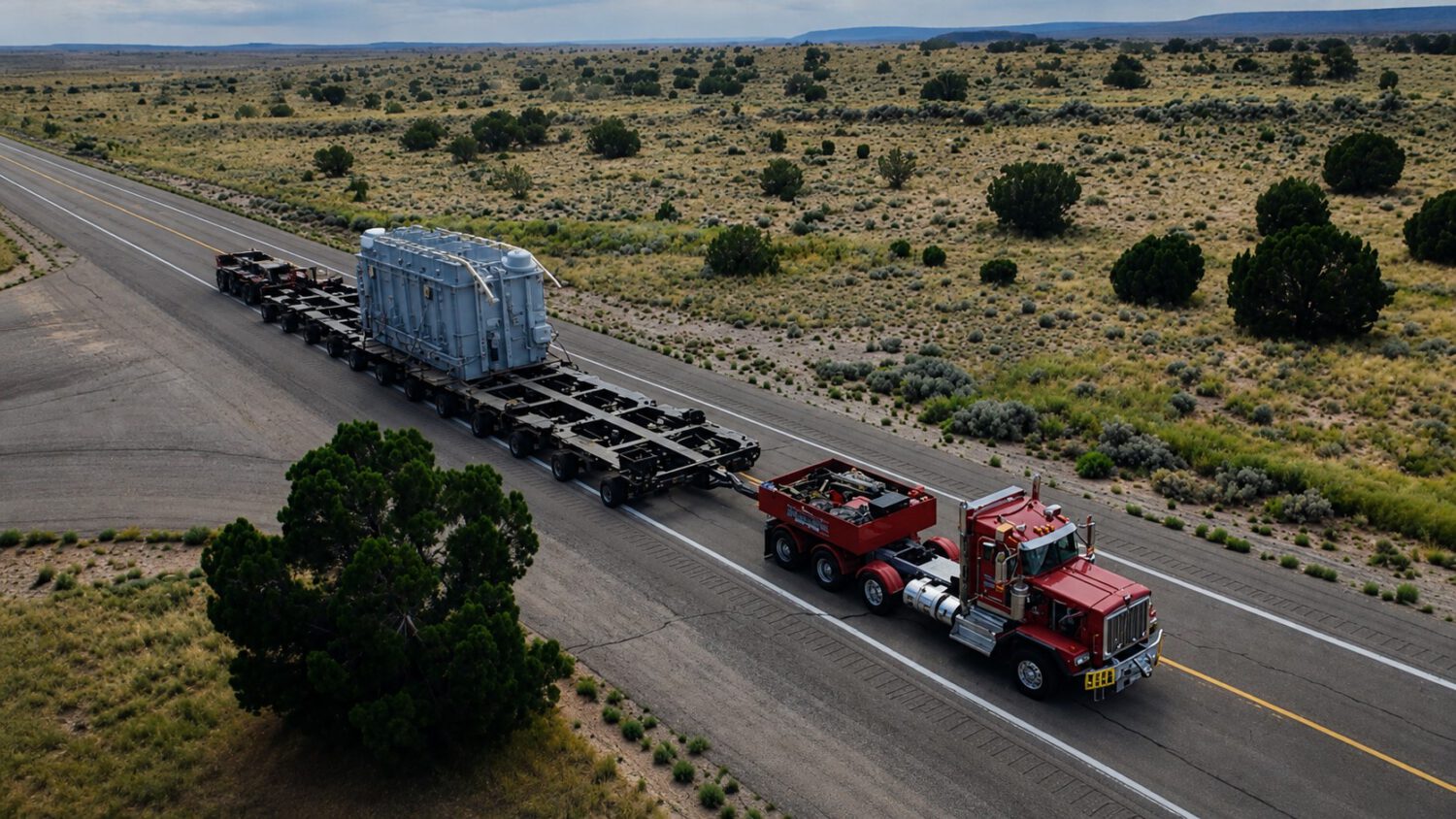
Since June 3, 2026, more than $110 million in data-center equipment has disappeared from U.S. highways, according to NBC News and industry investigators. These are not opportunistic roadside grabs: they are coordinated, digitally enabled operations targeting the physical supply chain of the AI buildout.
How the Heists Work
From phishing emails to highway ambushes, criminals are hitting AI freight at every weak point in the logistics chain.
The attack chain typically begins at a keyboard. Criminal networks reportedly phish freight broker or carrier accounts to access shipment manifests, pickup schedules, and carrier credentials, turning routine logistics software into a precise map of what is moving and when.
Armed with that data, they impersonate legitimate transportation companies or redirect authentic shipments using fraudulent paperwork. At pickup, a fake carrier can look indistinguishable from a real one.
In at least two California incidents, vehicles intentionally rammed security escort cars before the cargo truck was driven away. Private cargo-theft investigator Gerardo Pachuca told NBC News: “The accident was not an accident.”
At least one case reportedly involved GPS and beacon spoofing, with false coordinates broadcast to make a stolen trailer appear to be traveling normally and delay law enforcement response. Investigators also suspect driver involvement in some incidents, though specific attributions remain under investigation.
What Gets Stolen and Where It Goes
A single trailer can carry tens of millions in AI infrastructure, and investigators believe most stolen loads eventually leave the country.
The cargo profile reads like a data-center shopping list: complete servers, memory modules, storage drives, routers, fiber-optic and copper cabling, custom power equipment, and in some cases Bitcoin-mining hardware. AI-focused server shipments can also contain high-value accelerators, though the available reporting does not confirm specific GPU models were present in every theft.
The individual incidents are staggering in scale. A Reno theft reportedly involved approximately $38 million in equipment. A trailer bound for Fayetteville, Georgia, disappeared with roughly $13 million in server gear. Another shipment of server-rack components headed to Texas was intercepted for approximately $10 million, and a separate Mojave Desert-area theft accounted for around $13 million more.
Reno was already a known corridor for high-value technology cargo theft. Fortune reported roughly $15 million in semiconductors and Apple products stolen there in July 2025.
Keith Lewis of Verisk CargoNet described the cargo as “pure gold bars,” according to Tom’s Hardware. Server equipment is extraordinarily valuable, compact relative to its price, and in high demand as hyperscalers race to build AI infrastructure.
Law enforcement officials reportedly believe some stolen equipment is being acquired by entities in countries subject to U.S. AI-export controls, including China. The available reporting does not establish that specific organizations ordered any particular theft. Scott Cornell of TAPA Americas estimated that roughly six or seven of every 10 stolen cargo shipments ultimately go overseas, a figure that covers stolen cargo broadly rather than data-center hardware alone. Verified Carrier separately linked suspicious U.S. cargo theft activity to India, Uzbekistan, Pakistan, Colombia, and Moldova.
The deeper problem is structural. Every handoff in the freight ecosystem, from broker portals and carrier credentials to driver onboarding and delivery verification, represents an attack surface that organized networks are actively exploiting. Logistics providers will likely face mounting pressure to harden each of those handoff points. The physical infrastructure of the AI economy is vulnerable at the most ordinary logistical chokepoints. The threat is not inside the data center. It is somewhere on a highway in the dark.