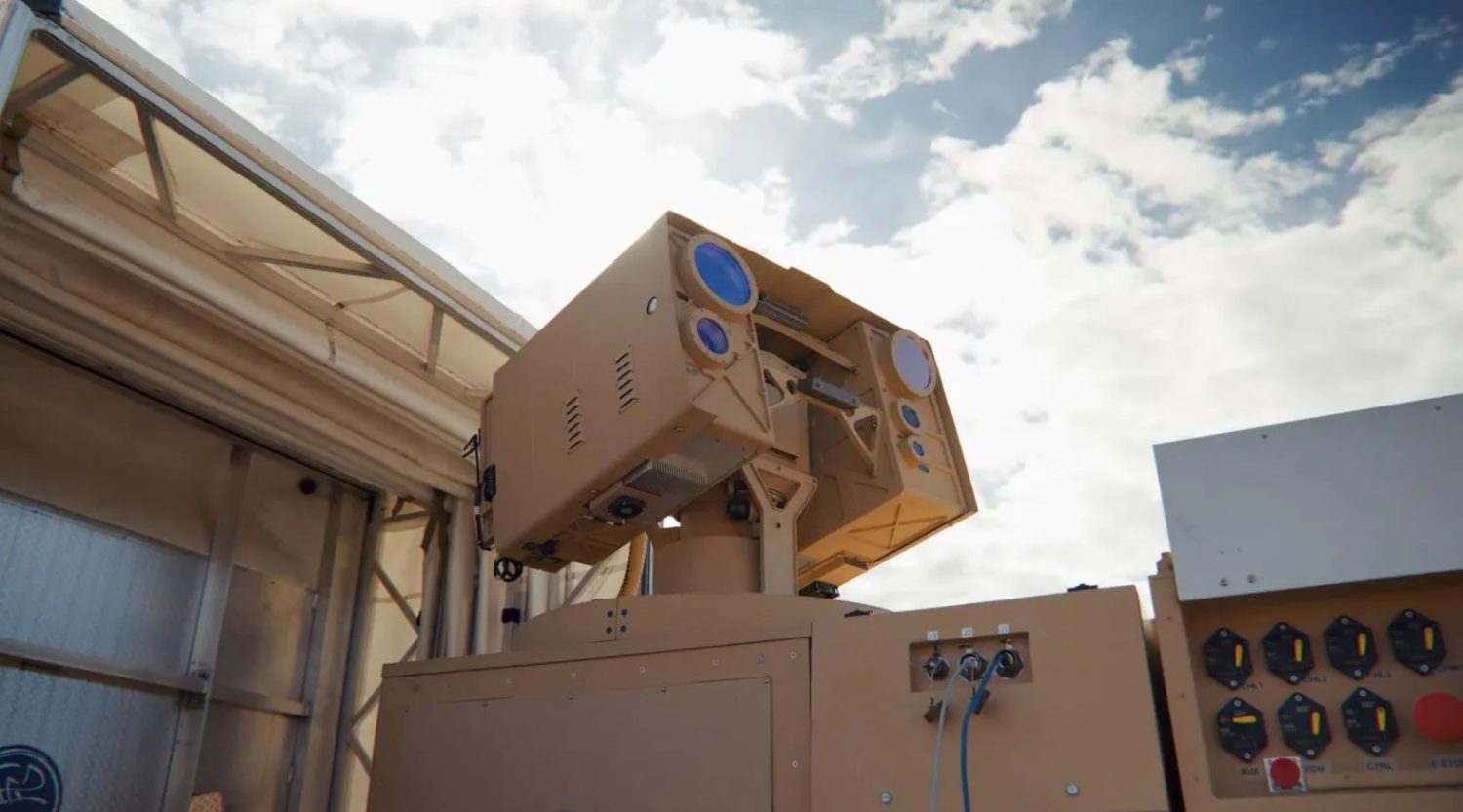
Roughly 1,000 cartel drones probe the U.S.–Mexico border every month. Surveillance runs. Route-clearing. The occasional armed payload. For years, the military’s best answer was jamming — knock a drone offline, watch it fly home, repeat tomorrow. Then, on August 25, 2026, a soldier in the Rio Grande Valley pointed something different at the sky. Within two weeks, drone activity in that sector reportedly dropped 75% — the first operational laser downing of cartel drones on U.S. soil. The technology joins a growing arsenal of advanced weapons like hypersonic missiles reshaping modern defense.
Xbox Controller, Invisible Beam, Melted Battery
Forget the Hollywood death ray — what you actually get is a truck, a tablet display, and a controller you’d recognize from your living room.
The LOCUST system from AeroVironment looks less like a sci-fi weapon and more like a tech demo from a Cyberpunk 2077 trailer — a vehicle-mounted beam director, control systems inside the cab, and an Xbox controller to steer the sensor and lock onto a target. AeroVironment’s product literature describes the system as scalable around 30 kilowatts, with AI-enabled targeting via its AV_Halo PINPOINT software. No visible beam. No explosion. A brief flash, and then the drone falls — recovered with a damaged propeller and a missing battery. Surgical. Fast. Permanent. It looks less like a real-world Star Wars weapon and more like a tech demo.
- Three drones went down on August 25–26, 2026.
- Eleven total were destroyed by laser over approximately ten days.
- Roughly 300 cartel-linked drones have been stopped by all methods since January 2026, according to CBS News reporting.
- Each laser shot costs approximately $3–$5 — compare that with the hundreds of thousands a missile intercept runs.
In early September 2026, the Army awarded AeroVironment a $464.8 million contract for dozens of LOCUST X3 systems integrated onto Joint Light Tactical Vehicles, marking the first production contract for a high-energy laser weapon system in U.S. military history.
“That tool can’t be used again against you,” Army Col. Robert Felicio told CBS News, framing the core difference between jamming and destruction. Jam a drone, and it flies again tomorrow. Burn out its battery housing, and the math changes permanently.
That math matters financially too. Army Lt. Col. Ray Richards told CBS News that a 75% cut in cartel surveillance capability ripples directly into smuggling revenue — because those drones dictate which routes move product and which routes get hit.
Between 2021 and 2025, DHS-funded researchers at the National Counterterrorism Innovation, Technology, and Education Center documented 221 armed cartel drone incidents inside Mexico, resulting in 77 fatalities. These aren’t hobbyist quadcopters.
Don’t Call It a Silver Bullet
Every powerful tool has a weather report attached, and this one is no different.
Rain degrades the beam. So does fog. Vapor. Anything that scatters light at scale. Earlier testing forced the FAA to briefly shut down El Paso International Airport after a coordination gap surfaced — regulators warned that a misdirected laser hitting a civilian aircraft would be catastrophic. Col. Felicio says his unit now coordinates with the FAA before and after every engagement. Navy Admiral Daryl Caudle argued in a Washington Post opinion piece that lasers deserve more investment as a cost-effective tool — not a replacement for everything else. Think of it less like a cheat code and more like a very precise utility knife: indispensable in the right conditions, limited when the weather turns against you.
Military officials also acknowledged the 75% drop might partly reflect cartels rerouting rather than retreating — the timing lines up, but correlation isn’t causation. If the reduction holds and scales across sectors, cartels face a stark choice: abandon drone reconnaissance entirely, or flood the zone with cheap expendable platforms faster than a laser can cycle through targets. Either answer rewrites the border security equation — and neither one comes free.