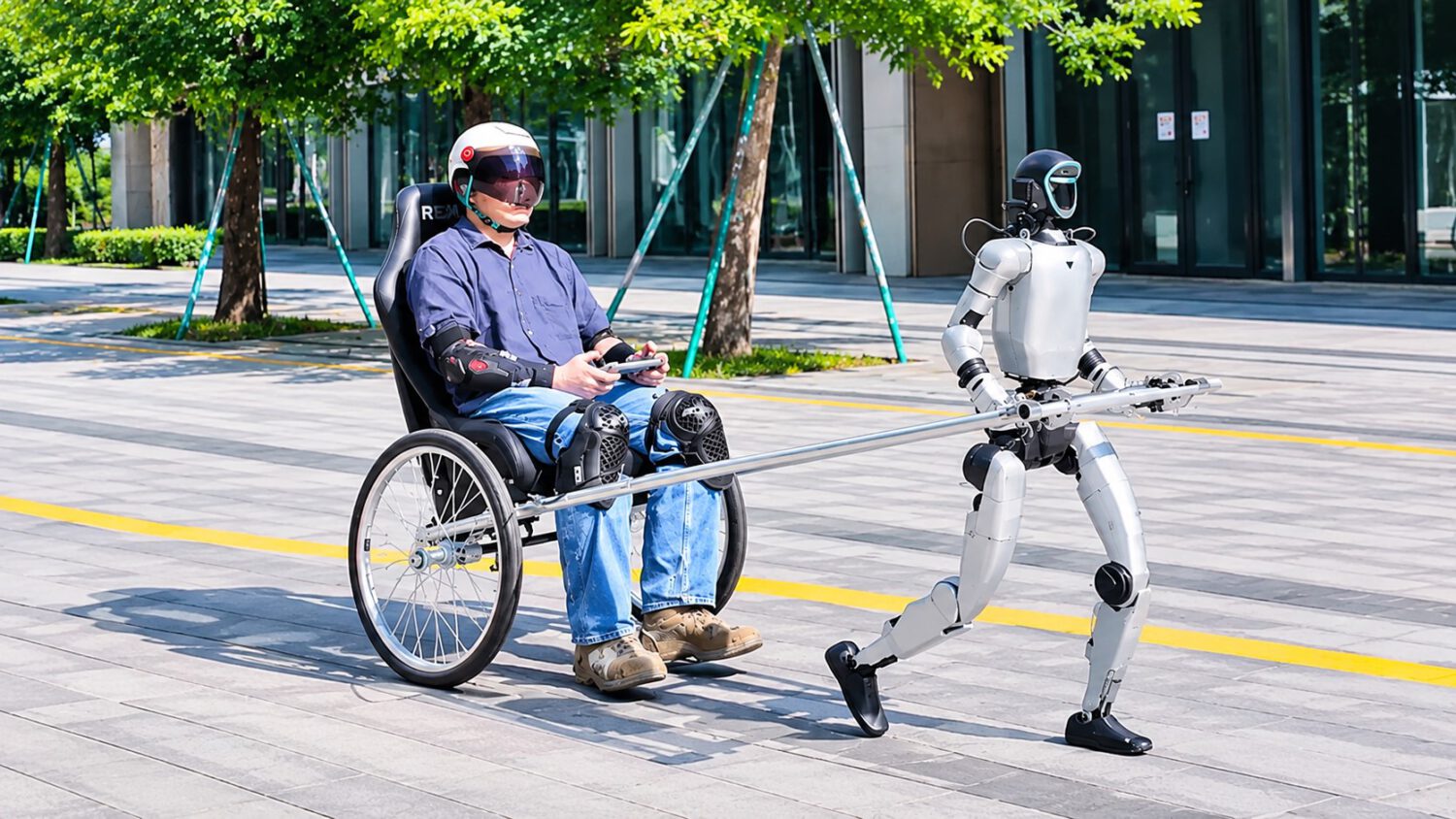
Researchers at the Shanghai Innovation Institute used a Unitree G1 humanoid robot to haul a custom unpowered rickshaw through a complete sequence. That sequence covered starting from rest, sustaining motion, navigating turns, and stopping.
The robot supplied the pulling force while managing its own balance throughout. This is a research demonstration, not a commercial product.
Why Pulling Is Harder Than Walking
A passive vehicle introduces a second mechanical system that feeds unpredictable forces back into the robot continuously.
Add a passive wheeled vehicle to a walking robot and you introduce a second mechanical system with its own inertia and its own momentum during braking. The robot cannot ignore any of it.
Lateral forces shift continuously as the vehicle’s orientation changes during turns. The robot must stay upright on two feet throughout.
According to the arXiv paper, the control framework handles starting, sustained motion, turning, and stopping with a single policy. No retuning for different payloads is required.
The experimental hardware was a G1 configured with 29 actuated joints and two Dex1-1 grippers. The custom rickshaw weighed 22.8 kilograms unloaded.
Researchers report the system handled a loaded rickshaw mass of up to 115 kilograms during testing. That figure is the researchers’ reported result for this specific experimental setup, not a certified towing specification.
It should not be generalized to arbitrary carts, terrain, or passenger configurations. One more detail worth noting: the rickshaw was built at a reduced scale because a full commercial rickshaw would be too large for the G1.
That distinction matters when assessing any real-world transport application.
What the G1 Actually Is
The G1 is a capable research platform, but its manufacturer component specifications are not equivalent to a validated whole-robot towing rating.
The Unitree G1 stands approximately 1.32 meters tall and weighs around 35 kilograms. Depending on configuration, it offers 23 to 43 degrees of freedom, depth-camera and 3D LiDAR sensing, and roughly two hours of battery life.
Unitree’s documentation lists an arm load of approximately 3 kilograms for the EDU version and a maximum robotic knee torque of up to 120 newton-meters. Those are component-level specifications, not a validated whole-robot load rating for pulling tasks.
Several details from the demonstration remain unconfirmed: the degree of autonomy involved, whether the robot operated independently or under supervision, the operating surface conditions, and the number of successful trials. The arXiv paper carries a 2026 date, but the date of the original public demonstration should be verified independently.
What Comes Next
The demonstration advances a specific research question, but meaningful gaps remain before any real-world deployment.
The result addresses whether a humanoid can coordinate bipedal locomotion, persistent hand contact, and a continuously changing coupled load without task-specific retuning. According to the paper, under these tested conditions, it can.
Useful follow-up benchmarks would include slopes, uneven terrain, emergency stops, longer-duration runs, independent replication, and transparent disclosure of the autonomy level used. A passenger-transport deployment would likely require additional safety validation and regulatory review. This demonstration does not establish that those steps have occurred. Broader challenges in real-world robot deployment are also illustrated by efforts like Snake Robots navigating complex environments in the field.