
Ice shatters. That’s the fundamental trade-off baked into every frozen surface you’ve ever cracked underfoot. Researchers at the Hebrew University of Jerusalem have challenged that assumption, publishing findings in Colloids and Surfaces B: Biointerfaces on a composite material called BioPykrete that reportedly performs close to conventional concrete under compression.
This is a laboratory proof of concept, not a building material arriving at your nearest construction site.
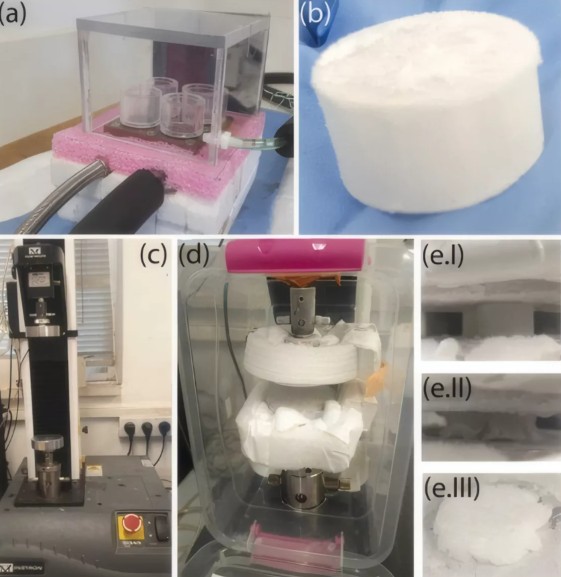
How the Material Actually Works
A plant-derived protein and nanoscale cellulose work together to prevent ice from fracturing the way it normally does.
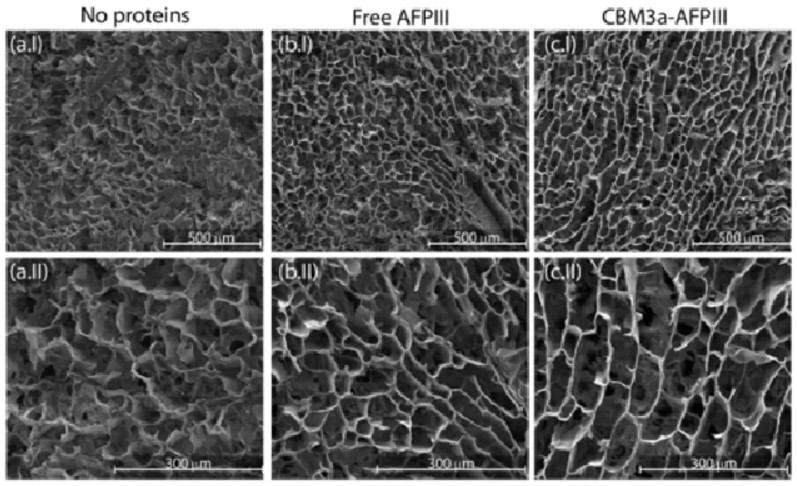
During freezing, cellulose nanocrystals derived from plants form a three-dimensional structural network around microscopic regions of ice. The engineered protein CBM3a-AFPIII acts as a molecular staple: one end grips the frozen brain tissue-adjacent ice while the other binds to the cellulose, creating a reinforced connection at the scale where crack formation begins.
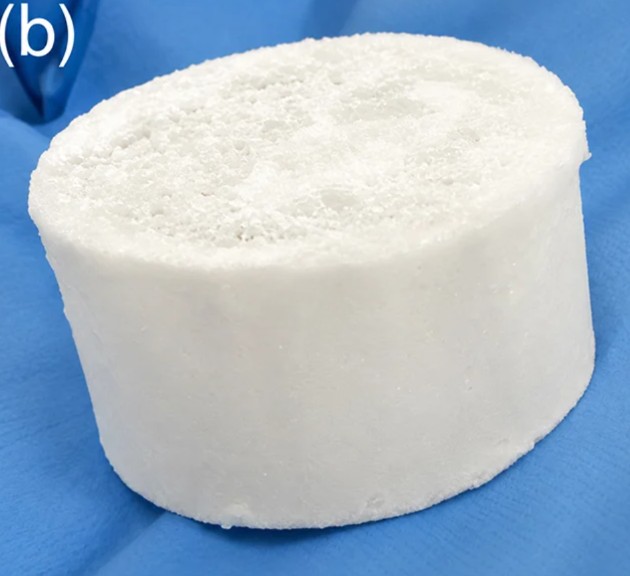
That bonding changes the failure behavior. Instead of fracturing abruptly as cracks spread without resistance, the reinforced structure slows that process, allowing BioPykrete to deform progressively rather than shatter without warning.
The numbers are notable. BioPykrete reportedly registers approximately 10 times greater compressive strength than ordinary ice under laboratory conditions, approaching conventional concrete’s compressive performance. It absorbs roughly 70 times more energy before breaking.
Adding the protein, rather than relying on cellulose alone, reportedly doubled both compressive strength and energy absorption compared to an ice-and-cellulose mixture without the molecular bridge.
“The result changes not only how strong the ice is, but also how it breaks. Instead of suddenly shattering, it can absorb much more energy and deform gradually.” The research team described the core shift in terms reported by ScienceAlert. Primary-paper verification of that characterization is recommended before final publication.
Why It Matters, and What It Cannot Do Yet
BioPykrete revives a wartime materials idea, but the path from the laboratory to actual construction remains long.
The concept has a strange wartime pedigree. During World War II, British engineers proposed Pykrete, a mixture of ice and bulk wood pulp, as a ship-construction material. That project was eventually abandoned. The Hebrew University work replaces bulk fiber with nanoscale cellulose and adds a purpose-designed protein, a molecular bridge that the original formulation lacked.
The researchers identify polar construction as a possible future application, where shipping concrete and steel to Arctic or Antarctic sites is expensive and logistically difficult. A material built primarily from water and plant-derived cellulose could, in principle, reduce that burden for temporary or specialized structures. Whether it actually delivers an environmental advantage remains unestablished, as life-cycle analysis has not yet been completed.
The study authors note, as reported by TechSpot, that establishing BioPykrete’s suitability for infrastructure will require further durability, freeze-thaw, creep, and life-cycle testing. Primary-paper confirmation of that attribution is advised before publication.
Scaling production consistently and validating performance across repeated freeze-thaw cycles both remain unresolved. So does real-world polar exposure testing under sustained structural loads. The distance between a compelling lab result and a deployable construction material is considerable. BioPykrete has not yet crossed it.