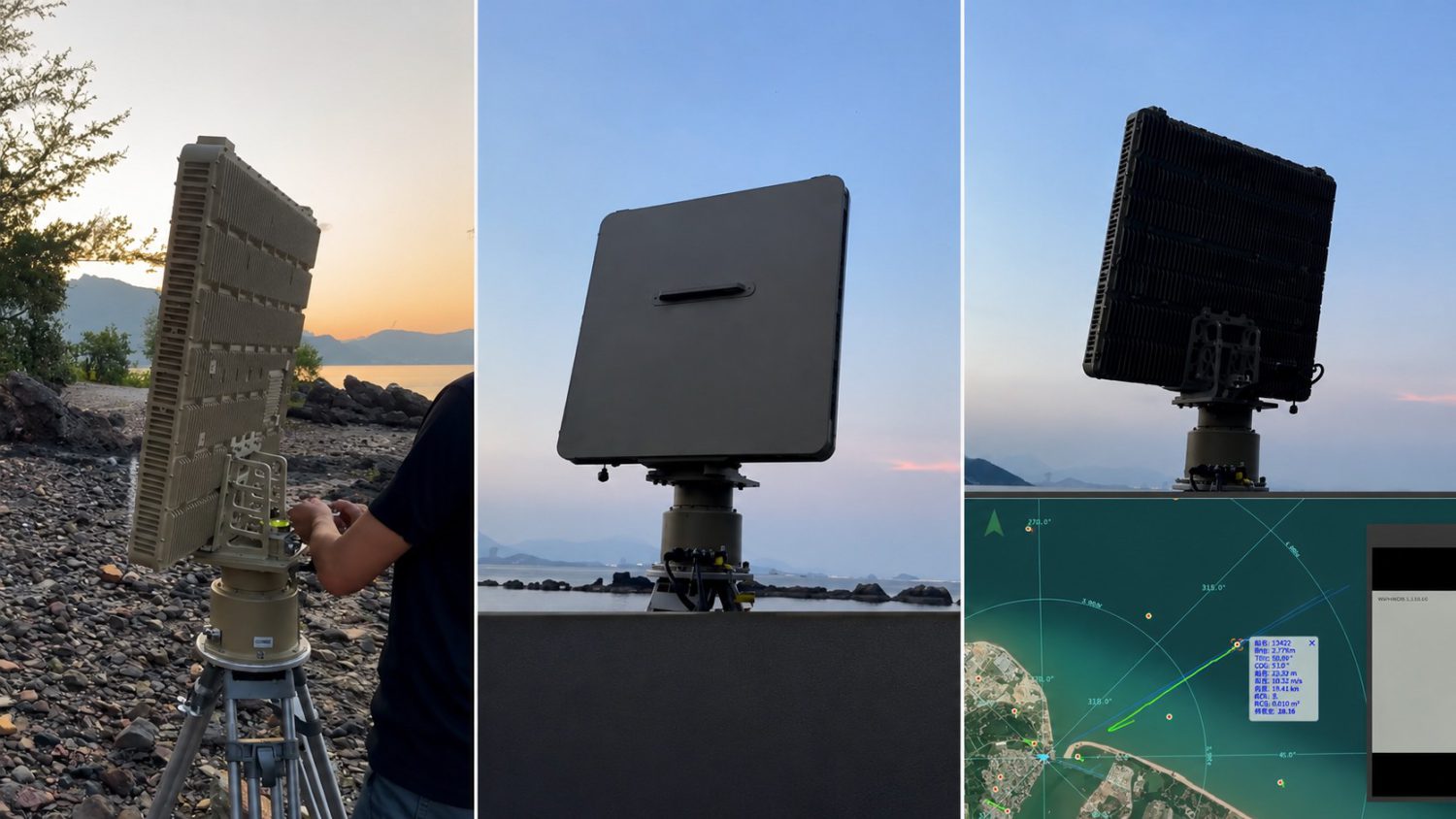
A flat panel spins on a motorized tripod near a shoreline. Someone on social media calls it “the ceiling of the DIY world.” The shot is cinematic. The claim is bold. Viral hardware demos have a pattern: cinematic footage, bold numbers, and missing proof. This one follows the script closely.
Steven Cheng (@stevencheng) posted the footage on August 16, 2026, describing his portable phased-array radar as capable of 360° surveillance within a 6-kilometer radius, reliably detecting small aerial vehicles with radar cross sections (RCS) as low as 0.005–0.01 m². The hardware is real. The portability is confirmed. The 6 km detection claim is not.
What the Video Actually Shows
The confirmed hardware details are genuinely interesting — the performance specs are a different story entirely.
The footage shows a tall rectangular flat panel mounted on a motorized pedestal and tripod, deployed and rotated by a single operator near a shoreline. Cheng confirmed a hybrid architecture — phased-array electronic steering across a limited field of view, combined with mechanical rotation for full azimuth coverage — describing it as a deliberate cost/complexity trade-off using an RF rotary joint. That approach is a known radar design strategy, so the architecture itself is credible.
What’s missing from the footage is harder to ignore:
- No target track, radar return, or controlled range test appears anywhere in the clip
- No probability-of-detection figures, false-alarm rates, or clutter conditions are provided
- RCS of 0.005–0.01 m² is aggressive territory — that range covers birds and some stealth aircraft
- Commercial multi-sensor systems like DedronePortable achieve 3–6 km detection using multiple panels, RF sensors, and cameras — not a single unit
- A BYU research radar running 800 mW transmit power detected UAVs with RCS under 0.1 m² at roughly 150 meters; scale matters enormously here
“The video does not show a target, tracking display, radar return or controlled range test that would substantiate the performance figures.” — RuntimeWire
Cheng also did not disclose frequency band, transmit power, antenna gain, waveform, or scan rate. Those are the exact parameters that determine whether the range equation works in your favor — or exposes the gap between a bold claim and a documented result. Patterns like this echo cases where surveillance app credibility gaps have drawn similar scrutiny.
Why It Still Matters
This unit is clearly beyond breadboard-prototype stage, but the regulatory picture is less exciting than the hardware.
Skilled DIY radar builders have steadily pushed phased-array capabilities further, and this system is clearly not a bench experiment. If Cheng or an independent tester ever publishes detection probability curves with real operating conditions and clutter data, it could mark a meaningful step toward accessible personal airspace awareness — the kind of tool property owners and small security teams have wanted at a fraction of current multi-sensor kit costs.
On legality, Cheng’s answer was “depends on your country.” In the U.S., that’s technically accurate but strategically vague. FCC radiolocation and Part 15 rules govern frequency, power, and authorization. Civilian-built does not mean unrestricted operation.
Until documented test data surfaces, the 6 km claim sits firmly in “interesting if true” territory. Hardware confidence is earned through range equations and field measurements — not posted.