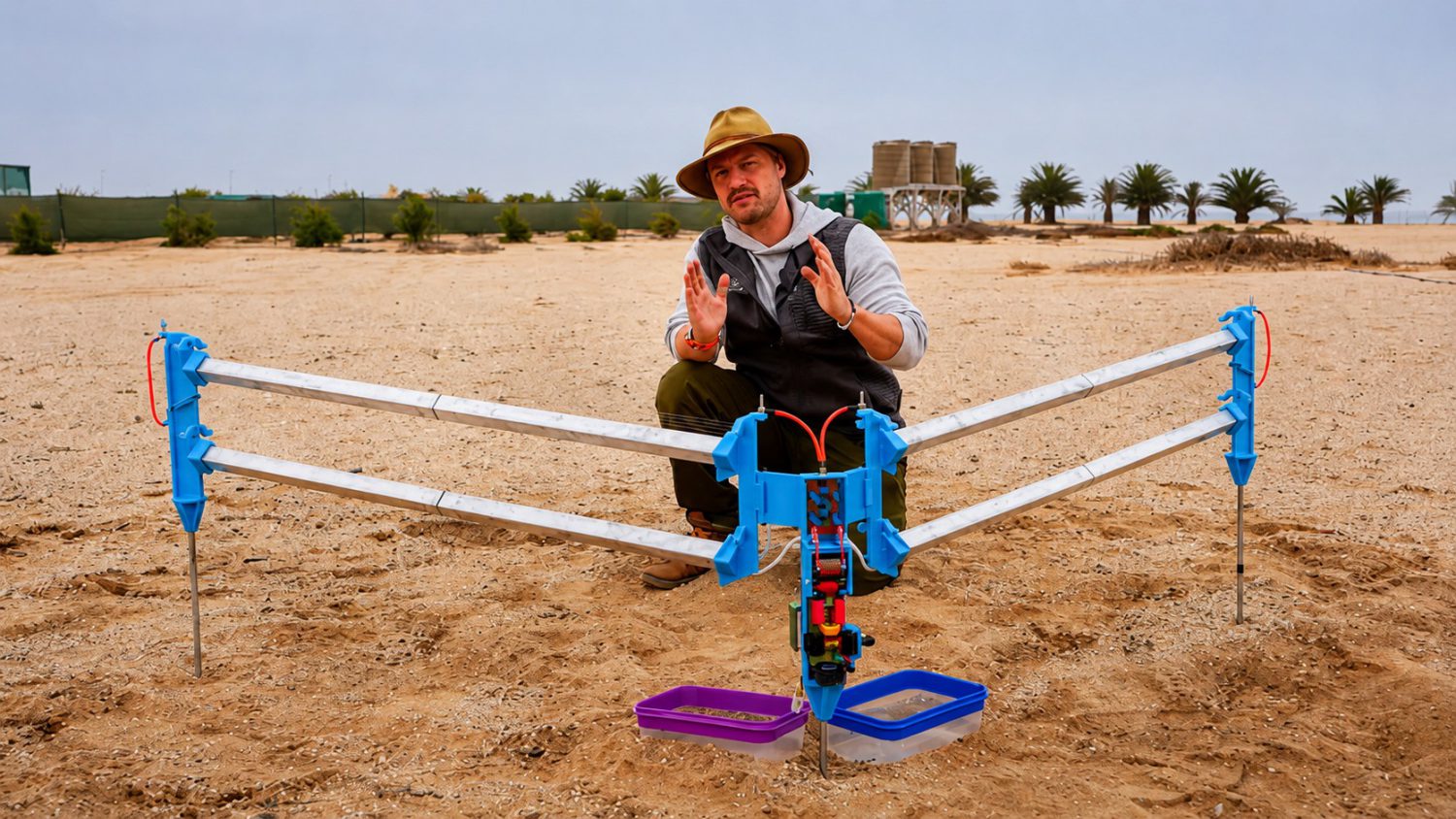
Dawn in the Namib Desert. A 50,000-volt machine hums on stakes in the sand while coastal fog rolls in from the Atlantic. Jay Bowles, creator of the Plasma Channel YouTube channel, watches and waits. His solar-powered rig — inspired by a 2018 MIT study on electrostatically driven fog collection, built with 3D-printed resin joints compact enough to clear airport check-in — charges fog droplets with a high-voltage wire, pulling them toward grounded collector meshes where they coalesce and drip into a reservoir.
The physics are sound. The Namib gets regular morning fog but almost no rainfall. The garage numbers looked genuinely promising. What the desert delivered was something else entirely.
From Garage to Desert: When the Numbers Stop Adding Up
Lab conditions flattered the machine in ways the Namib never would.
In controlled tests, Bowles’ enlarged rig consumed 120 W and produced roughly 42 mL of water per minute — about 21 mL per watt-hour, meaning one liter costs around 48 Wh of electricity. That outperforms a standard dehumidifier under the same conditions. Researchers at the University of Namibia, working alongside Bowles at a coastal campus near Swakopmund, were tracking results. The numbers looked like a credible alternative to passive fog nets. Then Bowles packed the modular rig into checked luggage, flew approximately 14,000 km, and the desert started grading on its own curve.
What the Namib Actually Revealed
Four field realities erased every advantage the garage had built.
- Fog arrived erratically. Nocturnal fog dissipated and returned patchily near sunrise, gutting the automated 6–8 a.m. duty cycle the timer was programmed around.
- Atlantic salt spray — even roughly a kilometer inland — infiltrated the high-voltage electronics, triggering arcing and equipment failures.
- Persistent coastal wind snapped stakes, deforming collector mesh geometry and reducing effective fog interception.
- The verdict, according to Hackaday: “collect absolutely nothing under real world conditions” beyond damp rods.
- Energy reality check: draining a full laptop battery’s worth of electricity may not yield a single liter of water in the field.
“They managed to collect absolutely nothing under real world conditions.” — Hackaday
Why This Failure Is Actually Worth Watching
The Namib didn’t disprove the concept — it wrote the engineering checklist.
Passive fog nets already deployed in the Namib operate with no electricity, tolerate salt, and shrug off wind. Lower theoretical efficiency, but reliably functional. Bowles’ machine is like a band that destroys every rehearsal, then watches the PA blow out at the festival — the gap isn’t about the music, it’s about what survives contact with the crowd.
If salt-proofing, mechanical ruggedization, and legitimate safety concerns around 50 kV near communities can be engineered away, active electrostatic harvesting could meaningfully outperform passive nets. Bowles plans to redesign the system and test next in Chile’s Atacama Desert — a second chance to find out whether the concept holds up where it counts.
Ambitious garage prototypes are exactly how new climate solutions start. The Namib doesn’t grade on effort, and this trial didn’t kill the concept. It defined precisely what needs to survive before electrostatic fog harvesting earns a place beside the nets already doing the quiet, unglamorous work.