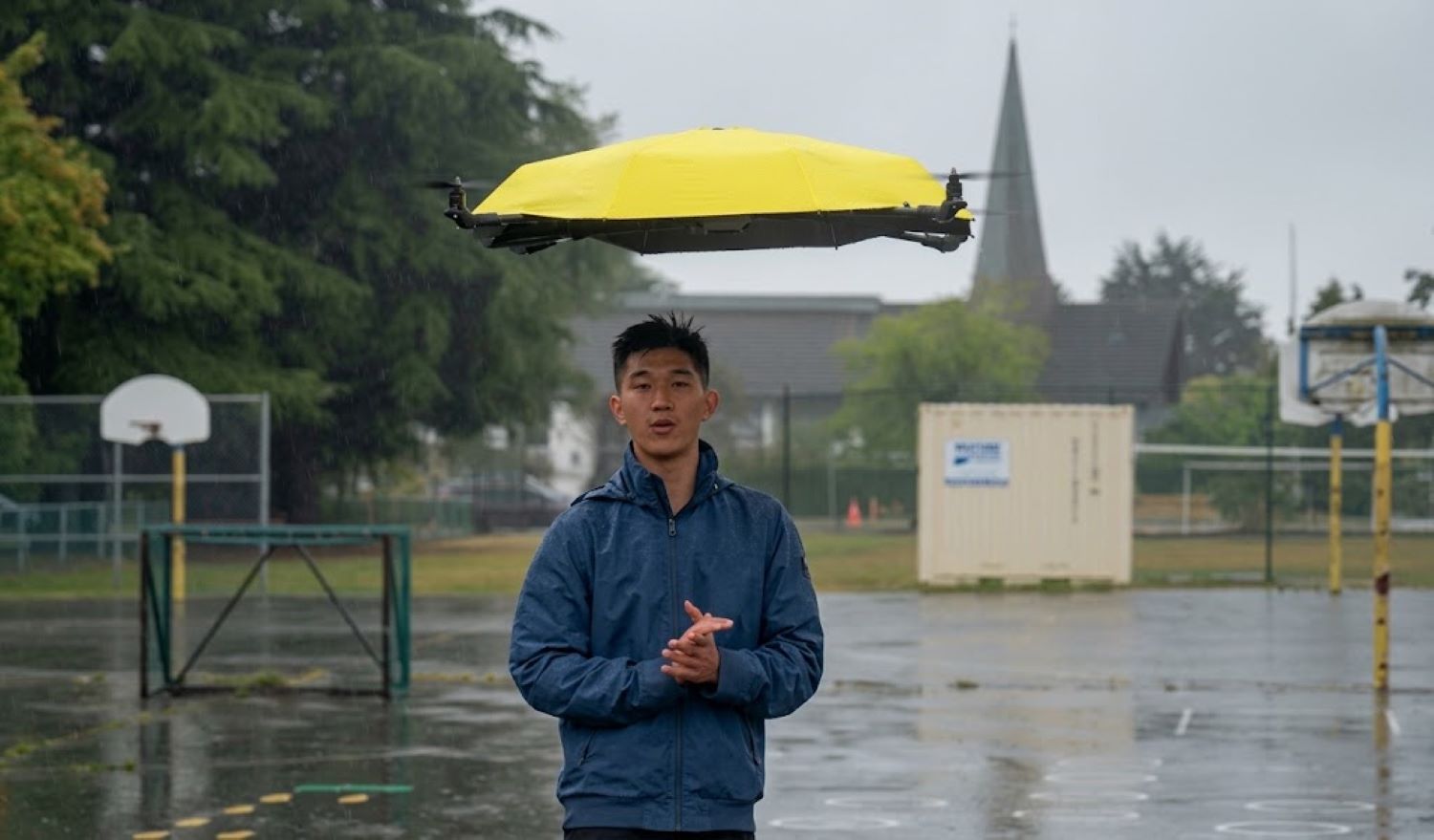
It is downpouring. Your hands are full — phone out, bag over one shoulder, coffee somehow still in hand. Above your head, a cheerful yellow umbrella hovers with the quiet confidence of a well-trained drone, because that’s exactly what it is: a quadcopter running computer vision on a Raspberry Pi. Canadian engineer John Tse, of the YouTube channel I Build Stuff, built it not for your commute, but because the engineering challenge was there and he had the tools to meet it. It works. You cannot buy it.
How a $10 Problem Gets Solved With $1,000 of Robotics
The build is genuinely clever — a quadcopter disguised so well it takes a second look to spot the propellers.
Standard yellow umbrella canopy on top. Underneath: four drone motors mounted on custom 3D-printed folding arms made from carbon-fiber nylon — lightweight, rigid, and foldable for transport. A time-of-flight depth camera, which fires light pulses and measures the return time to build a live 3D map of the scene, tracks your head position continuously. A Raspberry Pi processes that data and commands the flight controller to keep the canopy centered above you as you move. No GPS — consumer-grade positioning is far too coarse for hovering precisely above a moving person’s head.
What Tse built in 2026 is actually Flying Umbrella 2.0. The 2024 version required manual piloting. This one just follows you.
A few hard numbers worth knowing:
- Battery life runs 10–15 minutes per charge
- Performs in rain and low light; strong wind causes real problems
- Exposed spinning propellers hover near your head — an obvious safety concern in any crowd
- Not for sale, no launch plan, no confirmed price
- Roughly one to two years of iteration, including miswired motors and computing failures along the way
Solving a problem that a rain jacket handles for well under $30 with a sophisticated drone tracking system is objectively absurd. That’s also precisely the point. If you’re curious about smart gadgets that take a more practical approach, the contrast couldn’t be sharper.
Why This Won’t Show Up on Your Doorstep
The gap between “works in a parking lot” and “ships to consumers” is wider than the drone flies.
Most jurisdictions heavily restrict autonomous drones operating near people in public spaces — under current aviation codes in the EU, UK, and US, flying a self-guided drone at head height around bystanders is a regulatory obstacle course. Battery life would need to at least double before any real-world use case makes sense. Spinning propellers near bystanders create serious safety and liability concerns. And Tse has announced no retail path, no pre-order, nothing.
A rain jacket solves the same problem for a fraction of the effort. That’s not the point either.
What Tse actually built is a proof of concept for a category that doesn’t exist yet — autonomous personal accessories. Cheap sensors, maker-grade computing, and off-the-shelf drone hardware are now powerful enough that one engineer, working alone, can produce something that looked purely like science fiction just a couple of years ago. The flying umbrella isn’t a product. It’s a dispatch from the near future, filed early.