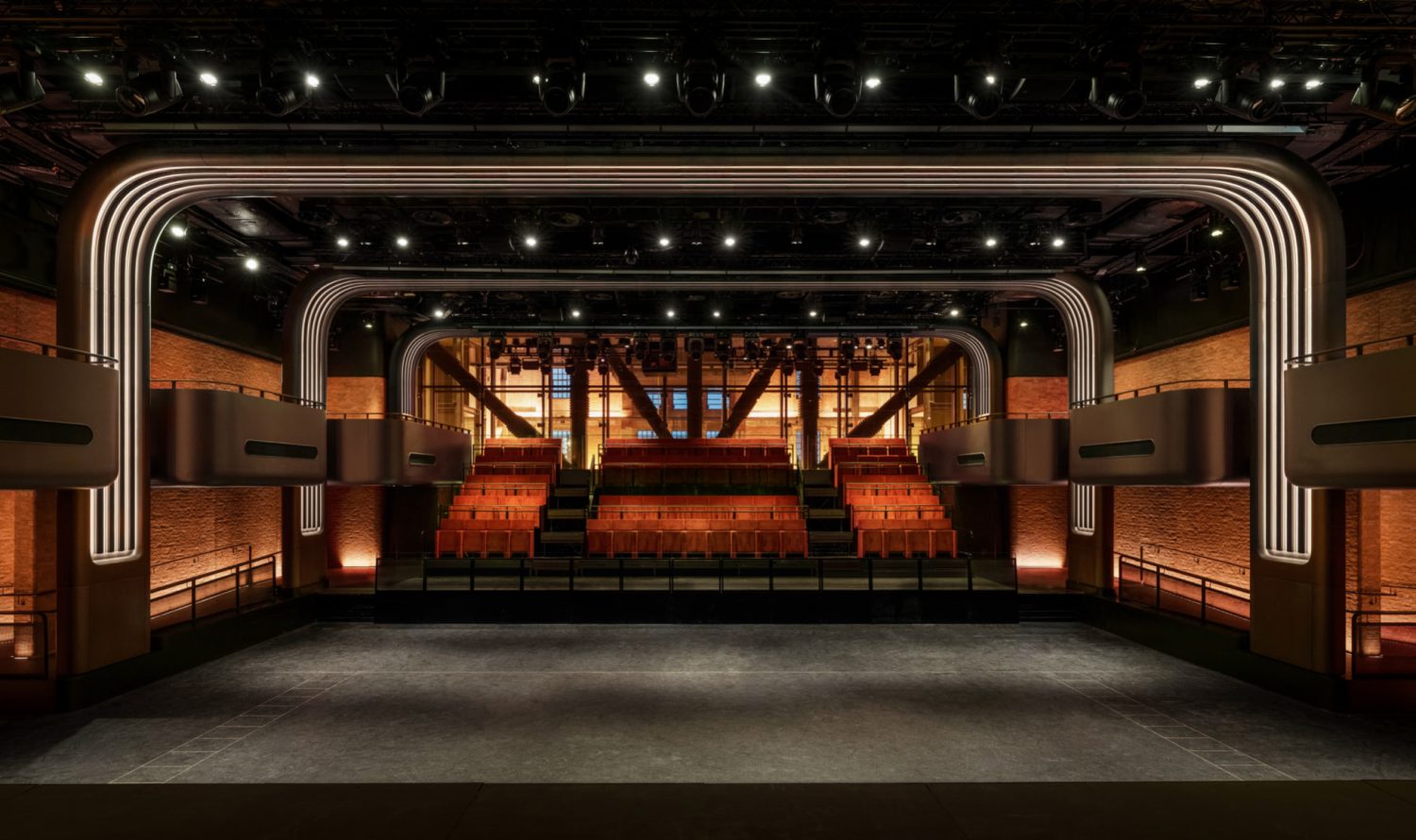
On September 28, 2026, a 600-capacity live venue and production facility opens inside London’s Battersea Power Station, and Elton John will perform first. One intimate concert is designed to produce a finished Spatial Audio recording, a broadcast-ready mix, and multicamera video, all from a single show.
That is a meaningful shift in how a streaming platform approaches live music.
The Room Itself
Brick walls, bronze detailing, and art deco-inspired arches define the interior, with a large glass wall providing views toward the complex and the river. The 38-foot-wide stage can be configured for a conventional forward-facing show or rearranged for performances in the round. The building has carried cultural weight since Pink Floyd used its four chimneys as the cover image for Animals in 1977; Apple is now layering a contemporary media operation inside the same landmark. Apple’s UK headquarters and a retail store already operate within the redeveloped site, making the hall an expansion of an existing footprint rather than a new arrival.
What the Technology Actually Does
The hall’s audio infrastructure centers on a 48-speaker spatial sound system arranged around the audience. It supports both conventional stereo and full immersive Spatial Audio. Two dedicated recording and mixing studios sit within the venue. Each can capture a multitrack recording and deliver a Spatial Audio mix during or after the performance.
More than 16 cameras, including iPhones working alongside professional broadcast equipment, cover the stage from a dedicated control room. Concert audio, multitrack recording, Spatial Audio mix, broadcast mix, and video all originate from the same performance.
According to an Apple statement reported by Music Week: “An artist can perform an intimate live show for fans at Apple Music Hall and walk out with a finished Spatial Audio recording, a broadcast-ready mix, and multicamera video, all from a single show.” Apple’s newsroom announcement added that the hall “is designed intentionally to close the gap between intimacy and production value and allow for an unprecedented level of creative control.”
Six hundred seats in London is, by definition, exclusive. Apple says performances will be available online globally, extending access to audiences who cannot be in the room.
Who Opens and What Comes Next
After Elton John, Baby Keem performs on October 2. The broader programme includes Skye Newman, Troye Sivan, Arlo Parks, Burna Boy, Chase & Status, and Charli xcx, who is listed for December 2. Communion ONE is handling bookings, with DICE serving as the ticketing partner; tickets are also accessible through the Apple Music Hall website.
Apple connects the project to its iTunes Festival history, framing the hall as the continuation of a long-running effort to link artist programming with digital distribution.
A New Kind of Venue
Apple Music Hall positions Apple as a production facility and live venue operator, not only a streaming service. If the model proves effective, purpose-built venues designed around simultaneous live attendance and digital distribution could become a recognizable format rather than a one-off experiment.