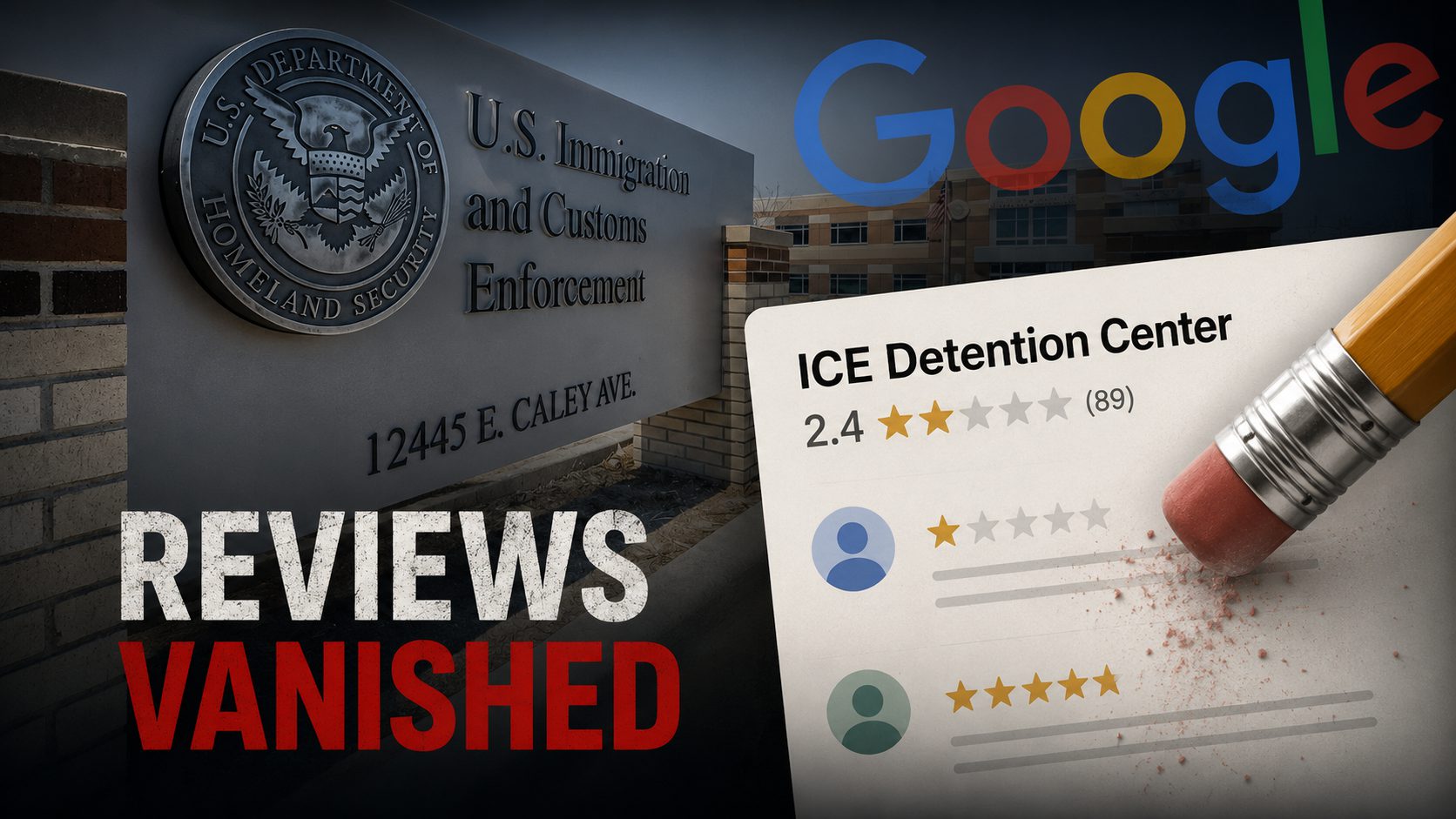
By August 2025, nearly every user review on ICE detention center listings in Google Maps had vanished. No announcement. No banner notification. Tulane professor Muira McCammon discovered the disappearance through her ongoing research, published in New Media & Society. These weren’t gripes about slow service. They were first-person accounts from detainees, family members, and advocates describing overcrowding, language barriers, and alleged abuse. Now they’re gone — and you probably never heard about it.
What Google Removed — and the Justification It Offered
The scale of the removals is significant, and the official reasoning raises more questions than it answers.
- McCammon identified 26 ICE facilities that still had active reviews alongside 91 immigration jails with none. By late 2025, nearly all reviews she had previously collected were no longer available.
- Google’s Maps policy permits removing reviews for places people visit “without choice” — prisons, police stations, detention centers — citing content that is often “unhelpful, harmful, or off-topic.”
- Removal erases the full record: star rating, written text, photos, videos. The entire evidentiary trace disappears.
- Google told reporters the removals were not requested by DHS or ICE.
- DHS denied making any such request. A DHS spokesperson claimed “being in detention is a choice” — a stated agency position, not a verified fact.
“The removals function as suppression of ‘carceral information‘ — public documentation of conditions inside detention facilities.” — Muira McCammon, New Media & Society
Google established this policy framework in 2023 for sensitive location categories — prisons, police stations, and similar facilities. On paper, ICE detention centers fit the pattern. The problem: applying a consumer-review moderation tool designed for spam complaints to coercive state institutions flattens a distinction that actually matters. Bad hotel Wi-Fi reviews and testimony about detention conditions do not belong in the same category of speech.
Google calls it product moderation. McCammon calls it erasure. Both can be true simultaneously — and that’s the uncomfortable part. No public notice process explains why specific review sections were disabled. No transparency exists about how uniformly the policy was applied across time, or whether any facilities were miscategorized and later corrected. When one dominant mapping platform controls both publication and removal of user-generated content, accountability demands more than a policy FAQ buried three clicks deep.
When the Map Becomes the Territory
Removing these reviews doesn’t just tidy up a listings page — it eliminates an accountability layer with no current replacement.
Google Maps had quietly become one of the few public-facing spaces where people connected to carceral institutions could leave a documented record — something like a digital bulletin board that actually carried civic weight. Removing those records doesn’t clean up spam. It strips an accountability layer that no mainstream platform currently replaces, and the open questions here matter: Was the policy applied uniformly over time? Were any facilities miscategorized?
What happens when the world’s dominant mapping platform decides that testimony from people in involuntary confinement doesn’t meet its review standards? That is not a product question but a power question — and right now, only one party is answering it.