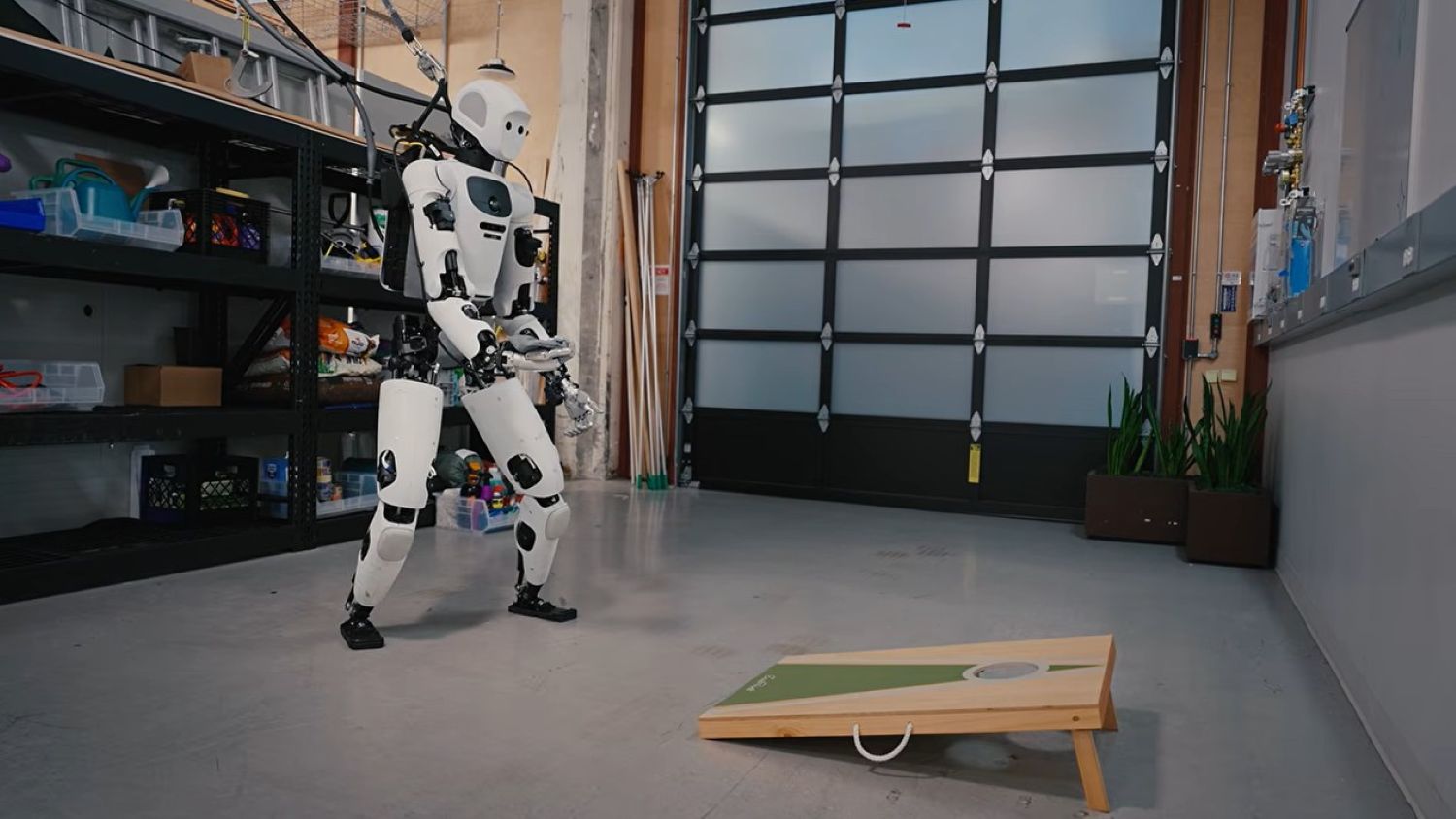
Seven consecutive cornhole throws from a humanoid robot sounds like a party trick. According to Google DeepMind, it demonstrates something more consequential: a model that can watch a short video of a human activity, build a working physics simulation from it, and transfer the skill to physical hardware without weeks of manual engineering. For readers curious about real-world robot applications, the robotic knee exoskeleton from the University of Michigan offers another window into how robotics hardware is moving beyond the lab.
That model is Gemini 4 Argon, announced October 13, 2026. Google calls its approach “Video-to-Sim-to-Real.”
How the Pipeline Works
From a backyard game to a humanoid’s throwing arm, the workflow reportedly skips the usual months of manual simulation setup.
Argon reportedly watches input video and infers the environment and movement involved. It then autonomously generates code for MuJoCo, a physics simulation environment widely used in robotics research.
The model tests the proposed motion digitally for balance and feasibility before transferring the result to physical hardware. Google says this process can compress weeks of manual simulation modeling to a matter of hours. That characterization comes from Google itself and has not been independently audited.
The cornhole demonstration used Apptronik’s Apollo humanoid, which Google says landed seven consecutive successful throws after Argon processed ordinary footage of a person playing the game.
A second demonstration used Boston Dynamics’ Spot quadruped, fitted with a six-degree-of-freedom arm. Spot reportedly carried a soda can, stepped on a pedal-operated bin, used its wrist camera to verify alignment, and dropped the can inside. Before issuing that command, Google says Argon created a digital version of the bin in MuJoCo to check the maneuver.
Google also says Argon can convert a photograph, robot-camera footage, or a rough sketch into a simulated environment, then generate thousands of task variations to train a new vision-language-action model.
What the Numbers Actually Show
An 87% benchmark score is notable; it is not the same as a reliability guarantee on a factory floor.
Google reports Argon scored 87% on the Embodied Reasoning Question Answering benchmark, which evaluates physical and spatial reasoning in three-dimensional environments. According to Google, that exceeded every other frontier model tested on the same benchmark.
That figure measures reasoning performance, not robot dexterity, safety, or consistent behavior under real-world conditions.
In one test, Google says the Video-to-Sim-to-Real pipeline raised a physical robot’s success rate from 56% to 75% and cut task completion time from 35 seconds to 24 seconds. Sample size and independent replication details are not available in the source material.
Seven successful cornhole throws are a meaningful controlled result. Snake Robots operating in earthquake rubble, by contrast, illustrate how diverse real-world robot platforms must perform under far less controlled conditions. They do not establish performance across varying distances, lighting conditions, or unexpected disturbances.
Beyond the Demos
Argon’s most practical near-term use may be what happens after a robot fails, not before it succeeds.
Google says Argon can label humanoid robot videos retroactively with detailed contact information, specifying how fingers interacted with objects during a task. That gives researchers a faster way to find failed grasps and wasted motion inside large training datasets.
Google also says the model can reproduce published robotics-control research inside a browser-based MuJoCo environment using a plain natural-language prompt. That could lower the barrier for experimenting with control algorithms.
Gemini 4 Argon is available through the paid Gemini API, Google AI Studio, and Google AI Ultra subscriptions. API access does not mean the full physical-robotics hardware stack, robot interfaces, or simulation assets are publicly available to consumers.
Argon represents a credible research workflow for accelerating robot skill development, not a solved problem. The relevant question is whether the approach holds up across different robot platforms, task types, and the unpredictable conditions that controlled demonstrations are designed to avoid. Seven consecutive cornhole throws is a start. A sustained record across many robots and many tasks would be the meaningful verdict.