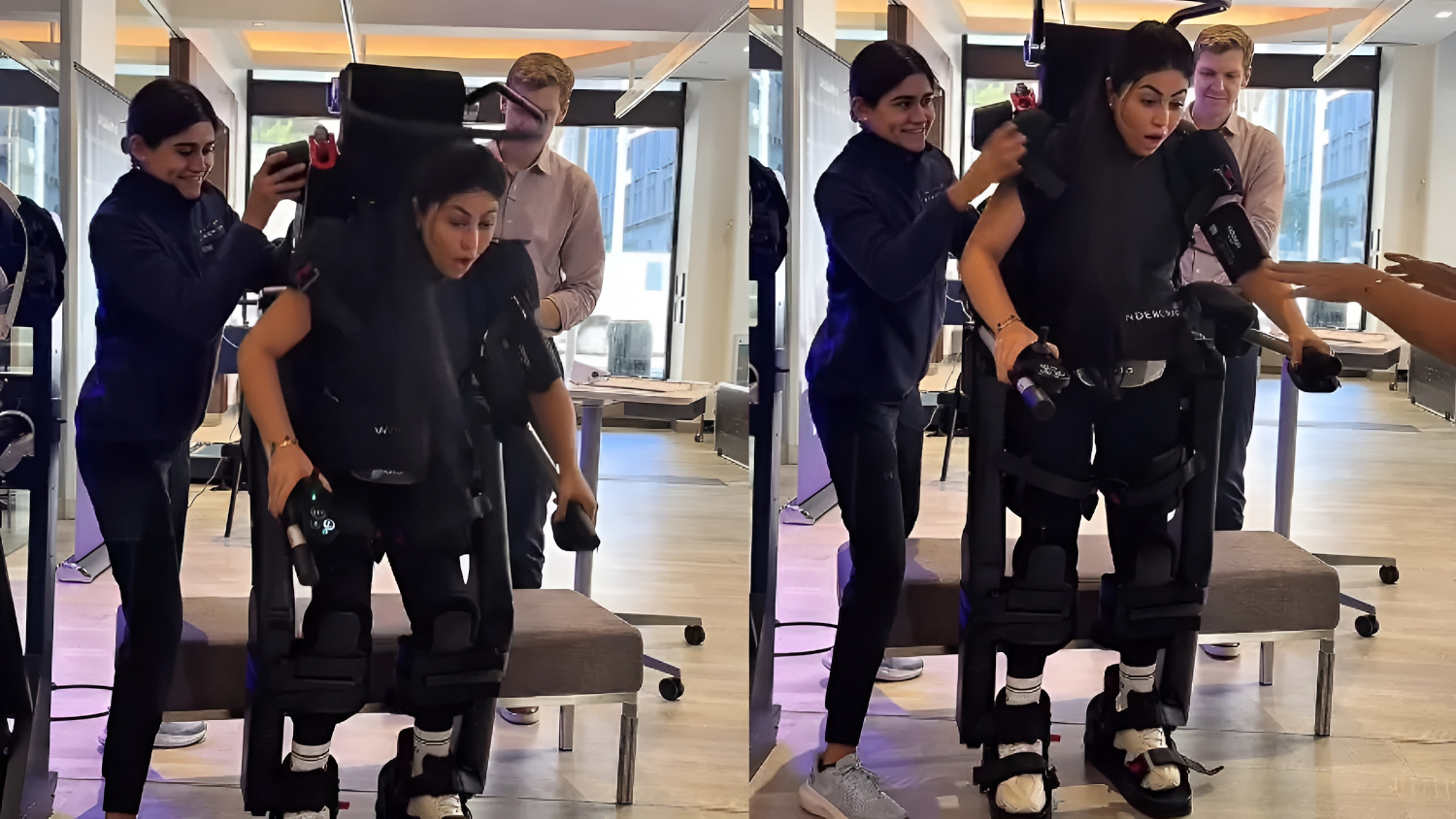
For about a decade, Jessica Tawil‘s view of the world was from a wheelchair. Then, with a powered robotic exoskeleton strapped to her body and specialists on hand to guide her through the controls, she stood up.
The video she shared to her Instagram account drew renewed attention after initially circulating in late 2025. Tawil has built an audience of more than three million across TikTok and Instagram documenting life with a disability, and her on-camera reaction said everything her words did not need to.
Tawil was 16 when a car accident in 2014 caused a spinal-cord injury resulting in T6 paraplegia, leaving the lower half of her body paralyzed. That is not a statistic. That is a teenager who woke up and had to reimagine every physical experience she had taken for granted.
What Eve Actually Does
The device provides mechanical support for standing and stepping; it does not restore neurological function or reverse paralysis.
The exoskeleton she used is called Eve. It is a powered wearable system built around motors, rigid supports, and onboard controls that assist a user in rising, standing, and taking steps. Reporting indicates specialists were present during the session to help Tawil operate the device, though the precise extent of their involvement was not independently confirmed from a primary source.
Eve does not restore neurological function. It does not reverse paralysis or repair a damaged spinal cord. What it provides is enough mechanical support to let a person who cannot move their legs independently experience upright, assisted movement.
The manufacturer, regulatory status, clinical specifications, and pricing for Eve were not established in available reporting, so those details remain unclear. Eligibility for an exoskeleton depends on the individual, the nature of the injury, and a clinical assessment. This is not a device that works for every person with a spinal-cord injury.
The Part the Specs Cannot Measure
The emotional and social value of assisted standing goes beyond what any technical description can fully account for.
Standing upright changes your relationship to a room. You meet people at eye level. You reach things. You occupy space differently. For someone who has spent roughly a decade experiencing the world from a seated position, those shifts carry weight that a spec sheet cannot capture.
Tawil has used her platform to share the everyday reality of life with a disability honestly, and her audience responds to that directness. Her video spread not because it promised a cure but because it showed something verifiable and human. That distinction matters, and it is worth separating from the hype that tends to attach itself to any viral robotics clip.
Assisted movement is not recovered movement. That is not a caveat to bury at the end of the story. It is the whole point.
Exoskeleton technology has moved steadily from laboratory and rehabilitation settings toward devices intended for supervised use. How far that progress extends in practice, and for whom, will depend on clinical evidence, safety data, and cost. Tawil’s video, shared from her wheelchair user’s perspective to an audience of millions, does not answer those questions. It does, clearly and without embellishment, show why they are worth asking, and who deserves to be at the center of that conversation.