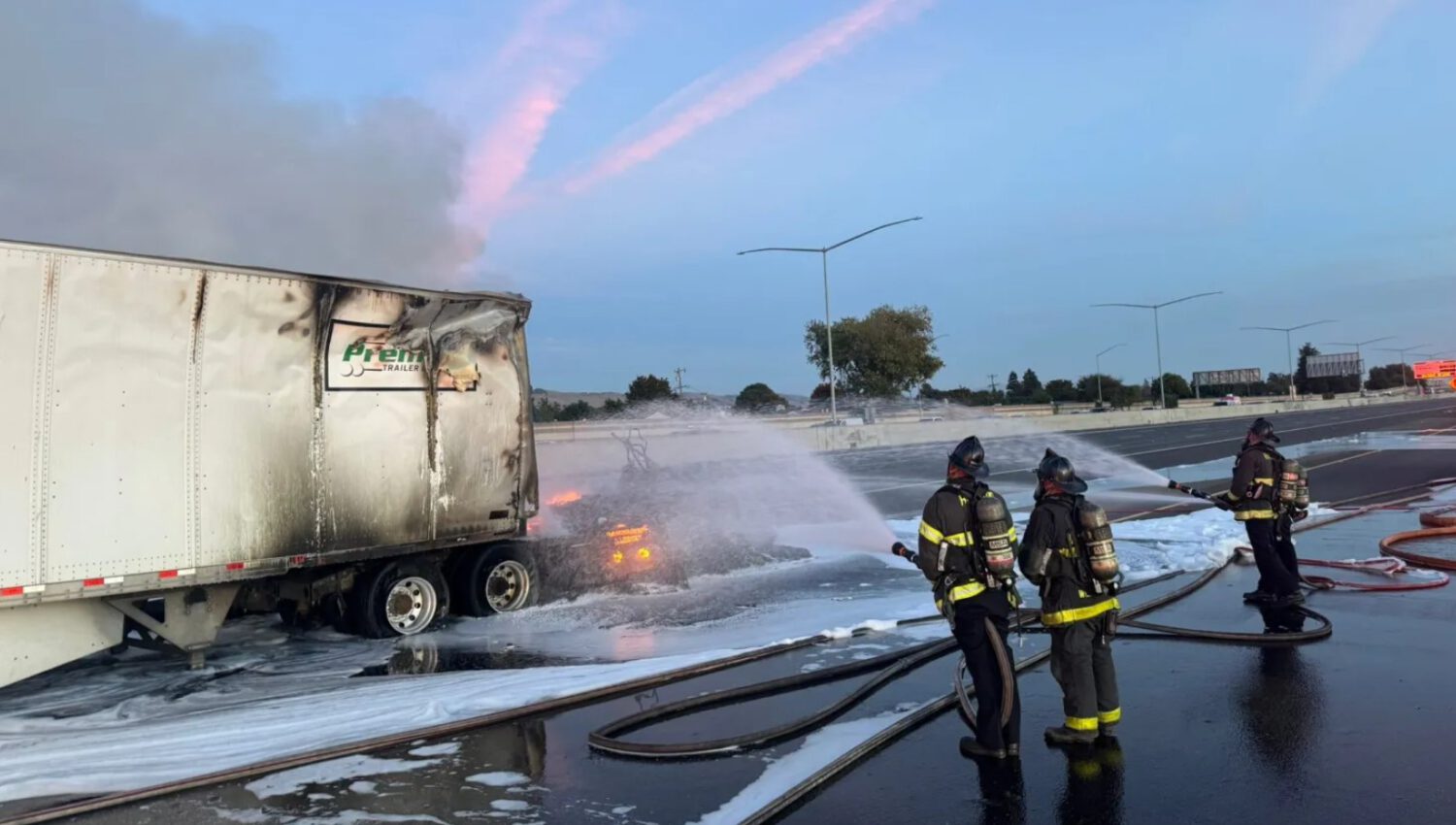
A Tesla Semi ignited on southbound Interstate 880 near Highway 92 in Hayward on the evening of October 27, 2026, with no collision reported in initial accounts, leaving investigators with an origin they could not immediately account for.
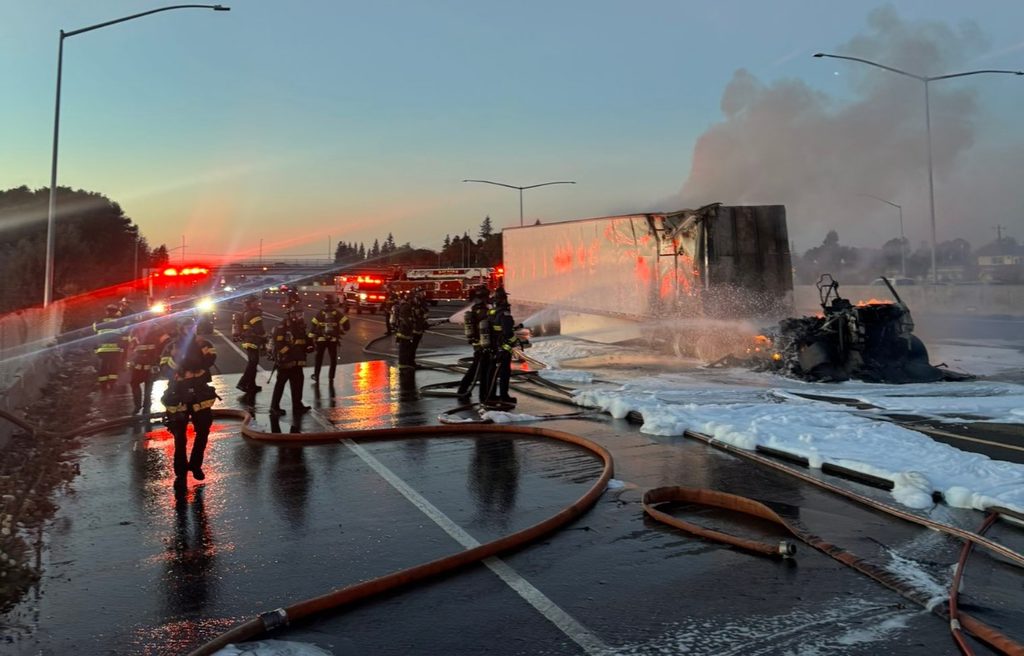
What Happened on I-880
The fire forced a full freeway closure lasting nearly ten hours, driven by hazardous smoke concerns rather than active flames alone.
The fire broke out at approximately 5:35 to 5:45 p.m., according to reporting by the East Bay Times. The driver escaped without reported injury, and the California Highway Patrol said no other vehicles were reported involved.
The driver told officers the rig caught fire but could not explain what caused it, according to ABC7. The CHP closed both directions of I-880 because of the potential risk of hazardous chemical smoke, the East Bay Times reported.
Northbound lanes reopened around 8:40 p.m. Southbound lanes did not reopen until approximately 3:30 a.m., after the battery fire had been extinguished and the scene was considered safe to clear.
Why a Battery Fire Complicates Everything
Large lithium-ion battery packs can keep generating dangerous heat long after visible flames disappear, turning what looks like a contained fire into a prolonged hazmat operation.
Lithium-ion battery cells can continue generating heat after visible flames die down, creating a risk of thermal runaway and reignition. Tesla’s own Semi emergency-response documentation instructs firefighters to apply large amounts of water to the battery enclosure and monitor the high-voltage pack for at least 24 hours because of that reignition risk.
The same guidance advises against submerging the vehicle. It also recommends storing a burned Semi outdoors, at least 50 feet from other vehicles and structures.
The sealed battery enclosure, high-voltage systems, toxic smoke potential, and delayed reignition risk can require different precautions and longer monitoring than some conventional vehicle fires.
A More Complicated Picture Than 2024
The absence of a reported collision sets this incident apart from the last major Tesla Semi fire and leaves investigators with fewer obvious starting points.
A Tesla Semi fire near Emigrant Gap on I-80 in 2024 followed a crash, required roughly 50,000 gallons of water, and closed eastbound and westbound lanes for 15 and 14 hours respectively, according to the National Transportation Safety Board. The Hayward fire’s apparent lack of a collision makes its origin harder to establish, according to Electrek.
The cause remained under investigation at time of publication. Investigators had not determined whether the igniting event involved the battery pack, high-voltage system, drivetrain, brakes, tires, or some other component. Describing the fire as spontaneous combustion would be premature based on available information.
What This Fire Surfaces
The incident highlights concrete operational challenges that large-battery commercial vehicle fires create for emergency agencies and highway managers.
A single incident cannot establish the overall fire rate or reliability of the Tesla Semi, particularly while the cause remains unknown. What it does illustrate are the challenges that large-battery commercial fires place on emergency agencies and highway managers.
As electric freight trucks expand into commercial fleets, fire departments, highway agencies, and freight operators face growing demands. Those demands include larger water supplies, high-voltage training, extended post-fire monitoring, and purpose-built storage protocols for burned vehicles. The question is no longer whether electric trucks require different emergency responses. It is how fast the infrastructure to support them can catch up.