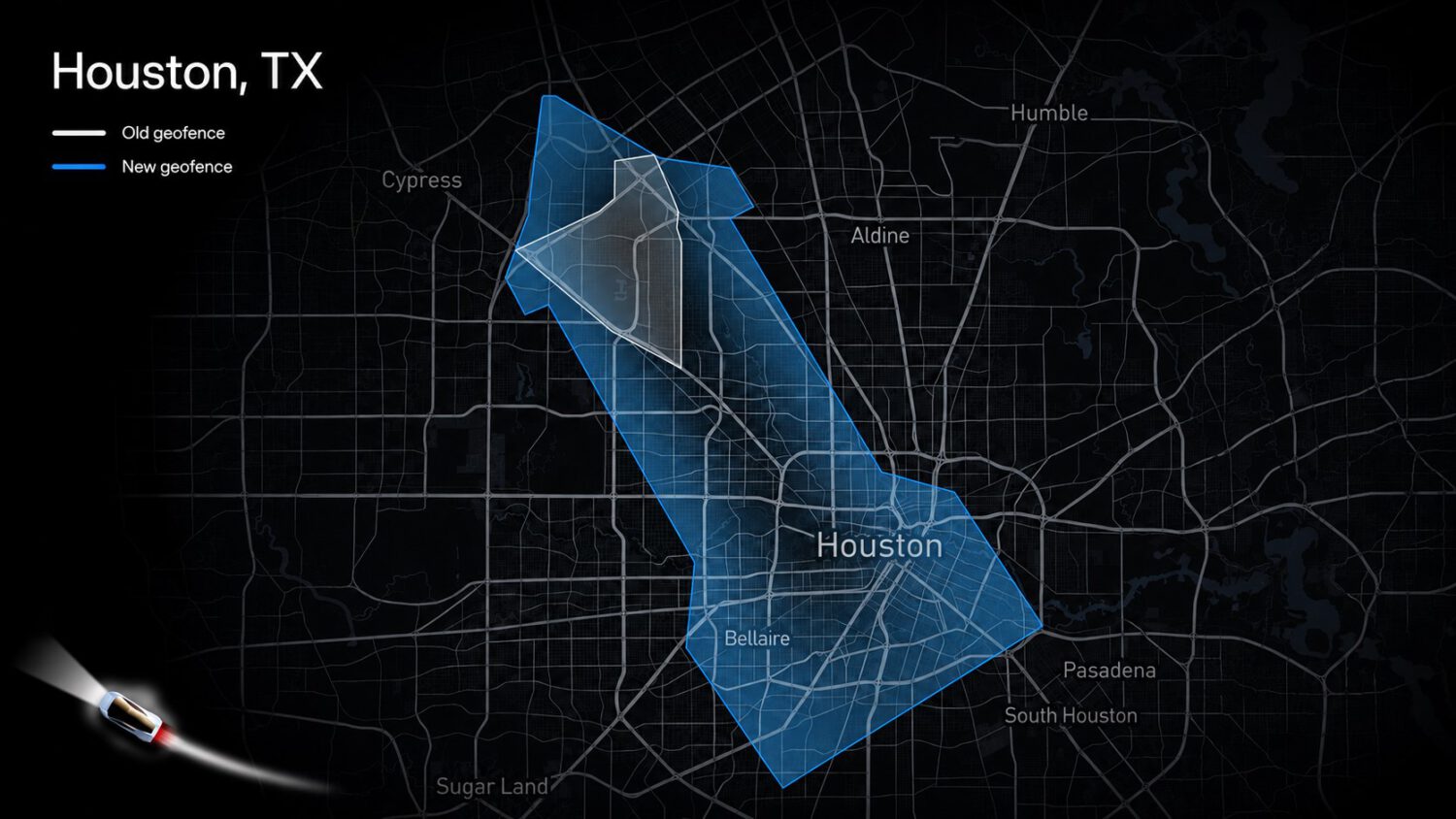
Houston’s Tesla Robotaxi service area jumped from approximately 24.9 square miles to an estimated 254 square miles, according to third-party trackers. That expansion, combined with a Texas registered fleet that has crossed 1,000 vehicles, marks a notable moment in Tesla’s effort to scale autonomous rides beyond early pilot territory.
A Much Bigger Map
The expanded Houston zone now covers northwest Houston, downtown, and reaches toward Bellaire, an area roughly five times the size of Waymo’s reported Houston coverage.
The 254-square-mile figure comes from independent tracking sources, not from Tesla, which has not published an official measurement for the new boundary. Waymo’s Houston operating zone is estimated at approximately 49 square miles, though both measurements are tracker estimates and the two companies use different methodologies, so the figures are not directly comparable.
The Boundary Looks Like a Rocket
Tesla’s official Robotaxi account announced the expansion with “Houston, we have liftoff,” but the company has not confirmed whether the rocket-shaped outline was intentional.
The new boundary has drawn attention beyond its size: the outline resembles a rocket or spacecraft. Tesla has not officially confirmed that the shape was designed as a Starship reference or any other intentional visual. The Starship interpretation remains speculation based on the map’s appearance. Houston’s identity as home to NASA’s Johnson Space Center and Mission Control gives the shape a natural cultural resonance, whatever the intent.
Fleet Crosses 1,000 Vehicles
Cybercabs now outnumber Model Ys in Texas registration data for the first time, though registered totals do not reflect how many vehicles are actively on the road.
Texas registration data reviewed on October 27 showed 1,051 Tesla Robotaxi vehicles in the state: 544 Cybercabs and 507 Model Ys. A subsequent update reportedly brought that total to 1,080, with 573 Cybercabs and 507 Model Ys.
Registration counts are not the same as active deployment. Vehicles listed in state records may not all be operating or available for rides at the same time.
Cybercabs surpassing Model Ys in registered count is worth noting given that Houston’s Robotaxi service launched using Model Ys. The growing Cybercab presence in Texas suggests the purpose-built vehicle is becoming increasingly central to Tesla’s autonomous fleet strategy.
What the Expansion Signals
A larger service area gives Tesla more room to collect autonomous driving data and reach a wider rider base, though a Cybercab launch in Houston has no confirmed date.
Reports of Tesla relocating a significant number of Robotaxis and Cybercabs to Houston have fueled speculation about an imminent Cybercab launch there. No official launch date appears in available sources. Tesla shares reportedly reached a three-month high as the fleet news circulated. Available reporting does not establish a direct causal link between the expansion and that market movement.
The Real Question Still Open
Size on a map is one thing; consistent service across 254 square miles is an entirely different operational challenge.
The number that matters most to Houston riders is not 1,080 registered vehicles. It is how many of those cars are on the streets at any given time. Scaling reliable autonomous service across a zone more than ten times its previous size is a far greater logistical test than running a contained pilot. Whether Tesla’s fleet and infrastructure can keep pace with the boundary it just drew remains an open question.