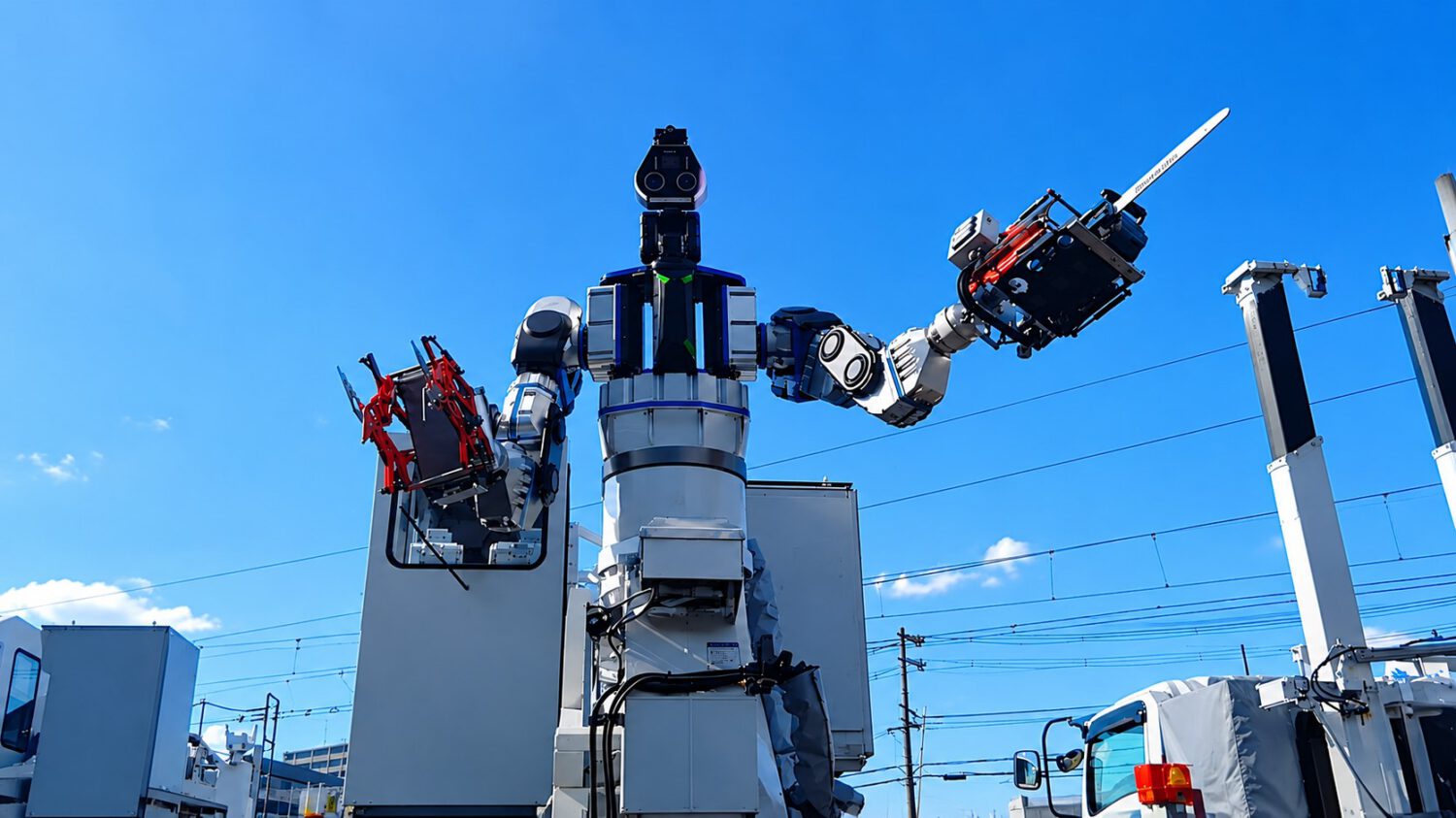
One robotic arm grips a tree branch. The other uses a chainsaw attachment to cut it, from a boom elevated approximately 15 meters above the track. The operator is on the ground.
West Japan Railway Company is expanding its ZIZAI program with two new teleoperated maintenance machines: the single-arm ZX-2 and the dual-arm ZX-3, scheduled for deployment on live railway infrastructure in October and November 2026, respectively.
The Two Machines
Each robot addresses a specific hazard that currently requires workers to operate at height or under heavy physical load.
Teleoperation means a human operator on the ground controls the robot in real time, watching camera feeds from the machine’s perspective rather than working alongside it at height.
The ZX-3 is the more technically striking of the two. Mounted on a vehicle boom that extends approximately 15 meters (49 feet), the dual-arm semi-humanoid can grip vegetation with one arm. The other arm uses a chainsaw attachment to cut it.
Its interchangeable tool system supports additional maintenance tasks, with a single-arm gripping capacity of 20 kilograms. The operator sits at ground level, guiding the machine through camera feeds at the robot’s head.
Compared to the earlier model JR West put into service in July 2024, the ZX-3 is smaller and lighter while offering a longer reach. The production model is scheduled to begin work in November 2026.
The ZX-2 addresses a different problem: the physical demands of overhead-line hardware. Mounted on an aerial-work vehicle, this single-arm machine grips loads up to 120 kilograms (roughly 265 pounds), handling the support arms and related components that crews currently work with at height.
Neither machine operates independently. Both remain under continuous operator control.
Why This Exists
JR West built the ZIZAI program around reducing the specific risks that come with elevated railway maintenance work.
Railway maintenance involves elevated positions near live electrical infrastructure, combining fall risk, electrical clearance requirements, and significant physical load. JR West cites fall and electric-shock prevention as core drivers of the program.
JR West developed the ZIZAI machines alongside Nippon Signal, robotics company Jinki-Ittai, and rail-vehicle manufacturer Toyo Sharyo. The name “ZIZAI” refers to flexible or unrestricted movement, which describes what the program is trying to achieve operationally.
The company’s stated target is approximately a 30% reduction in the number of personnel required for these specific tasks. That figure is an organizational goal, not a measured field result.
The core value proposition is straightforward: the machines move workers away from elevated and electrically hazardous positions, not out of the workflow entirely. One person stays on the ground; the machine handles the grip and the cutting tool at height.
JR West plans to build on operational experience from both deployments and expand the range of tasks and infrastructure applications over time. If the ZX-2 and ZX-3 hold up under real maintenance conditions, the template of vehicle-mounted, camera-guided manipulators with interchangeable tooling could extend well beyond Japanese railways. Any infrastructure sector involving height, electrical hazard, or components too heavy to handle safely by hand represents a plausible application.
The worker remains in the loop. The worker is just no longer the one using the chainsaw at 49 feet.