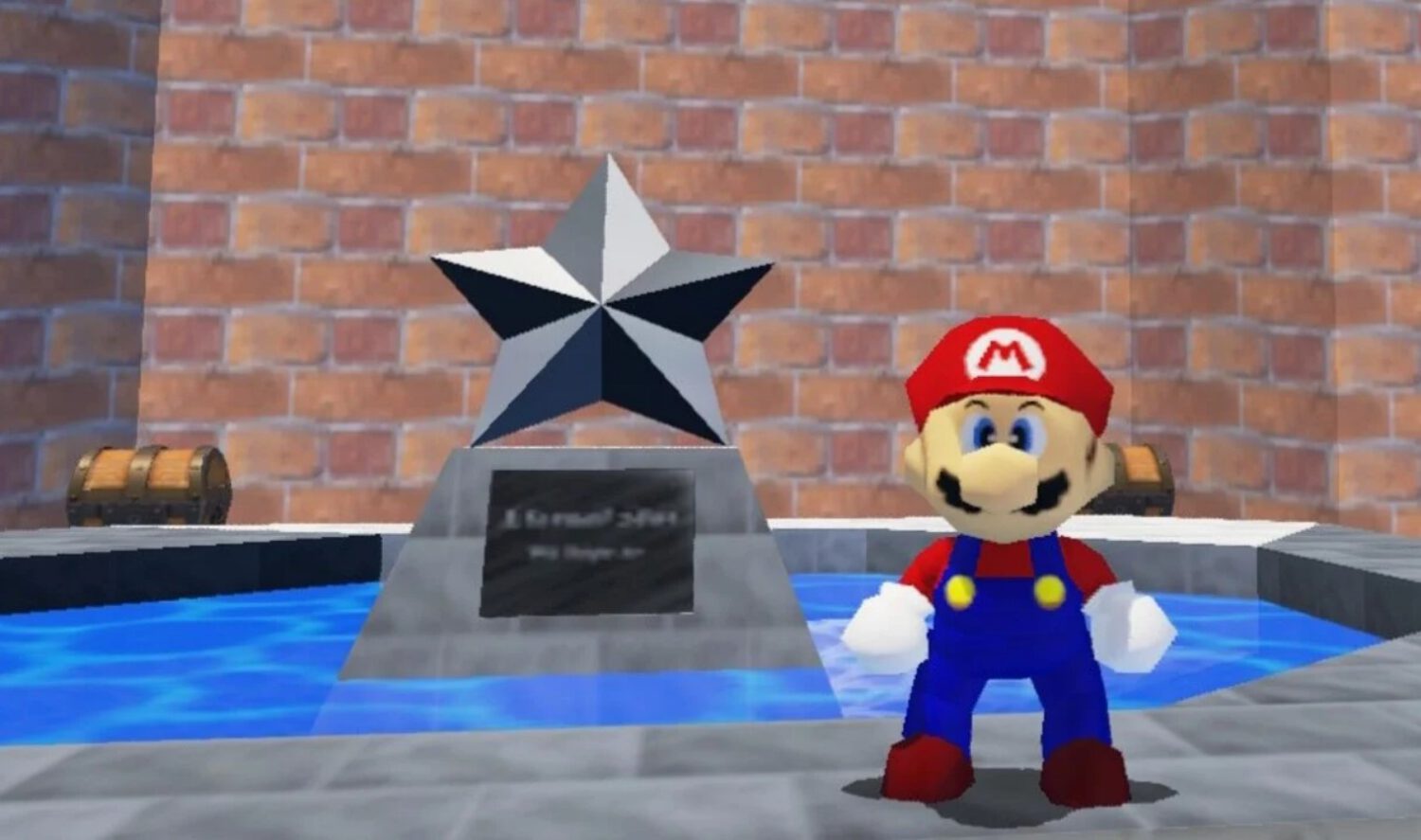
A 32×32 pixel texture, roughly the resolution of a postage stamp, has kept Nintendo fans speculating for nearly three decades. That tiny plaque in Peach’s Castle courtyard became the center of one of gaming’s most persistent legends: that the blurry inscription read “L is real 2401,” a supposed secret signal that Luigi was hidden somewhere in the game.
Programmer supermochi64 has now published an open-source reconstruction project that reportedly tested more than 1.2 million phrase combinations against the surviving texture. The project’s statistical winner isn’t Luigi; it’s “Eternal Star / We hope so.”
The Method Behind the Mystery
Rather than attempting to enlarge unreadable pixels, supermochi64 modeled how the texture might have been created in the first place.
Upscaling the plaque cannot recover information that was never retained in those 32 pixels. Instead, the project modeled how a 1996 texture artist might have worked: render candidate text, shrink it to the plaque’s tiny resolution, apply blur and color adjustments, then compare the result against the original texture. The closest font match identified through that process was Adobe Palatino Bold Italic, associated with the Adobe Type Manager era of the early 1990s. That doesn’t confirm Nintendo used that font; it means the font produced the best pixel match under the tested assumptions.
Lower mismatch scores indicate a closer pixel match to the original texture. “Eternal Star” on the first line produced a mismatch score of approximately 1,129, according to the project’s published data and reporting by Video Games Chronicle. “L is real 2401” scored roughly twice as poorly on that same first-line measure.
Why the Luigi Theory Lasted This Long
Secondary reports suggest Nintendo considered including Luigi during development before removing him, and fans filled that absence with decades of hope.
The plaque’s illegible text became a natural focal point for fans who believed Luigi was still hiding somewhere in the game. A 1998 Nintendo Power April Fool’s feature amplified the “L is real 2401” reading without constituting any official decoding of the texture, and the association stuck. The emotional investment that kept the theory alive for nearly 30 years reflects how a low-resolution asset can become a canvas for what people want to believe, rather than what the pixels actually support.
What Remains Unresolved
The second line carries less certainty than the first, and no public Nintendo response to the reconstruction has been identified.
The project presents “We hope so” as the best-fitting candidate for line two, but acknowledges that reading is less certain than the headline result. Capitalization details remain unclear, and without Nintendo’s original source artwork or creator testimony, the reconstruction stays a highly supported hypothesis rather than a confirmed transcription.
The methodology and full dataset are published openly on supermochi64’s GitHub repository, so other researchers and fans can test alternative phrases or challenge the underlying assumptions directly. That openness is the real value: this result is reproducible and testable in a way that message-board speculation never was.
A Better Question Than the Answer
The most defensible answer to a 30-year mystery may now exist, even if absolute certainty remains out of reach.
Absolute certainty, without Nintendo’s source files, is still unavailable. What supermochi64’s project demonstrates is that open-source reconstruction tools can bring methodological rigor to ambiguous, low-resolution artifacts from gaming history. Many other artifacts from that era may remain to be studied the same way.