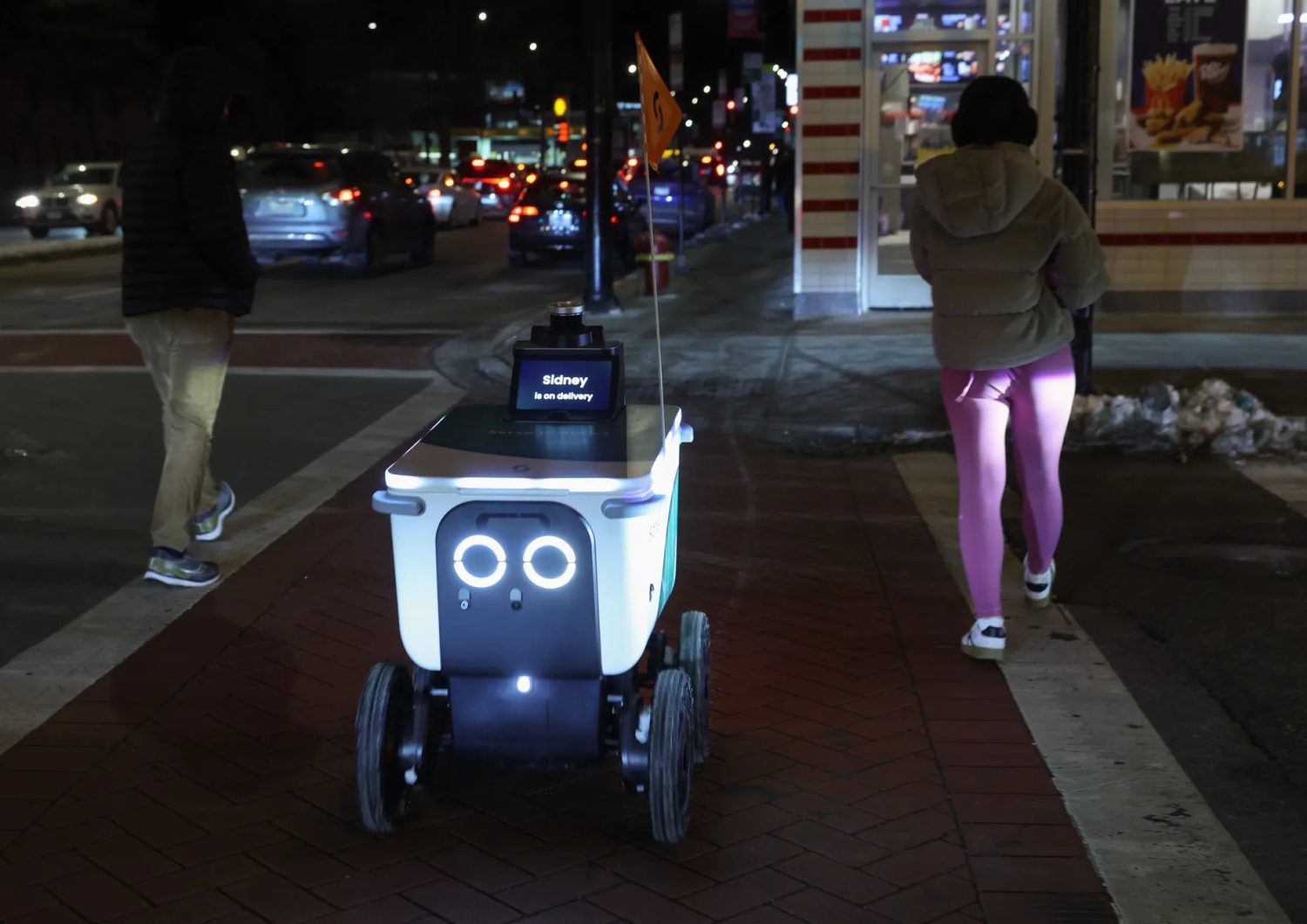
Step outside after dark in certain Los Angeles neighborhoods and you might find three or four cooler-sized robots glowing on your sidewalk, lights forward, cameras active, going nowhere. One American woman documented exactly that scene recently, and her footage carried the unmistakable energy of a sci-fi thriller opener. It isn’t a glitch. It isn’t a prank. It’s Tuesday night in a high-demand delivery corridor — and cities are only beginning to write the rules that govern it.
Why Robots End Up Parked Outside Your Front Door
Residential streets aren’t an accident in these fleets’ routing logic — they’re the destination.
Serve Robotics operates more than 500 sidewalk robots across 40 Los Angeles neighborhoods, according to the Los Angeles Times — up from just two neighborhoods in 2023. Coco Robotics, which runs over 1,000 robots across multiple cities, selects deployment zones based on restaurant density, short delivery distances, and high order volume. Between jobs, robots stage and idle in algorithmically identified high-demand zones, and those zones frequently include residential side streets. Coral Gables, Florida had to pass an ordinance explicitly banning robots from loitering on sidewalks longer than 30 minutes — because clustering near homes was already a documented problem, according to GovTech.
Here’s what’s actually happening outside your house:
- Safety programming causes robots to slow and stop entirely when people or obstacles are nearby — per WTOP’s coverage of Coco’s D.C. deployment — which can freeze them directly in front of your property
- 360-degree lighting is required for nighttime visibility; when stationary, those lights face whatever is directly ahead, often your façade
- Chicago residents filed over 800 petition signatures to pause their city’s robot pilot after bots blocked building entrances and collided with pedestrians, according to the Chicago Tribune and CBS News Chicago
The cameras onboard are navigation tools, not surveillance devices — operators say footage is used for routing and incident review. But a robot idling outside your home at 11 p.m., lights on, cameras forward, is functionally indistinguishable from something watching you. That perception gap doesn’t close with a company press release, and no amount of reassurance lands well when you’re standing in your own front door.
What You Can Actually Do About It
Complaining works — but only if you know exactly where to direct it.
Cities are responding. LADOT sets speed thresholds and fleet limits for “personal delivery devices,” per the Larchmont Chronicle. Coral Gables now hard-caps sidewalk loitering at 30 minutes. If robots are staging outside your home, identify the operator by the branding on the device — Serve, Coco, Avride — and contact their customer support or your local transportation department directly. Community organizing, as Chicago’s 800-signature petition demonstrated, has historically moved city councils to reconsider or constrain deployments.
Like e-scooters that flooded sidewalks around 2018 before a single meaningful regulation existed, delivery robots moved fast while the rules caught up slowly. The footage capturing robots clustered outside one woman’s home reflects something real — not a robot uprising, but a rollout that didn’t think to ask the neighborhood first. How her city responds may end up writing the playbook for everyone else’s.