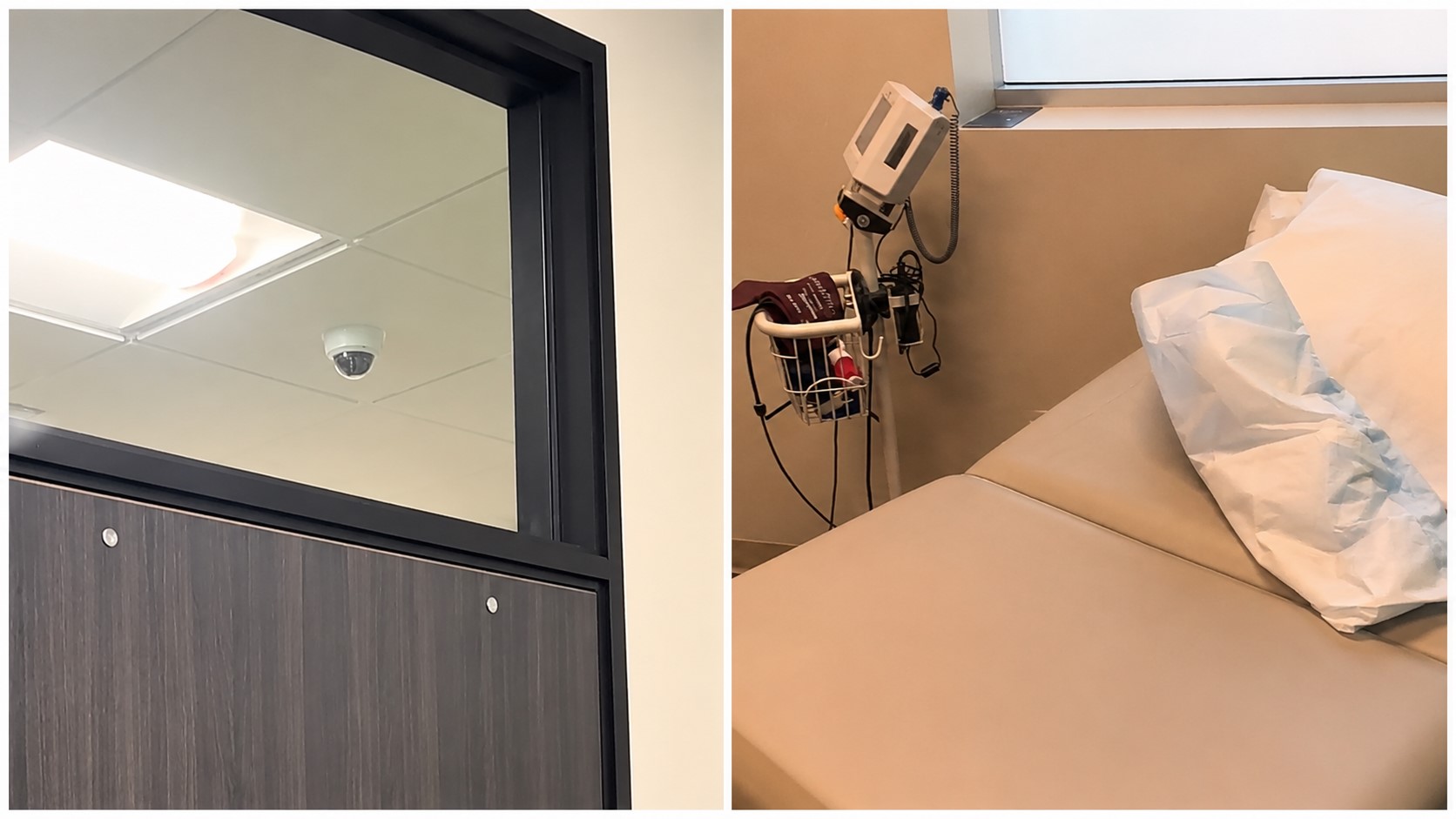
A woman at an Arizona gynecologist’s office reportedly noticed two things: the upper panel of her exam room door was see-through, and a camera was positioned in the hallway outside it. Gynecologic exams involve partial undressing and intimate physical examination. That context matters enormously here.
Whether the camera was actively recording remains unclear. Whether the clinic posted any surveillance notice is also unknown. Whether Arizona authorities or the facility have responded is similarly unconfirmed. What is not unclear is the guidance: according to healthcare compliance experts, cameras must not capture patients in exam rooms, treatment areas, or restrooms — spaces where patients hold a reasonable expectation of privacy. The question is not simply whether a camera exists outside a room. It is what that camera can see through the glass.
Where Cameras Belong – and Where They Don’t
Medical privacy standards draw a hard line, and a transparent door panel can erase it entirely.
A hallway security camera is not inherently improper. Healthcare compliance guidance confirms that cameras are permissible in public areas of a medical facility — waiting rooms, hallways, parking lots. The critical issue is line of sight.
If a transparent panel gives a camera an unobstructed view of an exam table, the camera’s physical location becomes functionally irrelevant. Compliance experts advise that if a camera positioned in a public area can see into a private one, that constitutes a potential privacy violation regardless of where the device sits. Healthcare facilities are expected to conduct placement risk analyses to ensure no camera captures private clinical activity.
Patients can run their own checks during any visit:
- Look for transparent panels, glass inserts, or windows with a direct view of the exam table
- Notice whether any hallway device has a clear, unobstructed sightline into the room
- Check for posted notices disclosing video monitoring
- Raise concerns immediately with the office manager or front desk
- If something feels genuinely wrong, contact local law enforcement — prior cases have escalated to criminal investigations
Not the First Time
Hidden and improperly placed cameras in gynecology settings have previously triggered criminal investigations and landmark legal settlements.
This concern has precedent. A former UCLA gynecologist was sentenced to prison after evidence included secretly recorded videos and photos of patients. A Johns Hopkins gynecologist was found to have secretly recorded patients, resulting in a $190 million settlement. Each new report in this category carries real public-interest weight — not because a camera’s presence is automatically criminal, but because the pattern is established and the harm is documented.
The core legal and ethical question in the Arizona case is straightforward, even if the facts are not: what matters is not whether a camera exists, but whether it can record a patient in a state of undress during examination. Key details — whether the device recorded anything, whether it was part of a legitimate security system, whether the facility or Arizona authorities have responded — remain unanswered.
A patient’s reasonable expectation of privacy does not end at the exam room door. Noticing something that looks wrong and reporting it is not an overreaction. It is exactly what that right looks like in practice.